
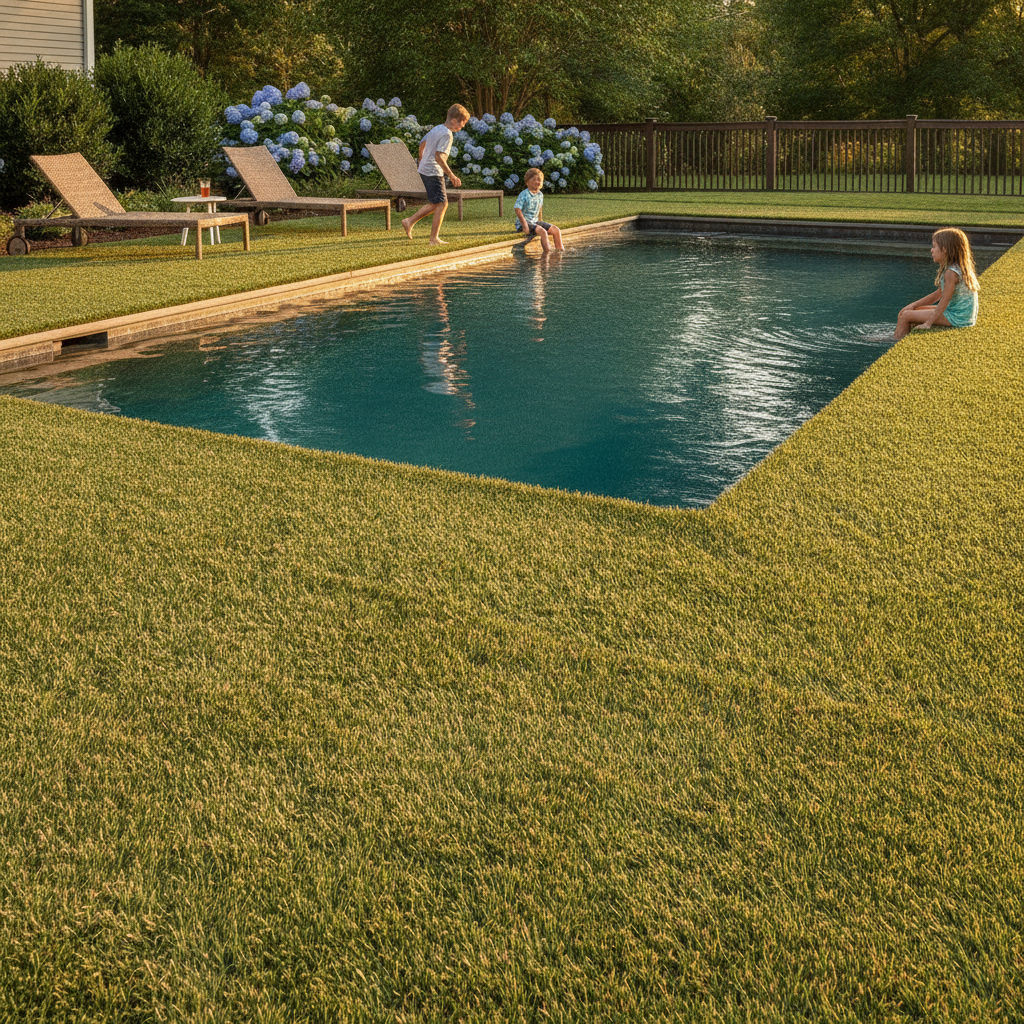
How Does Artificial Turf Perform Around a Pool Deck in Burke, VA? What Homeowners Need to Know Before Installing
Artificial turf around a pool deck in Burke, VA performs exceptionally well — but only when the right product and installation approach are used from the start. Standard residential turf is not pool turf. The two look similar from the outside, but the materials, backing systems, drainage specs, and surface textures are meaningfully different. If you’re planning to resurface a pool deck or patio in Fairfax County, this guide will walk you through what actually separates a safe, high-performing pool installation from one that looks good in photos and causes problems by the second summer.
Why Pool Deck Turf Is a Different Category Than Lawn Turf
Most homeowners assume any artificial grass product works anywhere. That’s true in the same way that any car can technically drive off-road — the question is whether it’s built for it. Pool environments expose turf to a specific combination of stresses: constant splash-zone moisture, concentrated chlorine exposure, direct sun baking the surface for hours, and bare wet feet walking across it all day. Each of those factors matters for product selection.
Here’s what pool-specific turf is engineered to handle that standard lawn turf is not:
- Chlorine-resistant backing: Standard polyurethane backing degrades faster when exposed to pool chemicals over time. Pool-rated turf uses a reinforced, chemical-resistant backing that holds up without delaminating or stiffening.
- Heat-resistant fiber technology: Dark-colored standard turf can reach surface temperatures of 160°F or higher in direct Virginia summer sun. Pool deck turf products use lighter-colored, UV-stabilized monofilament or slit-film fibers specifically designed to reflect radiant heat and reduce surface temperatures to a more tolerable range.
- Slip-resistant texture: Wet turf with the wrong blade shape can get slick. Pool deck turf uses a tighter pile and a textured, multi-blade construction that provides grip underfoot — even when soaking wet.
- Open drainage design: The backing needs to allow water to pass through quickly so poolside areas don’t turn into puddles. Properly spec’d pool turf drains at rates exceeding 30 inches per hour — more than enough to handle splash zones and Northern Virginia’s heavy spring rain events simultaneously.
If a contractor is quoting you the same product for your pool deck as they are for your front lawn, that’s a red flag worth asking about directly.
The Surface Temperature Problem — and How It’s Actually Solved
Surface heat is the most common concern homeowners in Burke and the broader Fairfax County area raise when they’re researching pool turf. It’s a legitimate issue, and it’s one that most competitors in the DMV market address only in passing — if at all. So let’s be specific about what’s actually happening and what actually helps.
Artificial turf absorbs radiant heat from direct sunlight. In a Northern Virginia summer — especially in late June through August when UV index regularly hits 8 or higher — a south-facing pool deck with no shade can push standard turf surface temperatures well above comfortable. The fix is not just “use lighter-colored turf” (though that helps). The most effective approaches combine:
- Heat-mitigating fiber blends: Products designed for pool decks and patios use lighter sage, tan, or multi-tone green blends that reflect more light than a dense, dark-green lawn turf. The Plush Pad product line is specifically designed for poolside and patio applications, balancing aesthetics with heat performance.
- Lower pile height: Pool deck turf typically runs 25mm–35mm pile height, shorter than a lawn turf (which often runs 35mm–50mm). Less fiber mass means less heat retention.
- Strategic layout planning: An experienced installer will evaluate sun angles, shade coverage from the house and fencing, and time-of-use patterns to determine where the surface temperature risk is highest — and design accordingly.
- A quick rinse: One of the simplest and most effective tools. A 30-second hose-down before your family heads out to the pool drops surface temperature by 20–30°F almost immediately. With a pool right there, this costs you nothing.
Surface temperature on pool decks is manageable. It’s not a reason to avoid turf — it’s a reason to work with an installer who knows how to spec the right product and set realistic expectations upfront.
What Base Prep Actually Looks Like for a Pool Deck Installation
Whether you’re installing over an existing concrete deck, paver patio, or a natural ground surface around the pool, base prep is where the installation is either set up to succeed or quietly set up to fail. This is an area where general landscapers and out-of-state franchise turf companies consistently underdeliver — and it’s one of the most underdiscussed topics across competitor content in the DMV market.
Here’s what proper base prep looks like for each common scenario around pools in Fairfax County and the surrounding area:
Installing Over Existing Concrete
Many Burke and Springfield-area pools have existing concrete or stamped concrete surrounds. Turf can be installed directly over concrete, but the concrete needs to be assessed first. Cracks, drainage pitch issues, and surface spalling all need to be addressed before turf goes down. We typically install a foam underlayment pad on concrete for comfort and cushion, then adhere the turf with a perimeter bond and seam adhesive rated for outdoor use and thermal expansion. The concrete itself becomes the drainage plane — the turf backing allows water through, the concrete drains it away via existing pitch.
Installing Over Natural Ground
If the turf is going around a pool that sits in a yard area rather than on a concrete surround, the base prep is more involved. We excavate 3–4 inches, compact a crushed aggregate base (typically Class II road base), install a weed barrier, and ensure proper grading for drainage away from the pool structure and the home’s foundation. In Fairfax County’s clay-heavy soil — common throughout Burke Centre, Longwood Knolls, and Rolling Valley neighborhoods — drainage engineering isn’t optional. Clay doesn’t drain. A properly compacted aggregate base does.
Seaming Around Pool Edges and Curved Features
Pool decks are full of curves, drains, ladders, and irregular edges. Seam quality around these features is where the visual difference between a professional installation and a shortcut job shows up most clearly within the first year. We use bender board or aluminum edging to secure perimeter cuts, and all seams are hand-cut to follow the grain direction of the turf fiber so they disappear naturally. A visible seam around your pool deck is not an aesthetic issue — it’s a trip hazard and a sign that the installation was rushed.
For a detailed look at how we approach the full installation process from ground prep to final brush, visit our installation guide.
HOA Considerations for Pool Areas in Northern Virginia
If your pool is part of a community with an HOA — common throughout Fairfax County, particularly in communities like Burke Centre and surrounding managed neighborhoods — you’ll want to check your architectural standards before ordering materials. Most HOAs that allow artificial turf in rear yards apply the same rules to pool deck areas. Some have specific requirements around product color (natural green tones only), maximum pile height, and how edging is finished where turf meets other surfaces.
We navigate HOA approval processes regularly for homeowners across Northern Virginia. If you’re unsure whether your community requires a submission, we can help you review your architectural guidelines and put together the documentation most boards ask for — product spec sheets, color samples, drainage details.
Great Falls, Alexandria, and Springfield: Pool Turf Demand Across the Region
Pool deck turf installations have grown steadily across the DMV over the past several years, especially in communities with larger lots where the pool sits in a yard rather than on a dedicated concrete pad. In Great Falls, where properties often have expansive pool areas and landscaping budgets to match, homeowners are increasingly replacing high-maintenance concrete or natural grass surrounds with heat-resistant synthetic surfaces that look clean year-round. In Alexandria and Springfield, where pool areas tend to be more compact and HOA-managed, the focus is often on clean edge work, product color matching, and quick-draining systems that keep the pool deck usable even after heavy summer rains.
The climate across Northern Virginia makes pool turf a strong long-term value play. You eliminate mowing around the pool, end the cycle of grass clippings getting tracked into the water, remove the mud and bare-spot problem that develops from heavy foot traffic, and give the area a finished, resort-style look that holds up through Virginia’s full four seasons — including the freeze-thaw cycles that crack concrete and shift pavers over time.
Frequently Asked Questions: Pool Deck Turf in Burke, VA
Can artificial turf be installed directly over an existing concrete pool deck?
Yes. Concrete is actually one of the easier surfaces to work with. We assess the condition of the concrete, address any drainage pitch issues, install an appropriate foam underlayment for comfort, and adhere the turf with outdoor-rated adhesive. The result is a comfortable, low-maintenance surface that doesn’t crack or stain like bare concrete.
Will pool chemicals damage the turf over time?
Not if the right product is specified. Standard turf backing can degrade with sustained chlorine exposure. Pool-rated products like Plush Pad use reinforced, chemical-resistant backing and UV-stabilized fibers that hold up in splash zones without breaking down or discoloring over a normal 15-year product lifespan.
Is artificial turf slippery when wet around a pool?
Pool deck turf is specifically designed with slip resistance in mind. The blade texture, pile density, and construction of pool-rated products provide grip even when saturated. This is one of the reasons we strongly recommend against using standard lawn turf in splash zones — the blade geometry is different and the wet grip performance is not the same.
How much does pool deck turf installation cost in Fairfax County?
Pool deck turf typically runs in the range of $15–$22 per square foot installed, depending on surface condition, access complexity, edging requirements, and product selection. Installations over existing concrete tend to be more straightforward than full ground-up builds. We provide free on-site estimates so you get a number based on your actual space, not a ballpark.
Does artificial turf around a pool require special maintenance?
Very little. Occasional rinsing to clear chlorine residue, a light brush with a stiff-bristle broom to keep the fibers upright, and clearing any debris that blows in. There’s no mowing, no fertilizing, no re-seeding bare spots. Most homeowners find pool deck turf dramatically simpler to maintain than the natural grass or concrete they replaced.
Ready to Talk Through Your Pool Deck Project?
If you’re a homeowner in Burke, Fairfax, Springfield, Alexandria, or anywhere across Northern Virginia considering artificial turf around your pool, Grassify is a licensed, insured local installer with over a decade of experience in the DMV market. We spec pool-rated products, engineer drainage for Virginia’s climate, and back every installation with a lifetime warranty on seams, edges, and base performance. There are no out-of-state crews, no subcontracting surprises, and no generic national franchise approach to your specific yard.
Request your free consultation today and let’s take a look at your pool deck together. We’ll walk the space, talk through your goals, and give you a clear, honest picture of what the right installation looks like for your property.


