
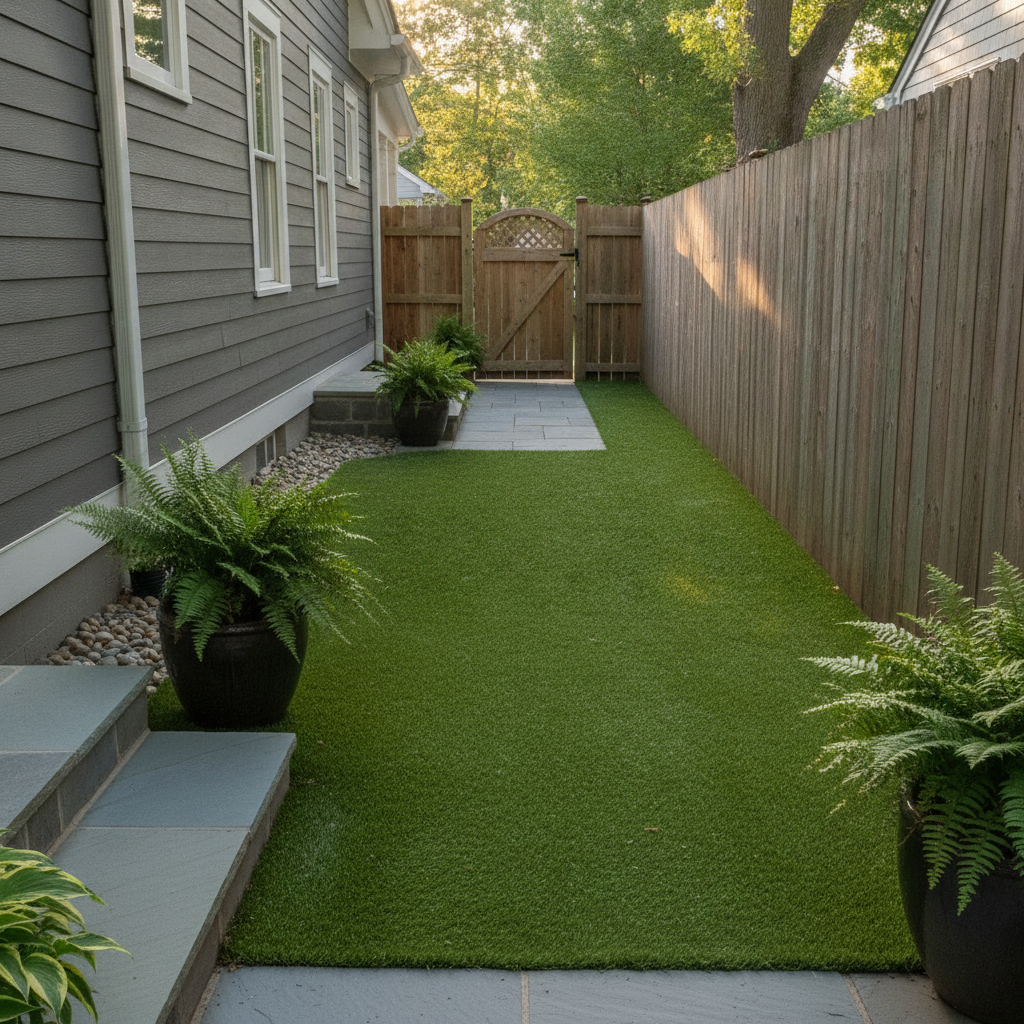
How Do You Install Artificial Turf in a High-Traffic Entryway or Side Yard in Arlington, VA?
If you’ve got a side yard or front entryway that looks like a mud pit by February and a dust bowl by August, you’re not alone — and it’s not a maintenance problem you can solve with better seed or more fertilizer. These zones get brutalized. Heavy foot traffic compacts the soil, shade from fences or structures kills grass coverage, and every heavy rain in the DMV spring turns them into drainage nightmares. For homeowners in Arlington, VA — where lots tend to be tighter, grades more complex, and HOA scrutiny real — artificial turf is increasingly the practical answer. But installing turf in a high-traffic entryway or narrow side yard isn’t the same as laying it across a flat backyard. The base prep, drainage design, and installation logistics are completely different. Here’s what you actually need to know.
Why Entryways and Side Yards Are the Hardest Spots to Turf Correctly
Most turf content online — and frankly, most competitor websites in this area — focuses on open backyard installations. They show beautiful rolling lawns and sprawling putting greens. What they don’t address is what happens when your entire usable turf area is a 4-foot-wide corridor running alongside your house, or a 10-foot front entry zone that takes the full weight of every person and package delivery coming through your gate.
High-traffic zones create specific challenges that require a different approach:
- Compacted sub-base. Years of foot traffic compress the soil beneath these areas until it’s nearly impermeable. You can’t just lay a crushed aggregate base on top — you have to excavate, break up compaction, and re-engineer drainage from scratch.
- Concentrated load points. A side yard where people walk the same path every day puts repetitive stress on the same seams, edges, and infill zones. Turf installed without reinforced edge banding and adequate infill density will show wear and lifting within a few years.
- Drainage complexity. Narrow side yards often sit in low spots between structures, which means they collect water from roof runoff, grading, and neighboring impervious surfaces. In Arlington County, where older homes sit on clay-heavy soil, drainage engineering isn’t optional — it’s the difference between a 15-year installation and a soggy, failed one.
- Tight access for equipment. Many side yards in Arlington are 36 to 48 inches wide. Standard turf installation equipment can’t get in there. This forces hand-compaction of the base layer and manual cutting and seaming in confined spaces — tasks that separate experienced crews from the general landscaping outfits who occasionally do turf work.
What the Base Prep Actually Looks Like in a Narrow, High-Traffic Zone
In any artificial turf installation, the base is everything. But in a high-traffic entryway or side yard, there’s almost no margin for error. Here’s what a proper installation sequence looks like in these zones:
Excavation: Typically 3 to 4 inches for flat zones, deeper if there’s existing organic material or severe compaction. The goal is to remove all grass, roots, and unstable material that could settle or shift under load.
Sub-base preparation: A layer of geotextile weed barrier is placed first, followed by crushed aggregate (usually decomposed granite or crushed stone) compacted in lifts. In heavy clay soil — common throughout Arlington County and Falls Church — we sometimes install a perforated drainage pipe underneath the aggregate layer to channel water out of the corridor rather than letting it pool.
Compaction: In open yards, a plate compactor handles this quickly. In a 4-foot-wide side yard, you’re working with a hand tamper or a narrow walk-behind unit. It takes longer, and it has to be done in sections. Skipping this step is what causes turf to develop soft spots and uneven surfaces within the first year.
Turf selection for high-traffic areas: For entryways and side yards, we typically recommend products in the 35mm to 40mm pile height range with higher face weight (60–80 oz per square yard). Higher face weight means denser fiber that holds up under repetitive load without matting flat. UV-stabilized fibers are non-negotiable in any exposed area.
You can see how our Lush Life product performs across both residential lawn and high-traffic applications — it’s one of the options we frequently specify for entry zones and side corridors where appearance and durability both matter.
Seaming and Edge Finishing in Tight Spaces
This is the part that general contractors and out-of-state franchise installers consistently underperform on. In a narrow side yard, you may need to run one or more seams lengthwise along the installation — parallel to the direction of foot traffic. That’s the worst possible orientation for seam stress. Every step taken along that corridor loads the seam directly.
The fix is proper seaming technique: using specialized seaming tape rated for outdoor use, applying turf adhesive correctly under DMV temperature and humidity conditions, and backing the seam with an additional layer of crushed aggregate to prevent micro-movement. Seams done right in these zones should be invisible and should hold for the life of the installation — at Grassify, that’s covered under our lifetime installation warranty on seams, edges, and base.
For edge finishing along fence lines, concrete borders, or structures, aluminum banding nailed every 3 to 4 inches provides the secure perimeter edge that keeps turf from lifting, especially through the freeze-thaw cycles Northern Virginia gets every winter. A December freeze followed by a January thaw is exactly when a poorly secured edge starts peeling back.
Infill Choices for High-Foot-Traffic Applications
Infill is what gives artificial turf its resilience — it’s what allows fibers to stand back up after being compressed by foot traffic. In high-traffic zones, the right infill choice matters more than in a low-use decorative lawn area.
- Silica sand: The baseline for most residential applications. Dense, stable, and affordable. Works well in entryways but can compact over time in extreme high-traffic zones.
- Crumb rubber + sand blend: Adds spring-back recovery in areas with very heavy use. Common in commercial applications and high-use side yards where kids or dogs are running through repeatedly.
- Zeolite infill: If pets are part of the equation — and in Arlington and the broader DMV, they almost always are — zeolite works as a natural deodorizer, locking in ammonia molecules rather than letting odor build up in the infill layer. Our pet-friendly turf systems use zeolite as a dedicated layer in high-pet-use corridors.
HOA Considerations in Arlington County
If your property falls under an HOA — and a significant portion of Arlington County communities do — you’ll want to confirm approval before any excavation begins. Arlington HOA boards vary widely in how they regulate turf: some have specific color requirements (avoid anything too bright or too olive), some restrict turf to rear yards only, and some require a sample swatch review. The front entryway is typically the most scrutinized zone because it’s visible from the street.
A few things that smooth the approval process: choose a natural-looking blade color (medium green, not lime green), use a product with realistic thatch layering, and be prepared to show the HOA that the installation will include proper border edging so it doesn’t look unfinished. We’ve navigated this process for homeowners across Arlington, Alexandria, and Falls Church many times — it’s very manageable when you go in prepared.
Frequently Asked Questions
How much does it cost to turf a side yard or entryway in Arlington, VA?
For most residential high-traffic installations in Arlington County, expect to budget in the $15–$22 per square foot range installed. Narrow corridors with tight access, hand compaction, and complex drainage routing tend to land on the higher end due to the labor intensity. The good news is that these are often small square footage projects — a 4×30-foot side yard is only 120 square feet total.
Will artificial turf hold up to daily foot traffic from a primary entry path?
Yes — when specified and installed correctly. The key is selecting a turf product with adequate face weight (at least 60 oz/sq yd for daily-use paths), proper infill depth to support fiber recovery, and reinforced edge and seam treatment. Turf rated for commercial applications is worth considering for primary entry zones.
How does drainage work in a side yard that gets roof runoff?
A proper base installation uses compacted permeable aggregate with a drainage rate that far exceeds typical rainfall rates — well-installed turf systems achieve 30+ inches per hour of drainage, which handles even heavy DMV spring storms. For side yards with concentrated roof runoff, we often add a perforated pipe system beneath the base to direct water toward an appropriate outlet rather than letting it back up against your foundation.
Can artificial turf be installed right up to my fence or house foundation?
Yes. Turf can be cut and finished directly against fence posts, concrete footings, or siding — but the edge treatment matters. We use aluminum banding secured into the border material to lock the edge down. This prevents lifting and keeps moisture from wicking under the turf backing, which would eventually cause delamination.
What if my side yard has a slight grade or slope?
A gentle slope actually helps drainage, and turf handles grades well up to about 30–35%. Steeper slopes require anchoring techniques to prevent the turf from shifting downhill over time. Grades that drain toward a structure need careful re-grading before installation so water moves away from, not toward, your foundation.
Ready to Stop Fighting That Side Yard?
If your entryway or side yard in Arlington — or anywhere across Northern Virginia and the DMV — has become a maintenance problem you’re tired of fighting every season, artificial turf is worth a serious look. The installation is more involved than a standard lawn project, but done right, it’s a 15-plus-year solution that requires nothing beyond an occasional rinse and brush.
At Grassify, we’ve been doing this work across Burke, Arlington, Falls Church, Alexandria, and the broader Fairfax County and Arlington County area long enough to know exactly where the shortcuts show up and exactly how to avoid them. Our crews are licensed, insured, and background-checked. Every installation comes with a lifetime warranty on seams, edges, and base. Reach out to us for a free consultation — we’ll come out, look at your space, and give you an honest assessment of what it takes to do it right.


