
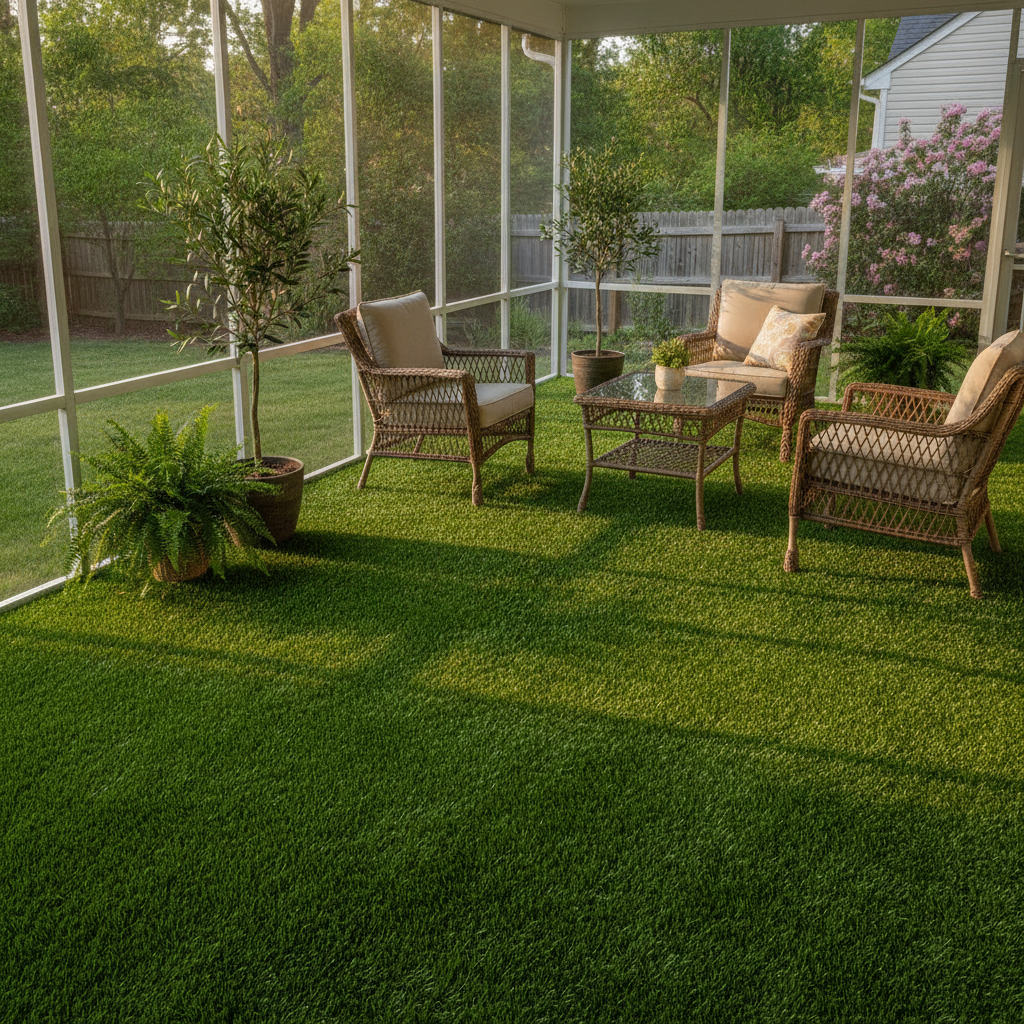
How Do You Install Artificial Turf Inside a Screened Porch or Sunroom in Rockville, MD?
Yes — you can absolutely install artificial turf inside a screened porch or sunroom, and in Rockville, MD, it’s become one of the most requested specialty installations we see from homeowners who want to extend livable outdoor-feel space without dealing with dirt, mud, or dead winter grass. But this is not the same job as laying turf in a backyard. The subfloor, drainage considerations, product selection, and adhesion methods are all different — and getting any one of those wrong will cost you a lot more than the installation did.
Here’s what the process actually looks like from start to finish, what products work best in semi-enclosed environments, and what you should expect from any installer you hire for this kind of project.
Why Screened Porches and Sunrooms Are a Different Animal
Most turf installations start with a gravel base and a compacted sub-base below grade. In a screened porch or sunroom, you’re almost always working with an existing concrete slab, wood decking, or tile floor — none of which allow for traditional excavation. That fundamentally changes how the turf is anchored and how moisture is managed.
In the DMV area, screened porches face a specific set of challenges. Montgomery County gets significant rainfall in spring, and even a screened enclosure isn’t fully weatherproof — wind-driven rain, humidity, and condensation from warm summers all introduce moisture into the space. If turf is installed directly on a non-porous substrate without proper planning, that moisture has nowhere to go, which creates odor problems, mold under the backing, and premature degradation of both the turf and the floor beneath it.
At the same time, sunrooms that get full sun exposure through glass panels can reach dramatically higher surface temperatures than open outdoor installations — especially during Maryland summers. That affects which turf fiber technology you choose.
Subfloor Assessment: The Step Most Installers Skip
Before anything is cut or rolled out, a proper installer should assess your existing floor for:
- Levelness: Any low spots or high ridges in the slab or decking will telegraph through the turf over time and create uneven wear patterns or trip hazards.
- Moisture intrusion: Concrete slabs in older Rockville and Bethesda homes sometimes wick ground moisture from below. This needs to be addressed with a vapor barrier before turf goes down.
- Surface porosity: Sealed concrete and tile require different adhesive systems than bare concrete. Using the wrong adhesive — or worse, just relying on double-sided tape — leads to turf that lifts at the seams within 12 to 18 months.
- Structural integrity for wood decks: If your screened porch has a wood subfloor, the board condition, spacing, and any flex or bounce in the surface all affect how the turf will perform and feel underfoot.
This subfloor assessment step is something that a lot of general landscapers and out-of-state franchise installers overlook entirely. They treat every surface the same, which is why you see callbacks and warranty disputes on jobs like these.
The Right Turf Product for Indoor and Semi-Enclosed Spaces
Not every turf product is built for interior or semi-enclosed use. Products designed for open backyard lawns have thicker, denser backing systems built to handle ground contact and heavy drainage loads — features you don’t need indoors, and which can actually add unnecessary weight and rigidity in a porch setting.
For screened porches, sunrooms, and covered patios, you want a turf with a shorter to mid-range pile height — typically 30mm to 38mm — with a softer, flexible backing that lays flat against hard surfaces without bubbling. UV-stabilized fibers are still important even in sunrooms, where UV rays pass through standard glass. The fiber should also be antimicrobial if pets are part of the picture, which in Rockville and across Montgomery County, they often are.
Grassify’s Plush Pad is specifically engineered for exactly this application — poolside, patio, and porch installations where the turf needs to lie flat, look clean, stay comfortable underfoot, and hold up against moisture exposure without the heavy base profile required for outdoor lawns.
Drainage: Don’t Ignore It Just Because You’re Indoors
Here’s where a lot of DIY screened porch turf projects fail: people assume that because they’re not outside, drainage doesn’t matter. It does — especially if you have pets, if rain blows in during storms, or if you regularly clean the space with water.
On a concrete subfloor, the solution isn’t drilling drainage holes through your slab (though that’s sometimes part of it). Instead, a professional installation uses a combination of perforated drainage mat underlayment and strategic adhesive placement that allows moisture to flow laterally toward a floor drain, weep holes, or the edges of the enclosure. The turf backing itself should have a perforated design — not a solid rubber back — so water doesn’t pool under the surface.
If you have dogs using the porch space regularly, that drainage planning becomes even more critical. We’ve done pet-heavy screened porch installations across Chevy Chase and Bethesda where the owners wanted the grass look and feel indoors but needed odor-control performance equivalent to a full outdoor pet run. In those cases, we add a zeolite deodorizer layer between the drainage mat and the turf backing — the same system used in our pet turf installations — and treat the turf fibers with antimicrobial infill to prevent bacterial buildup.
Seaming, Edges, and Transitions: Where Interior Jobs Get Complicated
Screened porches and sunrooms often have irregular dimensions — columns, step-downs, built-in furniture footprints, sliding door tracks, threshold transitions to indoor flooring. Each of those features requires precise cuts, clean edge finishing, and in some cases custom-fabricated transition strips so the turf doesn’t fray or lift where it meets another surface.
Seams — if the space is wider than a standard roll width of 15 feet — need to be heat-bonded and glued, not just taped. A poorly seamed interior installation will gap within a season due to the heating and cooling cycles that enclosed glass spaces go through, particularly in Fairfax County and Montgomery County where temperature swings between January and July are extreme.
At Grassify, all seams and edges on interior and semi-enclosed projects come with a lifetime installation warranty — which covers exactly the kind of edge lift and seam separation that cheaper installs develop after a year or two.
What This Project Typically Costs and How Long It Takes
Interior turf installations on existing hard surfaces generally run in the $12 to $18 per square foot range depending on the complexity of the space, the product selected, and the extent of subfloor preparation needed. A 200-square-foot screened porch is typically a one-day installation once the surface prep is complete. Larger sunrooms with multiple transitions or significant floor remediation work may require two days.
If you’re in a HOA-governed community — and many neighborhoods in Rockville and across Montgomery County are — check whether your HOA architectural guidelines extend to interior or semi-enclosed spaces before you start. Most don’t regulate what’s inside a screened enclosure, but it’s worth confirming before you schedule anything.
Frequently Asked Questions
Can artificial turf be glued directly to a wood deck in a screened porch?
Yes, but the wood surface needs to be clean, structurally sound, and free of rot or excessive flex. We typically use a flexible, moisture-resistant adhesive rated for wood substrates and may add a drainage mat underlayment depending on the deck board spacing. Gaps wider than about half an inch between boards need to be addressed first to prevent turf from sinking into them over time.
Will artificial turf in a sunroom get too hot to walk on barefoot?
It depends on direct sun exposure through glass panels. In fully sun-exposed sunrooms, turf surface temperatures can climb noticeably on summer afternoons. We recommend UV-stabilized, heat-resistant fiber technology for any glass-enclosed space. Products with HeatBlock or similar cooling technologies perform meaningfully better in those conditions. Adequate ventilation in the room also helps moderate temperatures.
How do I clean artificial turf in a screened porch?
A light rinse with a garden hose and occasional brushing with a stiff-bristle broom is usually all that’s needed. For pet areas, a diluted enzymatic cleaner applied monthly keeps odors from building up. Avoid steam cleaning or harsh chemical cleaners that can break down the turf backing or infill over time.
Does Grassify serve Rockville, MD and the rest of Montgomery County?
Yes. Grassify serves Rockville, Bethesda, Chevy Chase, and the broader Montgomery County area, in addition to our home base in Burke, VA and the surrounding Northern Virginia and Washington DC region.
Is a permit required to install turf in a screened porch in Rockville?
Generally no — replacing a floor surface inside an existing enclosed structure doesn’t trigger a building permit in most Montgomery County jurisdictions. However, if any structural work is involved (like modifying drains or subfloor framing), that may be a different conversation. Your installer should be able to advise based on the specific scope of your project.
Ready to Transform Your Screened Porch or Sunroom?
If you’re in Rockville, Bethesda, Chevy Chase, or anywhere in Montgomery County, and you’re thinking about putting artificial turf in a screened porch, sunroom, or covered patio, Grassify can walk you through exactly what makes sense for your specific space. We’ll assess your subfloor, recommend the right product for your usage and sun exposure, and give you a detailed quote with no pressure and no surprises.
Contact Grassify today to schedule a free consultation. We bring 12+ years of DMV-area installation experience to every project — including the specialty interior and semi-enclosed jobs that most local installers haven’t figured out yet.


