
How Do You Install Artificial Turf in a Backyard with Kids and Pets in Chevy Chase, MD? What Families Need to Know
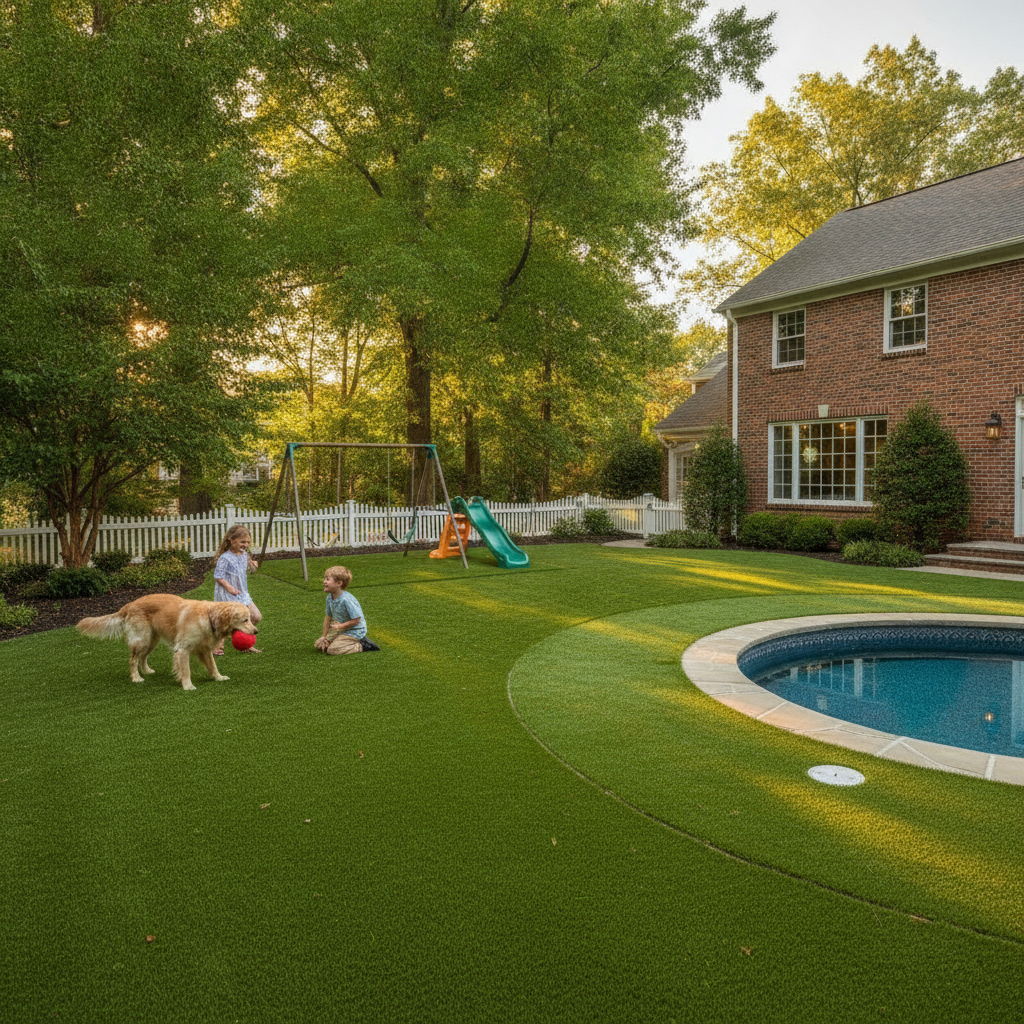
If your backyard in Chevy Chase, MD is shared real estate for a golden retriever and a seven-year-old, you already know that natural grass doesn’t stand a chance. Between muddy paws, worn-out play zones, and the mid-summer dead patches that seem to appear overnight, most family lawns in this part of Montgomery County are fighting a losing battle by June. Artificial turf solves a lot of those problems — but only if you choose and install a system that’s actually designed to handle both children and animals at the same time. These two use cases have different technical demands, and combining them into one yard requires a specific approach that most generic turf installations don’t address.
Why Combining Kids’ Play Space and Pet Space Is Trickier Than It Sounds
Most turf companies will sell you either a pet-optimized product or a play-area product. The challenge for families is that you often need both in the same footprint. Your dog isn’t going to stay in a tidy designated zone, and your kids aren’t either. That means the turf you select has to pass tests on two different fronts simultaneously: it needs the certified shock absorption that playground surfacing requires for fall protection, and it needs the drainage capacity and odor-control infrastructure that pet turf demands.
When those requirements get treated as separate problems, you end up with a yard that works well for one use case and fails the other. We’ve seen this in Chevy Chase, Bethesda, and Potomac — homeowners who installed a standard residential turf and then added a dog, or had a basic pet product installed in a space where kids play daily. Neither scenario ends well.
The Safety Baseline: What CPSC and IPEMA Certification Actually Means for Your Backyard
If children are playing on your turf — running, jumping, falling — the backing and infill system need to meet specific safety thresholds. CPSC (Consumer Product Safety Commission) and IPEMA (International Play Equipment Manufacturers Association) certifications aren’t just for school playgrounds. They define critical fall height ratings: the maximum drop height from which a child can fall onto a surface without the impact exceeding 200 g-force at the head.
For a residential backyard, the relevant question is: what equipment is in the space? If you have a playset, a trampoline surround, or even a low deck edge, the turf underneath needs to be engineered accordingly. A certified shock-absorbing pad layer beneath the turf pile can extend the fall protection rating significantly. Without it, you’re relying entirely on the infill depth, which is rarely sufficient on its own.
This is a detail that many residential installers skip — either because they don’t know it matters or because it adds cost. Ask any installer you’re interviewing whether they’re spec’ing CPSC-compliant backing for a yard where kids play. If they look at you blankly, that’s your answer. You can learn more about the commercial-grade standards we apply to residential playground spaces on our playground turf page.
The Pet Side of the Equation: Drainage Engineering That Actually Works
Here’s where most pet turf installations fall short, especially in the DMV’s climate. Montgomery County gets real rainfall — heavy spring downpours, humid August thunderstorms, and a freeze-thaw cycle in winter that tests every layer of your base. A drainage system that works in Southern California doesn’t hold up the same way in Chevy Chase.
Effective pet turf isn’t just about the product itself. It’s about the full system beneath it. At Grassify, our pet installations use a 5-layer drainage approach: a compacted aggregate base, a drainage mat layer, the turf backing, a zeolite deodorizer infill layer, and an antimicrobial infill top coat. The drainage rate on a properly built system should exceed 400 inches per hour — which sounds like overkill until your dog decides to use the same corner every single day for three years.
Zeolite is worth understanding specifically. It’s a naturally occurring mineral that traps ammonia molecules — the compound responsible for the sharp, persistent odor in dog urine. Without it, no amount of rinsing or infill replacement will fully eliminate the smell in a heavily used pet area. With it, combined with proper base drainage, the system can stay functionally odor-free for years. We back our pet installations with a 90-day odor-free guarantee for exactly that reason.
For families in Chevy Chase and nearby Rockville or Potomac who have large dogs or multiple animals, this isn’t optional infrastructure — it’s the difference between a yard you want to use and one you avoid. Learn more about how we engineer pet-specific systems on our pet turf installation page.
Infill Selection: The Hidden Decision That Affects Both Kids and Pets
Infill is what sits between and beneath the turf blades, and it does several jobs at once: it keeps the fibers standing upright, contributes to cushioning, and in pet-turf applications, it plays a major role in hygiene and odor management. For a shared kids-and-pets yard, you need an infill that handles all of it.
Here’s a breakdown of what to consider:
- Crumb rubber: Common and cheap, but not ideal for spaces where children play and pets spend extended time. There are ongoing questions about particulate inhalation, and it can heat up significantly in direct sun — a real factor during Washington, D.C.-area summers.
- Silica sand: A stable, food-grade option that’s inert and doesn’t hold heat as aggressively. Works well for general residential use but needs a zeolite layer added for pet areas.
- Zeolite: As noted above, essential for ammonia control. Often layered with sand rather than used alone.
- Organic infills (cork, coconut husk): Cooler and non-toxic, but require more frequent replacement and can develop their own odor issues in humid climates if not properly maintained.
- Antimicrobial-treated infill: For households with both young children and animals, an antimicrobial coating on the infill provides an additional layer of hygiene protection that standard sand alone doesn’t offer.
The right choice depends on your specific yard layout, how much shade coverage you have, and how heavily the space gets used by both kids and pets. A good installer will help you work through that tradeoff — not just default to whatever they have in stock.
What the Competitor Landscape Often Misses for Combined-Use Yards
Most turf companies in the DMV treat residential pet turf and residential play areas as separate product categories — which they technically are, but which creates a real gap for families who need both. The competitor content we’ve seen in this market tends to address each use case in isolation. You’ll find articles about pet turf drainage and separate articles about playground safety ratings, but almost nothing about how to design a single yard that meets both sets of requirements simultaneously.
The practical gap shows up in actual installations: a pet-optimized product installed in a yard with a playset, where no one thought to add a shock pad. Or a playground-grade surface installed without adequate drainage engineering, so it holds moisture and odor wherever the family dog decides to go. If you’re interviewing installers and they treat these as two completely separate conversations without connecting the dots, push back and ask how they’d handle the overlap.
Base Preparation in Montgomery County’s Climate
Chevy Chase and the surrounding parts of Montgomery County have a lot in common with Northern Virginia in terms of soil composition and weather patterns — heavy clay content, real freeze-thaw pressure in winter, and enough rain in spring that surface drainage can’t be an afterthought. A crushed aggregate base layer of at least 3 to 4 inches, properly compacted and graded with a 1-2% slope away from structures, is the starting point. Anything less, and you’ll see standing water, shifting, or seam separation within a few seasons.
For yards with mature trees — common in older Chevy Chase and Bethesda neighborhoods — root management also needs to be part of the prep. This typically means a root barrier fabric before base installation to prevent roots from eventually lifting the turf. It’s one of those details that adds time and cost upfront and saves a complete reinstallation five years later.
Frequently Asked Questions
Is artificial turf safe for kids to play on directly?
Yes, when the right product and backing system are selected. Look for turf with certified shock-absorbing backing rated to CPSC standards for the relevant fall height. Infill should be non-toxic — antimicrobial-coated silica sand is a solid choice for mixed-use family yards.
Will pet odors affect the area where my kids play if it’s the same yard?
Only if the drainage and infill system isn’t engineered properly. A 5-layer drainage system with zeolite and antimicrobial infill controls ammonia at the source. Without it, odor will migrate across the entire surface over time, regardless of how the space is zoned.
How do I keep artificial turf clean in a shared kids-and-pets backyard?
Basic maintenance is straightforward: rinse the pet zones weekly with a garden hose, remove solid waste promptly, and brush the turf fibers with a stiff-bristle broom monthly to keep them standing upright. Semi-annual enzyme-based cleanser application on heavy-use pet areas adds an extra layer of hygiene management.
Do I need a separate turf product for the pet area versus the kids’ play area?
Not necessarily. A well-specified combined-use product — one with the right pile height, backing, and infill system — can handle both. The key is making sure your installer engineers the drainage for the pet use case while selecting a backing that meets play-area safety requirements. Don’t let them default to a single-purpose product and hope it holds up.
How much does a combined kids-and-pets turf installation cost in Chevy Chase, MD?
For a properly engineered system that addresses both play safety and pet drainage, expect to be in the $16–$22 per square foot range depending on yard size, access conditions, and infill selection. That range reflects the additional layers — drainage mat, zeolite, shock pad — that a basic residential install doesn’t require. It’s more upfront than a standard lawn turf job, but the alternative is a system that fails one of the two use cases it needs to handle.
Talk to Grassify About Your Family’s Backyard
If you’re in Chevy Chase, Bethesda, Rockville, Potomac, or anywhere in Montgomery County and you’re trying to figure out how to make one yard work for both your kids and your animals, we’d rather have that conversation early than after a product’s already been installed. We’ve been doing this across the DMV for over a decade, and combined-use family yards are one of the more nuanced installations we handle — but also one of the most satisfying when it’s done right.
Request a free consultation with Grassify and we’ll come out, assess the yard, and put together a system recommendation that actually accounts for how your family uses the space — not just what looks good in a product catalog.


