
How Do You Install Artificial Turf on a Rooftop Deck or Balcony in Washington, D.C.? What Urban Property Owners Need to Know
Yes — you can absolutely install artificial turf on a rooftop deck or balcony in Washington, D.C., and it transforms underused urban outdoor space into something genuinely livable. But the installation is meaningfully different from a backyard job in Burke, VA or a townhome side yard in Fairfax. Rooftop and balcony turf involves structural weight analysis, waterproofing membrane protection, and drainage engineering that most general landscapers and out-of-state turf franchises aren’t equipped to handle correctly. Get it wrong, and you’re looking at voided waterproofing warranties, pooling water, and a structural headache that costs far more to undo than it did to install. Get it right, and you’ve got a low-maintenance, weather-durable outdoor space that holds up through D.C.’s muggy summers, hard spring rains, and freeze-thaw winters alike.
Why Rooftop and Balcony Turf Is a Completely Different Installation Category
Most artificial turf installations start with excavating native soil, laying a compacted aggregate base, and engineering ground drainage. On a rooftop deck or balcony, none of that applies. You’re working on a structural surface — concrete slab, composite decking, or a membrane-protected roof deck — and every decision you make has to account for what’s underneath it.
The three issues that separate a successful rooftop turf installation from a failed one are load capacity, waterproofing compatibility, and drainage path. Miss any one of them, and the project creates problems that didn’t exist before.
Structural Load: Know Your Numbers Before You Buy a Single Roll
Artificial turf itself is relatively lightweight — the turf rolls, infill, and any underlayment padding typically add somewhere between 2 and 5 pounds per square foot, depending on product selection and infill depth. For most residential balconies and rooftop decks built to modern code, that’s manageable. But you need to verify that with your building’s structural engineer or property manager before anything else happens.
For commercial rooftop spaces in D.C. — event venues, restaurant patios, office building terraces — the calculation gets more complex because live load from occupancy, furniture, and planters stacks on top of the turf system weight. A qualified installer will ask for your structural load rating upfront, or tell you directly that they need a structural sign-off before they can spec the job. If an installer skips that conversation entirely, that’s a red flag.
On lighter-rated balconies, infill selection matters more. Standard crumb rubber infill is heavier than silica sand or a hybrid zeolite-sand system. A turf specialist who understands urban installations will help you choose an infill that keeps the system light without sacrificing performance.
Protecting Your Waterproofing Membrane — This Is the Critical Detail Most Installers Miss
This is the gap that almost no competitor in the DMV area addresses directly, and it’s one of the most important things to understand about rooftop turf. Nearly every rooftop deck and balcony slab has a waterproofing membrane beneath the surface — TPO, EPDM, modified bitumen, or a liquid-applied coating. That membrane is what protects the structure below from water intrusion. It’s also what gets destroyed by improper turf installation.
The problem: standard turf installation on concrete uses nails, staples, or screws driven into the substrate to anchor perimeter edging and seams. On a rooftop, any penetration into the deck surface punctures the waterproofing membrane. One nail. One staple. That’s all it takes to create a leak path that won’t show up until the next heavy rain — or next spring when D.C. gets three inches in a weekend.
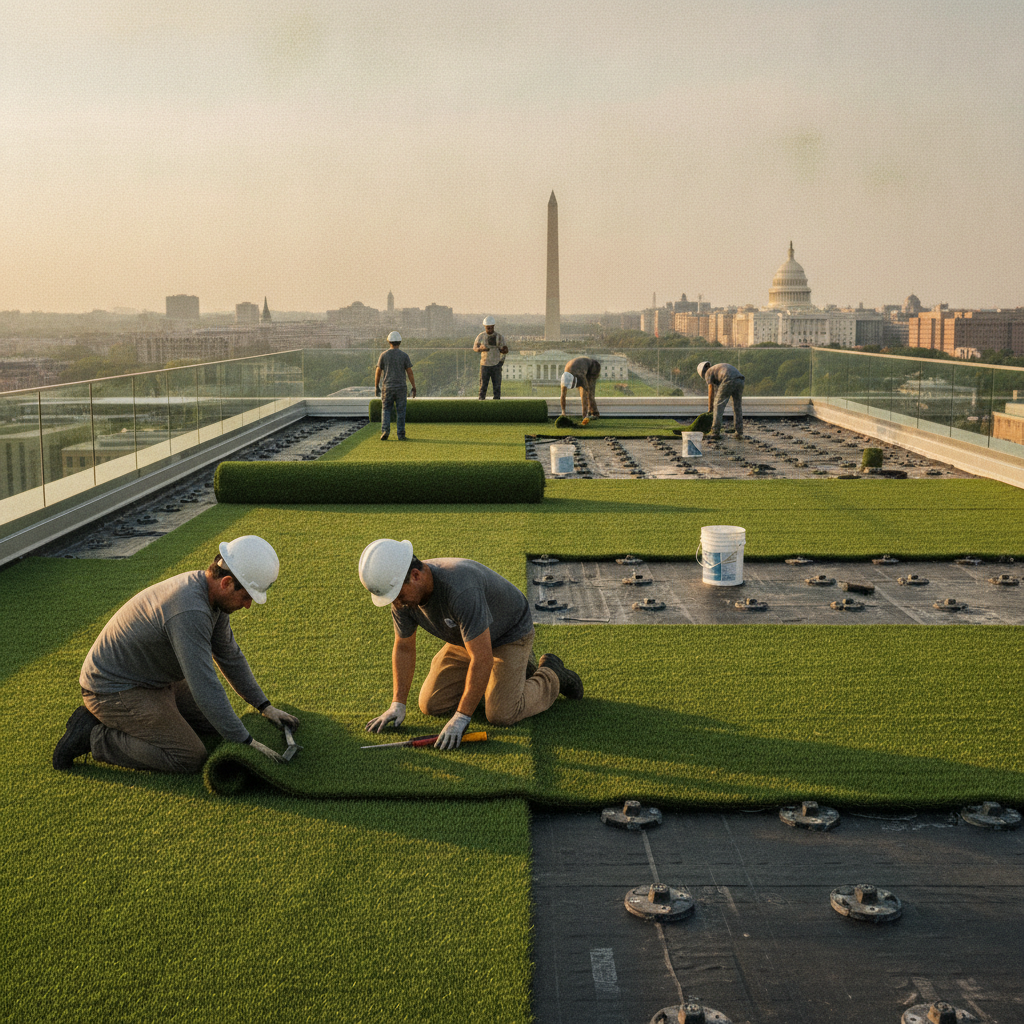
The correct approach for membrane-protected surfaces is a non-penetrating installation system. This typically involves weighted perimeter channels, adhesive bonding compatible with the membrane type, or a raised drainage tile layer as a decoupling substrate. Some rooftop applications use a modular tile system beneath the turf that protects the membrane entirely and creates a built-in drainage gap without a single fastener touching the waterproofed surface.
Before any work begins, you or your installer needs to identify the membrane type on your deck and confirm the adhesive or installation method is compatible with it. Some membrane manufacturers will void their warranty if certain adhesives are applied on top. This is a conversation that has to happen between your installer, your building manager or waterproofing contractor, and sometimes the membrane manufacturer directly.
If the installer you’re talking to doesn’t bring this up on their own, ask them explicitly: How do you protect an existing waterproofing membrane during installation? The answer tells you everything you need to know about their experience level with rooftop work.
Drainage Engineering for Rooftop Turf in a High-Rain Market Like D.C.
Washington, D.C. averages around 40 inches of rainfall annually, with heavy spring and summer storm events that can dump an inch or more in a matter of hours. Your rooftop turf system needs to move that water off the surface quickly and into existing roof drains or balcony scuppers without overwhelming them.
Quality synthetic turf for rooftop and balcony applications uses a perforated or flow-through backing that allows water to drain vertically through the turf pile and into whatever substrate sits below it. Plush Pad, for example, is designed specifically for patio, poolside, and deck environments where surface drainage and aesthetic finish both matter. The backing allows water to pass through efficiently without the turf holding moisture — which is critical in D.C.’s humid summers where trapped moisture becomes a mold and odor problem fast.
The drainage path after the water moves through the turf backing is equally important. If your rooftop has primary drains, your installer needs to confirm the turf system and underlayment don’t cover or impede them. On balconies with scuppers, the finished turf edge needs to terminate before the scupper opening so water can flow freely. Poor drainage planning on a balcony doesn’t just damage the turf — it can cause standing water that damages the building structure over time.
Turf Product Selection for Rooftop and Balcony Environments
Not every turf product is appropriate for a rooftop or balcony setting. You want UV-stabilized fibers that resist color fade from direct, reflected, and overhead sun exposure — rooftop environments are often more sun-intense than ground-level yards because there’s no tree canopy or shadow relief. You also want a product with heat-resistant technology, because dark synthetic fibers on an exposed urban rooftop can get significantly hotter than ground-level turf in the same conditions.
For residential rooftop and balcony applications in D.C., Arlington, Bethesda, or Chevy Chase, a shorter pile height in the 25mm–35mm range often works better aesthetically and practically than taller residential pile heights. It lays flatter under furniture, handles foot traffic cleanly, and doesn’t require heavy infill to maintain its structure — which keeps system weight manageable.
For pet owners with rooftop access or balcony dog runs, odor control is non-negotiable. A zeolite-blended infill neutralizes ammonia from urine at the chemical level, not just masking it. In an enclosed balcony environment especially, standard infill without antimicrobial or deodorizing properties will create odor problems within a season. Our pet turf installation service includes infill systems built specifically for this scenario.
What Rooftop Turf Installation Actually Looks Like in Practice
For a typical residential rooftop deck or large balcony in D.C. or Arlington, here’s a realistic picture of how the installation unfolds:
- Site assessment: The installer evaluates the substrate, membrane type, existing drain locations, sun exposure, and load capacity documentation. This is not optional.
- Surface prep: Any loose debris, standing sealants, or compromised membrane sections are addressed before turf goes down. On membrane-protected decks, a decoupling layer or drainage tile may be installed first.
- Turf layout and cutting: Rolls are cut to fit the space with seams positioned away from high-traffic walking paths. On rooftops with irregular shapes, HVAC units, or parapet walls, this takes more precision than a standard rectangular backyard.
- Securing perimeter and seams: Using non-penetrating methods — adhesive, weighted channels, or a combination — to anchor the system without breaching the membrane.
- Infill application: Appropriate infill is brushed in and power-broomed to stand the fibers upright and distribute weight evenly.
- Final inspection: Drain flow is tested, seams are inspected, and edges are confirmed as secure.
Cost for rooftop and balcony turf in the D.C. metro area generally runs in the $15–$25 per square foot range installed, depending on product selection, membrane protection requirements, and access complexity. Higher floors with elevator-only access and tight staging areas affect labor time and should be factored into your quote.
Frequently Asked Questions: Rooftop and Balcony Turf in Washington, D.C.
Will rooftop turf void my building’s waterproofing warranty?
It can, if installation involves penetrating the membrane or applying incompatible adhesives. A qualified installer will identify your membrane type first and use a compatible, non-penetrating installation system. Always loop in your building manager or waterproofing contractor before installation begins.
How hot does artificial turf get on a D.C. rooftop in July?
Rooftop turf can get significantly warmer than ground-level turf due to reflected heat from surrounding buildings and the absence of ground-level cooling. Choosing UV-stabilized, heat-resistant fiber products and light-colored infill helps reduce surface temperature. Periodic light misting brings temperatures down quickly on hot days.
Can I install turf on a condo balcony without getting building approval?
Most condo associations and co-op boards require architectural approval for any exterior modification, including turf. In D.C. and the surrounding area, you should expect to submit a modification request with product specs and installation method documentation before work starts. Silver Spring, Chevy Chase, and Arlington condo buildings often have their own specific approval processes as well. We can help you prepare that documentation.
Does rooftop turf hold up through D.C. winters?
Yes, with the right product and installation. UV-stabilized, all-weather turf fibers handle freeze-thaw cycles without cracking or fiber breakdown. The critical factor is that seams and perimeter bonds are properly executed — low-quality adhesive or improper bonding will fail in repeated freeze-thaw conditions, which is exactly what D.C. winters deliver from November through March.
What size rooftop or balcony makes sense for artificial turf?
There’s no minimum — we’ve done balconies as small as 80 square feet and rooftop terraces over 2,000 square feet. Smaller spaces benefit from turf because they transform a barren concrete slab into something usable without irrigation, mowing, or soil mess. The economics generally work well at any size when you factor in the long-term maintenance savings and the increase in usable outdoor living area.
Ready to Turn Your Rooftop or Balcony Into Something You’ll Actually Use?
Whether you’re a D.C. condo owner with a rooftop terrace, a Fairfax property manager looking to upgrade a commercial outdoor space, or a homeowner anywhere in the DMV area with a deck or elevated patio, Grassify has the experience to get this done right — from membrane assessment through final installation. We’re licensed, insured, and background-checked, and we back our work with a lifetime warranty on seams, edges, and base prep.
Start with a free consultation. Reach out to Grassify here and we’ll walk through your space, answer your structural and drainage questions honestly, and put together a proposal that makes sense for your specific situation. No pressure, no generic quotes — just real answers from a local team that knows this region’s buildings, climate, and installation challenges firsthand.


