
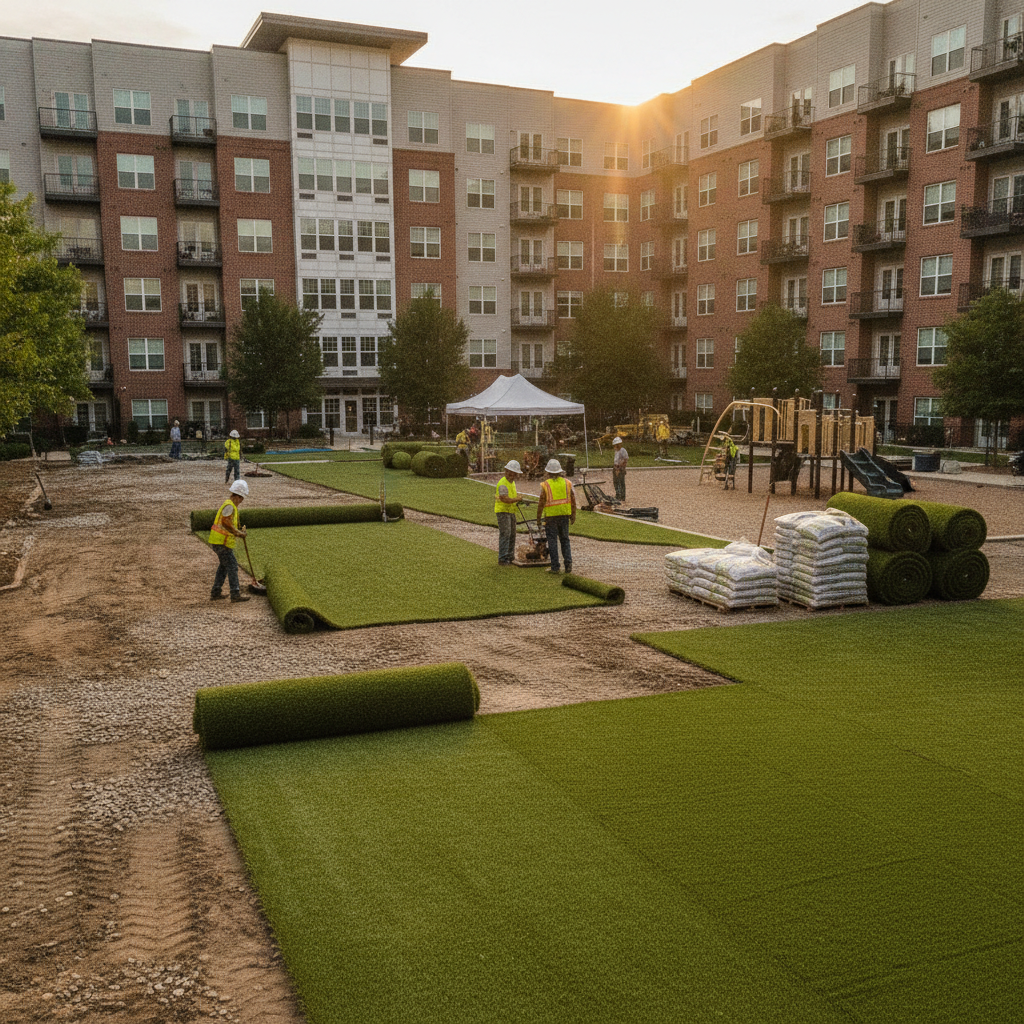
How Do You Install Artificial Turf on a Multi-Unit Apartment Complex Courtyard in Alexandria, VA? What Property Managers and Building Owners Need to Know
Yes, artificial turf absolutely works in apartment complex courtyards — and in the right situation, it’s one of the smartest landscaping investments a property manager in Alexandria, VA can make. But a shared courtyard serving dozens or hundreds of tenants is a completely different project from a homeowner’s backyard. The surface has to hold up to constant foot traffic, diverse uses, and zero margin for drainage failure. Done right, it becomes a durable, low-maintenance amenity that increases curb appeal and tenant satisfaction for years. Done wrong — with the wrong product spec or a crew that treats it like a residential job — you’ll be tearing it out within three years. This guide breaks down exactly what a commercial-grade courtyard installation looks like from the ground up.
Why Apartment Complex Courtyards Demand a Commercial Turf Specification
The biggest mistake property managers make is letting a contractor quote a residential product for a commercial application. A 35mm pile-height residential lawn turf designed for light family use will mat down under constant pedestrian traffic within 12 to 18 months. Foot traffic compaction — especially on fixed paths between building entrances, mailboxes, seating areas, and parking access — is brutal on grass fiber that wasn’t engineered for it.
For a multi-unit property, you need turf with a face weight of at least 60 to 80 ounces per square yard, a dual-layer backing system rated for commercial use, and a pile height in the 30mm to 40mm range — dense enough to look lush, short enough to stay upright under repeated compression. UV-stabilized fiber is non-negotiable in Northern Virginia’s summers. Without it, color fading accelerates fast in full-sun courtyard exposures.
The infill system matters just as much as the fiber. A silica sand infill base keeps pile standing upright and provides ballast that prevents turf shift under heavy traffic. If the courtyard includes a designated pet relief zone — increasingly common in dog-friendly apartment communities across the DMV — a secondary zeolite deodorizer layer in that zone controls odor at the source rather than just masking it.
Base Prep Is Where Most Courtyard Projects Either Win or Fail
Alexandria gets meaningful rainfall — roughly 42 inches annually — and anyone who’s managed an apartment property here knows what standing water does to tenant satisfaction and common-area liability. Courtyard drainage isn’t a nice-to-have. It’s the backbone of the whole installation.
A properly engineered commercial turf base starts with excavating the existing soil or organic material to a depth of 3 to 4 inches, grading the subgrade toward perimeter drains or pre-existing drainage infrastructure, and compacting a crushed aggregate base (typically Class II road base or decomposed granite) to achieve 95% compaction. A permeable turf with a well-prepared base drains at well over 30 inches per hour — significantly faster than natural grass and with none of the mud or puddling that plagues poorly maintained courtyard lawns.
In properties where the courtyard sits over a structural deck or parking garage — a situation more common than you’d expect in Alexandria’s denser neighborhoods and older mixed-use buildings — the installation method shifts entirely. Drainage mats replace traditional aggregate base, load ratings have to be reviewed with a structural engineer, and seaming patterns are planned around deck penetrations and expansion joints. This is not work you hand off to a general landscaper.
Designing for How Tenants Actually Use the Space
One area where most turf contractors fall short on commercial courtyard projects — and where you’ll find almost nothing useful on competitor websites — is honest design guidance for mixed-use shared spaces. A courtyard isn’t a putting green or a dog run. It’s used for kids playing, tenants walking dogs, outdoor furniture placement, social gatherings, and sometimes property events. Your turf layout has to account for all of it.
Here’s how a thoughtful commercial courtyard design approaches the zone planning:
- High-traffic path zones: Use a denser, shorter-pile turf (30mm) on corridors between building entries and common-area features. These areas see the most compression and need the most resilient product specification.
- Open lawn zones: A 38mm to 40mm pile gives a fuller, more inviting appearance in the open areas where tenants relax or kids play. These zones tolerate lighter, more distributed traffic.
- Pet relief zones: If your property is pet-friendly, designate a specific zone with a dedicated drainage grade, antimicrobial infill, and a zeolite deodorizer layer. Keep it set back from primary seating areas. This one decision prevents 90% of odor complaints. Learn more about how Grassify’s pet-friendly turf systems handle drainage and odor control at the engineering level.
- Furniture pad zones: Hardscape pads, pavers, or concrete spots should be planned before turf goes down. Retrofitting around furniture after installation creates edge problems and moisture traps.
What Commercial Clients in the DMV Often Don’t Realize About Installation Logistics
Apartment courtyard installations almost always involve constraints that a residential crew isn’t equipped to handle. Narrow gate access, tenant-occupied surrounding units, HOA or property management approval chains, utility line considerations, and noise ordinance windows for power equipment all have to be coordinated in advance.
In Arlington and Alexandria specifically, many mid-rise and high-density residential properties have interior courtyards accessible only through building corridors or narrow side gates. Material delivery, equipment staging, and crew access all have to be pre-planned with building management — not figured out on install day. A contractor who hasn’t done this before will cost you time, damaged common areas, and tenant complaints.
Professional installation timelines for a commercial courtyard typically run two to five days depending on square footage, grading complexity, and drainage work required. Budget planning for a commercial-grade courtyard installation generally falls in the $15 to $25 per square foot range depending on site conditions, product spec, and drainage engineering scope. Get a site-specific assessment — not a per-square-foot quote off a website — before committing to any number.
For broader context on how commercial turf installations are scoped and executed, the Grassify installation guide walks through base prep, materials, and what separates a lasting installation from a short-term fix.
The Long-Term ROI Argument for Property Managers
Natural grass in a shared courtyard is a maintenance budget drain. Irrigation systems, seasonal fertilization, aeration, overseeding, mowing contracts, and mud/puddle remediation after heavy spring rains add up fast — often $3,000 to $8,000 or more annually for a mid-size property. High-quality artificial turf eliminates essentially all of that. Maintenance drops to periodic brushing, leaf blowing, and the occasional rinse — tasks your existing maintenance team can handle without a landscaping contract.
On the tenant retention side, a clean, green, mud-free courtyard that looks good year-round is a tangible amenity. In competitive DMV rental markets, that matters. Prospective tenants touring a property in February or after a wet October week will see real grass that’s brown, muddy, or dead — or turf that looks exactly the same as it did in June. That visual contrast closes leases.
Quality commercial turf products carry manufacturer warranties in the 15 to 20-year range on fiber and UV performance. A professional installation warranty from a licensed contractor should cover seams, edges, and base integrity independently. Ask for both in writing before any contract is signed.
Frequently Asked Questions: Apartment Courtyard Turf in Alexandria and Northern Virginia
Do I need permits to install artificial turf in an apartment complex courtyard in Alexandria?
In most cases, turf installation on an existing grade doesn’t require a building permit in Alexandria or Fairfax County. However, if drainage modifications tie into city infrastructure, or if structural decking is involved, additional review may apply. A local contractor familiar with Alexandria’s permitting environment will know the thresholds. Always confirm with your city or county before work begins.
How do we handle a courtyard used by both children and dogs?
Zone separation is the answer. A designated pet relief area with its own drainage grade, antimicrobial infill, and zeolite deodorizer layer keeps odor and hygiene issues contained. The general lawn zone uses a standard silica sand infill. The two zones are installed as a single continuous surface but engineered differently underneath. Proper signage and tenant communication around the pet zone also make a real difference in how well the system performs long-term.
How long does a commercial courtyard turf installation take?
Most projects in the 1,500 to 5,000 square foot range run two to five days on site. Larger properties, complex drainage work, or significant grading requirements can extend that. Site access logistics — especially in urban Alexandria buildings — are often the biggest scheduling variable.
What happens to artificial turf in heavy rain? Does it flood?
A properly installed turf system with engineered aggregate base and perimeter drainage handles heavy rain significantly better than natural grass. Drainage rates through quality turf backing exceed 30 to 60 inches per hour — well above any rainfall event in the DMV. What you eliminate is the surface puddling and compaction that plagues high-traffic grass areas after every significant rain.
Can we install turf in phases to manage budget?
Yes, phased installation is workable if the design is planned as a unified system from the start. Drainage grades, seam locations, and base prep have to account for future phases so you’re not reworking finished sections later. Communicate your budget timeline to your contractor upfront so the design is built to accommodate phased build-out cleanly.
Ready to Transform Your Apartment Complex Courtyard?
If you manage a multi-unit residential property in Alexandria, Arlington, or anywhere across Fairfax County and you’re tired of fighting a losing battle with a high-maintenance shared lawn, Grassify can assess your site and give you a clear, honest picture of what a commercial-grade turf installation would cost, look like, and deliver over time. We’re a licensed and insured Northern Virginia turf contractor based in Burke, VA — and we’ve done this work in exactly the kinds of dense, access-constrained properties that out-of-state franchise installers aren’t set up to handle. Contact Grassify to schedule a free on-site consultation and get a proposal built around your actual property, not a generic square-foot price sheet.


