
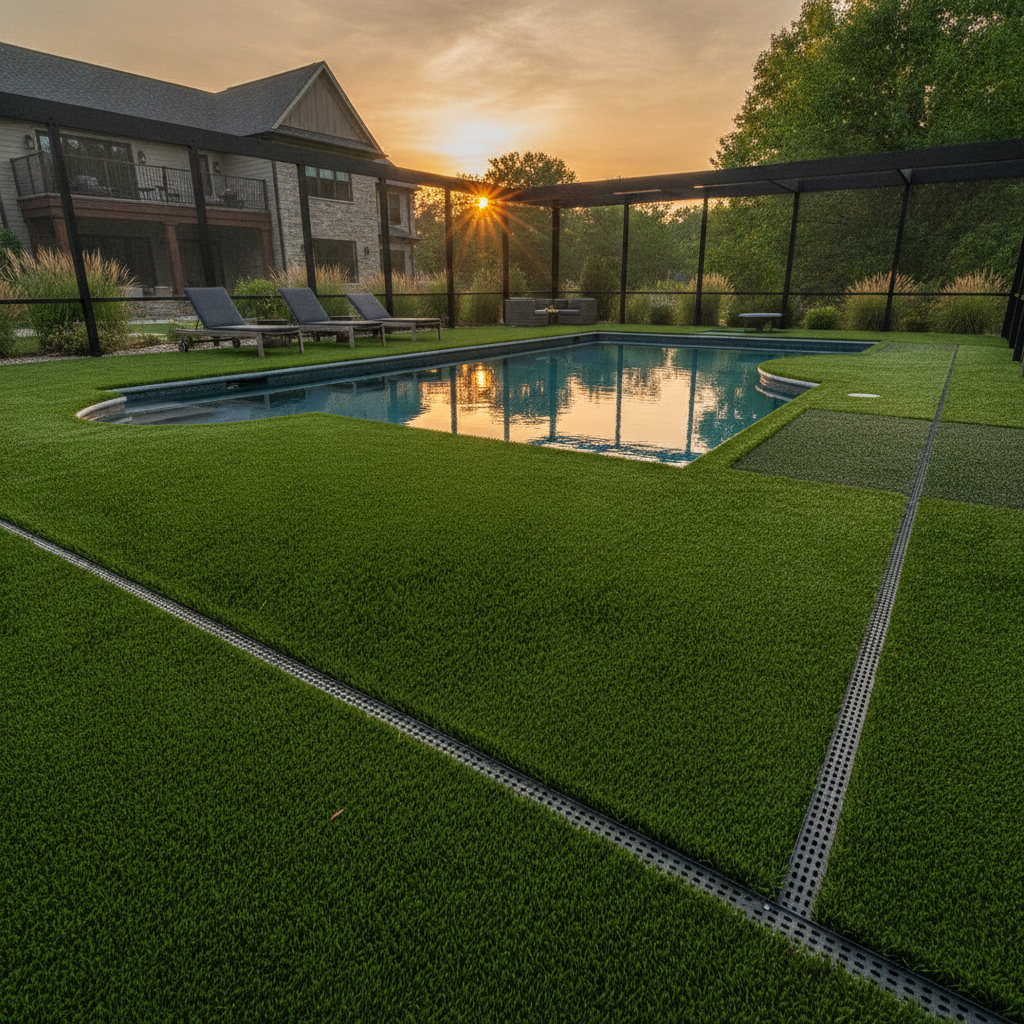
How Do You Install Artificial Turf Around a Pool Enclosure or Screen Room in Great Falls, VA? What Homeowners Need to Know
Yes — artificial turf works exceptionally well inside a pool enclosure or screened pool room, but only if the product and installation are matched to that specific environment. In Great Falls, VA, where many properties feature substantial outdoor living spaces with enclosed or screened pool structures, this is a project we get called about regularly. And it’s also one of the most frequently mishandled installations in the region — by general landscapers and national turf franchises alike — because an enclosed pool environment introduces four technical demands that a standard backyard lawn installation simply does not face: contained drainage, constant moisture and chlorine exposure, elevated surface temperatures, and a surface that people walk on with bare wet feet. Get any one of those wrong and you’ll be pulling the turf up within two seasons.
Why an Enclosed Pool Area Is a Different Animal Than an Open Backyard
When you’re surfacing an open lawn, excess water drains outward and dissipates through the surrounding soil. Inside a pool enclosure — whether that’s a full screen room, a lanai-style structure, or a partially enclosed deck area — water has nowhere to go unless you engineer it a specific route. Splash-out from the pool, runoff from bathers walking across the surface, and rain that enters through screen openings all accumulate in a defined, bounded space. If the base prep and drainage routing aren’t designed for that reality, moisture traps under the turf, the base material degrades, and you end up with odor, mold risk, and a surface that shifts and ripples within the first year.
In Northern Virginia specifically, this challenge is compounded by the region’s summer humidity and heavy spring rains. Great Falls and the broader Fairfax County area can see multiple inches of rainfall in a single storm event. For an enclosed pool space, that means even modest screen penetration can deliver significant water volume to a relatively small enclosed surface area — often 400 to 800 square feet. That water needs a defined exit.
Drainage Engineering for Enclosed Pool Spaces: What the Base Actually Needs
For a standard residential lawn, we typically install a compacted aggregate base — usually 3 to 4 inches of crushed stone — that allows water to percolate down and away from the turf surface. Inside a pool enclosure, you need to take that a step further. The concrete or pavers underneath most pool enclosures don’t absorb water at all, so every drop that lands on the turf needs to flow through the pile, through the turf backing, and then be directed off the hardscape through intentional slope and drainage points.
This means the existing surface needs to be evaluated for pitch before the turf is ever cut. Ideally, you want at least a 1% slope — roughly 1/8 inch per foot — directing water toward a drain, a screen channel, or the enclosure perimeter. If the existing concrete is flat or pitched the wrong direction, a leveling layer may be needed. We’ve done installations in Great Falls and McLean where the existing pool deck slab was pitched back toward the house — a problem the homeowner didn’t know about until we assessed it. Correcting that before turf goes down is the job. Ignoring it is how you get standing water and a failed installation.
The turf backing itself matters here too. For pool enclosure work, we use products with a flow-through perforated backing rated for high-moisture environments — not the standard woven polyurethane backing used for lawn applications. You want drainage rates well above 30 inches per hour at the backing level, because unlike a soil base, there’s no secondary absorption layer beneath the hardscape to take the overflow.
Heat-Resistant Turf: A Non-Negotiable for Enclosed Spaces in Northern Virginia
Screen enclosures and screen rooms trap radiant heat. Even a structure with open screen walls concentrates solar radiation on the floor surface — and a south- or west-facing pool room in a Great Falls home during July can push surface temperatures significantly higher than an exposed open-air patio. Standard synthetic turf fibers can reach surface temperatures 40 to 60 degrees above ambient air temperature under full sun. In an enclosed structure, that differential can be even higher.
For enclosed pool spaces, we specify heat-resistant turf products with ThermaBladeâ„¢-style or equivalent cooling fiber technology — fibers engineered to reflect rather than absorb infrared radiation. Combined with a light-colored or white silica sand infill, this can reduce surface temperature by 30 to 50 degrees compared to standard turf with crumb rubber infill. That’s the difference between a surface that’s comfortable on bare feet and one that’s borderline painful by noon in August. For families with kids using the pool — which is the majority of the pool enclosure projects we do across Fairfax County — this matters enormously.
Chlorine Exposure: Why Product Chemistry Matters More Than People Realize
Splash-out from chlorinated pools is a consistent, ongoing chemical exposure for any turf surface adjacent to or inside a pool enclosure. Over time, chlorine degrades inferior turf backings, weakens seam adhesives, and can cause fiber discoloration or brittleness. This is a gap we’ve consistently noticed in how competitors across the DMV describe pool deck turf — most mention that turf “is compatible” with pool environments but don’t specify what that actually means at the product level.
What it means specifically: the turf backing needs to be chlorine-resistant polyurethane, the seaming adhesive needs to be rated for chemical exposure, and the infill should be inorganic — either silica sand or a zeolite-blend — not organic material that degrades when repeatedly wet. At Grassify, every pool-adjacent and pool enclosure installation uses a product specified for aquatic environments. We don’t apply a lawn product and hope it holds up. The backing chemistry, the infill spec, and the adhesive selection are all chosen for the application before the job begins.
Slip Resistance: What “Wet Foot Traffic” Actually Requires
Barefoot wet traffic is the primary use case for a pool enclosure surface, and slip resistance is where a lot of generic turf installations fall short. Longer pile heights — 40mm to 50mm — that look lush and full in a lawn context are actually the wrong call for a pool deck surface. When fibers are that long and fully saturated, they lay flat and create a slick mat. For pool enclosures and pool decks, we typically recommend a shorter, denser pile in the 20mm to 30mm range with a textured face yarn that maintains friction even when wet.
This is also why infill density matters for pool applications. A properly infilled pool enclosure turf — with silica sand distributed evenly through the pile — keeps the fibers upright and provides consistent underfoot stability even after bathers have been walking across it for hours. An underinfilled surface compresses, fibers mat down, and the slip risk increases.
What the Installation Process Looks Like for a Screened Pool Room
For a typical Great Falls or Fairfax County pool enclosure project, here’s how the process runs from start to finish:
- Site assessment: We evaluate the existing surface material (concrete, pavers, tile), measure and photograph drainage pitch, note the enclosure structure’s orientation and shading, and identify any obstacles like drains, steps, or fixed furniture anchors.
- Product selection: Based on sun exposure, expected foot traffic, and proximity to the pool edge, we specify the appropriate pile height, fiber type, backing, and infill. For enclosed pool spaces, this is almost always a 20mm to 30mm heat-resistant product with perforated chlorine-resistant backing.
- Surface prep: Any existing surface irregularities are addressed. Cracks in concrete are filled and feathered. If the slope pitch is inadequate, a leveling or corrective layer is applied. Drains are prepped for compatibility with the turf system.
- Cutting and seaming: In an enclosed pool room, every seam line needs to be placed and adhered with precision — the turf cannot shift or lift at seam edges when wet. We use construction-grade seaming tape and urethane adhesive rated for moisture exposure, not standard outdoor adhesive.
- Infill application and brushing: Silica sand infill is spread evenly using a drop spreader and power-brushed into the pile to an even distribution across the entire surface. This is the step that determines whether the finished installation stays upright and stable for years or mats down within months.
Total project timelines for a 400 to 600 square foot enclosed pool room typically run one to two days for installation, with the surface ready for light use within 24 hours and full use — including pool activity — within 48 hours.
HOA Considerations in Great Falls and Fairfax County Communities
Great Falls properties tend to be larger lots with fewer HOA restrictions than townhome communities in Burke or Springfield — but HOA review is still relevant for some neighborhoods. More commonly, the constraint in Great Falls is a building permit requirement for structural changes to an enclosure. If you’re adding a screen room or modifying an existing pool enclosure structure as part of the project, Fairfax County building permits may be required. The turf surface itself typically doesn’t trigger a permit, but any structural or drainage modification to the enclosure might. We help homeowners think through that before the project begins rather than after.
Frequently Asked Questions: Pool Enclosure Turf in Great Falls and Northern Virginia
Can artificial turf go directly over existing concrete inside a pool enclosure?
Yes, in most cases. The existing concrete needs to be in reasonably sound condition — no major cracking or heaving — and the slope pitch needs to direct water toward a drain or perimeter exit. If the concrete is pitched away from drainage or is uneven, a leveling layer is required first. We assess the concrete as part of every site evaluation.
Will chlorine from pool splash-out damage the turf over time?
Not if the right product is specified. Chlorine-resistant polyurethane backing and inorganic infill materials handle ongoing chemical exposure without degradation. The critical point is that not all turf products are rated for aquatic environments — product selection has to match the application from the start.
How hot does artificial turf get inside a screen enclosure in a Northern Virginia summer?
Without heat-resistant fiber technology, surface temperatures inside an enclosure facing south or west can reach 130 to 150°F during peak afternoon hours in July and August. Heat-resistant turf products with reflective fiber technology and light-colored sand infill can reduce that to 90 to 110°F — still warm, but manageable for bare feet. This is a non-negotiable product spec for any sun-exposed pool enclosure installation in the DMV.
What pile height is best for a pool enclosure surface where people walk with wet feet?
For pool enclosures and pool decks, shorter and denser is better — typically 20mm to 30mm. Longer pile heights in the 40mm to 50mm range work well for lawn aesthetics but lay flat when saturated, increasing slip risk. A denser, shorter pile with adequate infill maintains friction and upright fiber structure even with constant wet traffic.
Do I need to seal the seams differently for a pool enclosure versus a standard lawn installation?
Yes. Pool enclosure seaming requires moisture-rated urethane adhesive rather than standard outdoor turf adhesive. Seams also need to be placed carefully relative to foot traffic patterns — never running parallel to the direction people walk when wet. Proper seam placement and adhesive selection are what separates a pool enclosure installation that lasts 15 years from one that starts lifting within the first season.
Ready to Talk Through Your Pool Enclosure Project?
If you’re in Great Falls, Potomac, McLean, or anywhere across Fairfax County and you’re looking at a pool enclosure or screen room surface that needs real engineering rather than a generic turf job, Grassify is the team to call. We’ve been doing technically demanding installations across Northern Virginia for over a decade — and enclosed pool environments are exactly the kind of project where product knowledge and installation precision make the difference between something that performs beautifully for 15 years and something you’re replacing in two.
We offer free on-site consultations with no pressure and no generic quotes. We look at your actual space, assess drainage and slope, discuss product options appropriate for your specific enclosure configuration, and give you a straight answer on what the project requires. Contact Grassify today to schedule your free consultation.


