
How Do You Install Artificial Turf on a Sports Court or Multi-Use Athletic Surface in Burke, VA? What Homeowners and Facility Managers Need to Know
If you’re planning to convert a backyard sports surface, side yard court, or community multi-use area to artificial turf in Burke, VA, the short answer is: yes, it absolutely works — but only when the system is engineered for athletic use from the ground up. A sports court installation is a fundamentally different project from a standard residential lawn. The pile height, infill density, backing stiffness, and base compaction all need to be dialed in for the specific sport or activity you have in mind. Get that wrong, and you end up with a surface that’s either too hard for safe play, too soft for reliable ball response, or both. Here’s what homeowners and facility managers across Fairfax County need to understand before the first shovel goes in the ground.
Why Sports Court Turf Is Not the Same as Lawn Turf
This is the gap that most general landscapers — and even a few turf-only competitors in the DMV area — tend to gloss over. They’ll sell you a standard 40mm residential product, lay it on a crushed stone base, and call it a sports surface. That approach fails in multiple ways for athletic applications.
First, pile height matters differently on a sports court. For soccer, lacrosse, or football-style use, you typically want a 40mm–50mm monofilament or slit-film fiber with sufficient blade density to support natural foot plant and lateral movement. For multi-use courts that include basketball, futsal, or pickleball play on adjacent concrete panels, you might want a shorter, denser pile in the 20mm–30mm range to maintain consistent ball response and reduce tripping hazards at surface transitions.
Second, infill selection changes entirely. A standard lawn install might use silica sand or a crumb rubber blend purely for ballast. On a sports surface, the infill system has to achieve a specific G-max rating — a measure of impact attenuation that tells you how much shock force the surface absorbs relative to a fall or collision. ASTM F1936 standards guide this for general athletic turf. If you’re building a court that kids will use heavily, you need to verify that your installer is testing and targeting the right G-max range, not just eyeballing infill depth.
Base Preparation: The Part That Actually Determines Long-Term Performance
Here in Burke and across the broader Northern Virginia area, the freeze-thaw cycle between November and March puts serious stress on any compacted base. A sports court installation needs a base that stays stable through that cycle — not just in October when the crew walks away. That typically means 4–6 inches of compacted Class II crushed aggregate, properly graded to a 1–1.5% slope for drainage, and in some cases a geotextile weed barrier below the aggregate to prevent migration over time.
On backyard courts where you’re working with existing concrete or asphalt, the approach shifts. You’re often mechanically bonding the turf system directly to the hard surface, adding a foam shock pad layer between the concrete and the turf backing to achieve the impact attenuation you need. That foam pad is not optional on an athletic surface — it’s what gets you to a safe G-max range without the full aggregate base that a ground-up installation would use.
The spring rains in Fairfax County are genuinely punishing. If your base prep doesn’t include adequate drainage slope and perimeter drainage channels on a larger court surface, you’ll see pooling and potentially base migration within a season or two. This is one area where cutting corners on a sports installation really does show up fast.
What Multi-Use Actually Means — and How to Plan for It
The term “multi-use surface” gets thrown around loosely. In practice, it means different things depending on whether you’re a homeowner in West Springfield trying to give your kids a safe backyard play court, or a property manager in Alexandria overseeing a community amenity space that needs to handle soccer practice, fitness bootcamps, and weekend flag football at the same time.
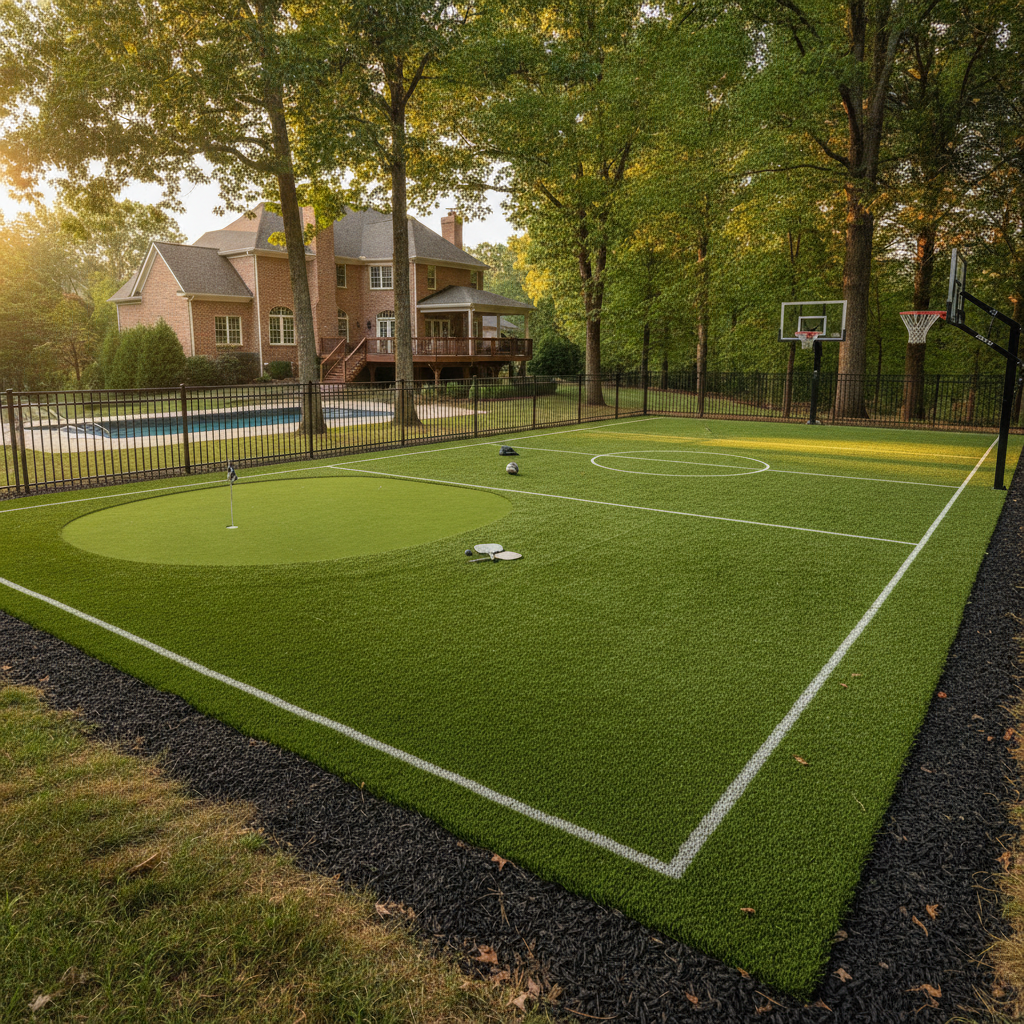
For residential backyard courts in Fairfax County neighborhoods, the most common request we see is a combination surface — roughly half turf field for kicking and throwing, half smooth hardcourt panel for basketball or pickleball. These hybrid layouts require precise edge transitions between the turf and hardcourt areas, with turf secured firmly at the seam line so there’s no edge lift or trip hazard. Infill depth at the transition zone also has to be managed carefully — too much infill and you create a height differential at the edge; too little and you lose your impact attenuation right where players are most likely to fall.
For commercial and community outdoor sports turf applications — school practice fields, HOA common area courts, or recreation center outdoor spaces in communities like Burke Centre or Signal Hill — you’re also dealing with local Fairfax County permitting considerations, and in HOA-governed areas, architectural review requirements before breaking ground. We navigate that process with clients regularly, and it’s much smoother when you’ve documented the drainage plan and surface specifications upfront rather than trying to retrofit that documentation after the fact.
Heat Management on Athletic Surfaces in the DMV
Anyone who’s played on a dark-colored turf surface on a July afternoon in Northern Virginia knows the heat issue is real. Standard synthetic fibers can reach surface temperatures 20–40°F above ambient air temperature on a clear summer day. On a sports court where kids or athletes are active and in contact with the surface, that’s a legitimate safety and comfort concern.
There are two main ways to address this. First, fiber color and composition matter — lighter field-green shades and certain UV-reflective fiber technologies run noticeably cooler than darker or older-generation products. Second, infill choice plays a role: organic infill options like cork or coated sand blends retain less heat than standard crumb rubber. Neither option completely eliminates the physics of a dark surface in full sun, but combining a heat-mitigating fiber with a cooler infill makes a measurable difference on a July afternoon in Arlington or Fairfax.
What a Legitimate Sports Turf Installation Costs in Fairfax County
Sports court and multi-use athletic turf installations run higher than standard residential lawn work because of the additional base engineering, infill precision, and in many cases shock pad systems involved. You’re typically looking at $15–$25 per square foot for a properly engineered outdoor sports surface, depending on application type, site conditions, and the specific infill and backing system specified. A backyard court on an existing concrete base will generally run toward the lower end of that range; a full ground-up installation with aggregate base, drainage channels, and a multi-sport infill system will run higher.
What separates a legitimate local installer from a general landscaper quoting the job cheap is the documentation: G-max testing results, drainage slope specs, seam and edge warranty terms, and product backing specs. If a quote doesn’t include any of that, the price is probably the only thing being competed on — and that’s exactly where sports surfaces go wrong.
For installation guidance specific to your site type, the Grassify installation guide walks through what site assessment and base preparation look like for different application types.
Frequently Asked Questions: Sports Turf in Burke and Fairfax County
Can I install artificial turf on an existing concrete or asphalt sports court?
Yes — and in many backyard situations, this is actually the preferred approach. A foam shock pad is bonded or laid over the hard surface, and the turf system is mechanically fastened on top. It eliminates the need to excavate and build an aggregate base, which saves time and cost. The key is making sure the existing surface is structurally sound, properly sloped for drainage, and free of major cracking that could telegraph through the turf layer over time.
What pile height should I use for a backyard multi-sport surface?
For surfaces that mix grass-field sports (soccer, lacrosse, flag football) with hardcourt play, a 35mm–40mm slit-film or monofilament product typically performs well as the field portion. If the entire surface is grass-only with no hardcourt panels, you may go up to 45mm–50mm for a more natural feel. Shorter piles (20mm–30mm) are generally better when you want consistent ball roll and firm footing for cutting movements.
Does my HOA in Burke or Fairfax County need to approve a sports court turf installation?
In most HOA-governed communities across Fairfax County — including many neighborhoods in Burke, Springfield, and West Springfield — any modification to a backyard that involves hardscaping, significant grading, or a new permanent surface material requires architectural review board (ARB) approval. The review process typically requires a site plan, a description of materials, and sometimes a drainage plan. We prepare that documentation as part of our pre-installation process.
How long does a sports turf surface last?
A properly installed and maintained sports turf system in the DMV climate typically lasts 12–18 years before the fiber begins to show significant wear. High-traffic zones — goal mouths, pivot points, sideline areas — wear faster than the rest of the field. Regular grooming to redistribute infill and prevent matting significantly extends the usable life of the surface. Grassify backs seams, edges, and base integrity with a lifetime installation warranty.
Is sports court turf safe for young kids?
When properly engineered with the right infill depth and, where needed, a foam shock pad layer, synthetic sports turf achieves G-max ratings well within safe ranges for child play. Products used for playground and school athletic applications are CPSC and IPEMA-certified with published critical fall height ratings. For backyard family court installations, we spec the system to meet the same impact standards we use on school and playground turf projects — not a lower residential standard.
Ready to Build the Right Surface for Your Property?
Whether you’re converting a backyard court in Burke Centre, building a community athletic space for an HOA in West Springfield, or planning a multi-use turf area for a school or recreation facility in Fairfax, the engineering behind the installation determines everything about long-term performance and safety. Grassify has been doing this work across Fairfax County and the broader DMV area for over a decade, and we bring the same base prep discipline and product specifications to a 1,200-square-foot backyard court as we do to a full commercial athletic field.
If you’re ready to get serious about your sports surface project, contact Grassify to request a free on-site consultation. We’ll evaluate your existing surface, talk through sport-specific requirements, and give you a detailed proposal — not a ballpark number from a spec sheet.


