
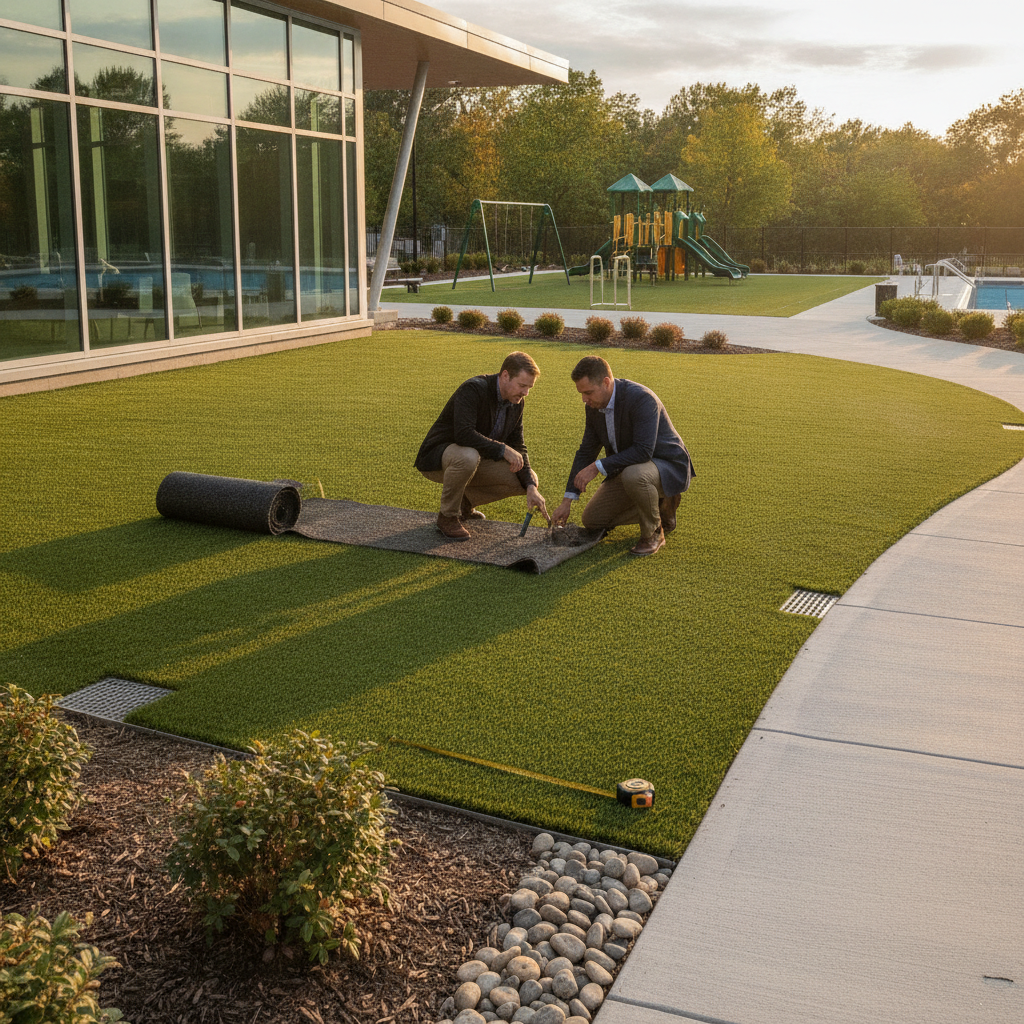
How Do You Choose the Right Artificial Turf for a School or Office Campus Entrance in Chevy Chase, MD? What Property Managers Need to Know
The short answer: not every turf product is built for a campus entrance, and choosing the wrong one will show within a year. Property managers and facilities directors in Chevy Chase, MD face a specific set of challenges — heavy daily foot traffic, strict aesthetic standards, Montgomery County’s famously wet spring seasons, and in many cases, ADA-accessibility obligations that most turf vendors barely mention. If you’re planning a turf upgrade at a school entrance, corporate campus walkway, or institutional grounds, this guide will walk you through exactly what to look for, what to ask, and what red flags to avoid.
Why Campus Entrances Are a Different Animal Than Residential Lawns
Most of the turf content you’ll find online — even from local installers — is written for homeowners with backyard lawns. Campus entrances are a completely different application. You’re dealing with potentially hundreds of daily foot crossings concentrated in the same narrow corridor, often on pavers or concrete edge transitions, and with an aesthetic standard that represents your institution to the public.
A residential-grade turf product installed in a high-traffic commercial entrance will mat down and develop permanent wear paths within 18 to 24 months. The fiber structure simply isn’t engineered for that kind of compression load. For campus entrances, you need a commercial-grade product with a minimum face weight of 70–80 ounces per square yard, a tighter stitch rate, and a dual-layer or reinforced backing that doesn’t delaminate under constant stress.
Pile height matters here, too. For high-traffic entrance areas, a 35–40mm pile height hits the sweet spot — tall enough to look lush and professional, short enough that foot traffic doesn’t create a permanent lean in the fiber direction over time.
The Drainage Problem That Most Chevy Chase Installations Get Wrong
Chevy Chase and the broader Montgomery County, MD area sees some of the heaviest spring rainfall in the DMV corridor. A campus entrance that puddles after a storm doesn’t just look bad — it creates a slip liability, can undermine your base layer, and accelerates turf aging. Yet drainage is the section most vendors gloss over when quoting commercial projects.
The industry standard minimum drainage rate for commercial turf is around 30 inches per hour. For a campus entrance in this region, we’d argue that’s the floor, not the target. Properly engineered commercial installations in Montgomery County should include a crushed stone base at 3–4 inches depth, a perforated sub-base drainage layer, and a turf product with a perforated or flow-through backing rated well above standard. You should be able to ask your installer to show you the drainage spec sheet for the specific product they’re proposing — not a generic estimate.
If a contractor gives you a quote without discussing what’s going under the turf in detail, that’s your first warning sign.
ADA Compliance: The Gap No One Talks About
This is the section that almost no competitor in this market covers in any meaningful depth, and it’s one of the most consequential oversights for a commercial client. If your campus entrance serves a school, daycare, medical office, or any publicly accessible institution, ADA surface requirements apply — and not all turf products meet them.
Under ADA guidelines, ground surface materials in accessible routes must be stable, firm, and slip-resistant. For artificial turf, that means the infill system and backing must be configured to prevent the surface from shifting or compressing in a way that creates an unstable walking path. Loose-fill sand infill at standard density typically meets the firmness standard; crumb rubber alone often doesn’t for accessible route applications. Some installations require a compacted, stabilized base with a turf product specifically rated for accessible surface use.
For school entrances in particular, if the path crosses a designated accessible route to a building entrance, you need documentation — not just the installer’s word that it’s compliant. Ask for written confirmation that the turf product and installation spec meet ADA Section 4.5 surface standards. Grassify’s playground and commercial turf work already accounts for these compliance requirements, including CPSC and IPEMA certifications for school applications, which is a useful baseline even for entrance areas that aren’t technically play zones.
What Product Specs Actually Matter for a Campus Entrance
When you’re reviewing proposals from turf installers, here are the specific numbers you should be asking about — and why:
- Face weight: 70–85 oz/sq yd minimum for commercial high-traffic areas. Lower than that and you’re buying a residential product at a commercial price.
- Stitch rate: 18–22 stitches per inch for dense, wear-resistant pile that holds up under directional foot pressure.
- Fiber type: Nylon or nylon-polyethylene blend for commercial entrances. Pure polyethylene is softer but less abrasion-resistant under heavy use.
- UV stabilization: All exterior turf should carry a 15-year UV warranty minimum. In the DMV area’s hot, humid summers, unstabilized fiber degrades visibly within 3–4 years.
- Backing system: Dual-layer polyurethane or reinforced latex. Single-layer backing delaminates under repeated foot load and temperature cycling — a real issue in Chevy Chase’s freeze-thaw winters.
- Infill system: For ADA-accessible entrances, a silica sand or coated sand infill at proper density. Avoid systems that rely primarily on loose crumb rubber for entrance applications.
Heat and the DMV Summer: What Campus Facilities Managers Miss
Chevy Chase sits squarely in the mid-Atlantic heat zone. Conventional dark-green synthetic turf in direct sun can reach surface temperatures of 150°F or higher on a 90°F July afternoon. For a school entrance where students are walking and sometimes sitting, that’s a safety and comfort issue that should factor into your product selection.
Heat-mitigating turf technologies — lighter-colored fiber blends, reflective coatings, and cooling infill systems like HydroChill or coated sand — can reduce surface temps by 30–50°F compared to standard products. These aren’t novelty features; they’re legitimate engineering decisions for any high-sun commercial installation in the Beltway corridor. Ask specifically whether the turf being proposed has been tested for surface temperature performance, and under what conditions.
What to Look for in a Local Installer for Commercial Campus Work
Not every residential turf installer has the crew capacity, equipment, or experience to handle a commercial campus project correctly. For institutional properties in Montgomery County, you want an installer who can provide:
- A written base prep and drainage specification, not just a product brochure
- Proof of general liability and workers’ comp insurance — required before most institutional facilities will allow contractor access
- References from at least one commercial or institutional project in the DC-Maryland area
- A written warranty covering both the product and the installation — seam integrity, edge anchoring, and base performance — not just a manufacturer’s product warranty
- Crew members who are background-checked, which matters for school properties in particular
Grassify’s crews are licensed, insured, and background-checked, and every installation comes with a lifetime warranty on seams, edges, and base prep — not just the product itself. For commercial clients in Bethesda, Rockville, Silver Spring, and across Montgomery County, that warranty structure matters because institutional properties can’t afford to re-mobilize a contractor every two years for repairs a solid installation would have prevented. You can learn more about the commercial and outdoor sports turf services Grassify offers for institutional clients.
Frequently Asked Questions
Can artificial turf be installed on a sloped campus entrance without drainage problems?
Yes — but slope actually helps drainage if the base is engineered correctly. A properly graded crushed stone sub-base with a perforated backing allows water to sheet off or drain through without pooling. The risk on slopes is seam integrity and edge anchoring, which require experienced installation on gradient surfaces. Always ask for a site-specific drainage plan, not a generic answer.
Does Montgomery County, MD require permits for commercial artificial turf installations?
It depends on the scope. Surface-level turf replacement on existing impervious or landscaped areas generally doesn’t require a permit, but if you’re altering grade, adding drainage infrastructure, or modifying an accessible route, a site plan review or permit may be required. Your installer should be able to advise — or you can check with Montgomery County’s Department of Permitting Services directly before signing a contract.
How long does a commercial campus entrance turf installation typically take?
For a standard 2,000–5,000 sq ft entrance area, plan on 2–4 days for base prep, drainage installation, and turf laying. Larger projects or those requiring significant grading work take longer. Most installations can be phased to minimize disruption to campus operations.
What’s the typical cost range for artificial turf on a commercial campus entrance?
Commercial turf installations in the DMV area generally run between $15 and $25 per square foot installed, depending on site conditions, drainage complexity, product grade, and access logistics. Campus entrance projects at the higher end of that range typically include upgraded drainage, heat-mitigating technology, and ADA-compliant infill systems. Get itemized quotes — not lump sums — so you can see where the money is actually going.
Is artificial turf a good fit for a school entrance used by young children daily?
When specified correctly, yes. The key is choosing a commercial-grade product with UV-stabilized fibers, a non-toxic infill system (no heavy-metal crumb rubber), and proper drainage so the surface doesn’t stay wet and become a slipping hazard. For school applications, Grassify recommends products that also meet CPSC shock-absorption standards — even outside of designated play areas — as an added safety margin.
Ready to Talk Through Your Campus Entrance Project?
Whether you’re managing a school in Chevy Chase, an office campus in Bethesda, or an institutional property anywhere in Montgomery County or across the DMV, the right turf decision starts with a site-specific conversation — not a generic quote from a national franchise. Grassify has been handling commercial and institutional turf installations across Northern Virginia, Washington, D.C., and Maryland for over a decade, and we bring the same engineering rigor to a 500 sq ft entrance as we do to a full athletic field.
Contact Grassify today for a free on-site consultation. We’ll assess your drainage situation, walk through product options that fit your traffic load and compliance requirements, and give you a fully itemized proposal — no surprises, no pressure.


