
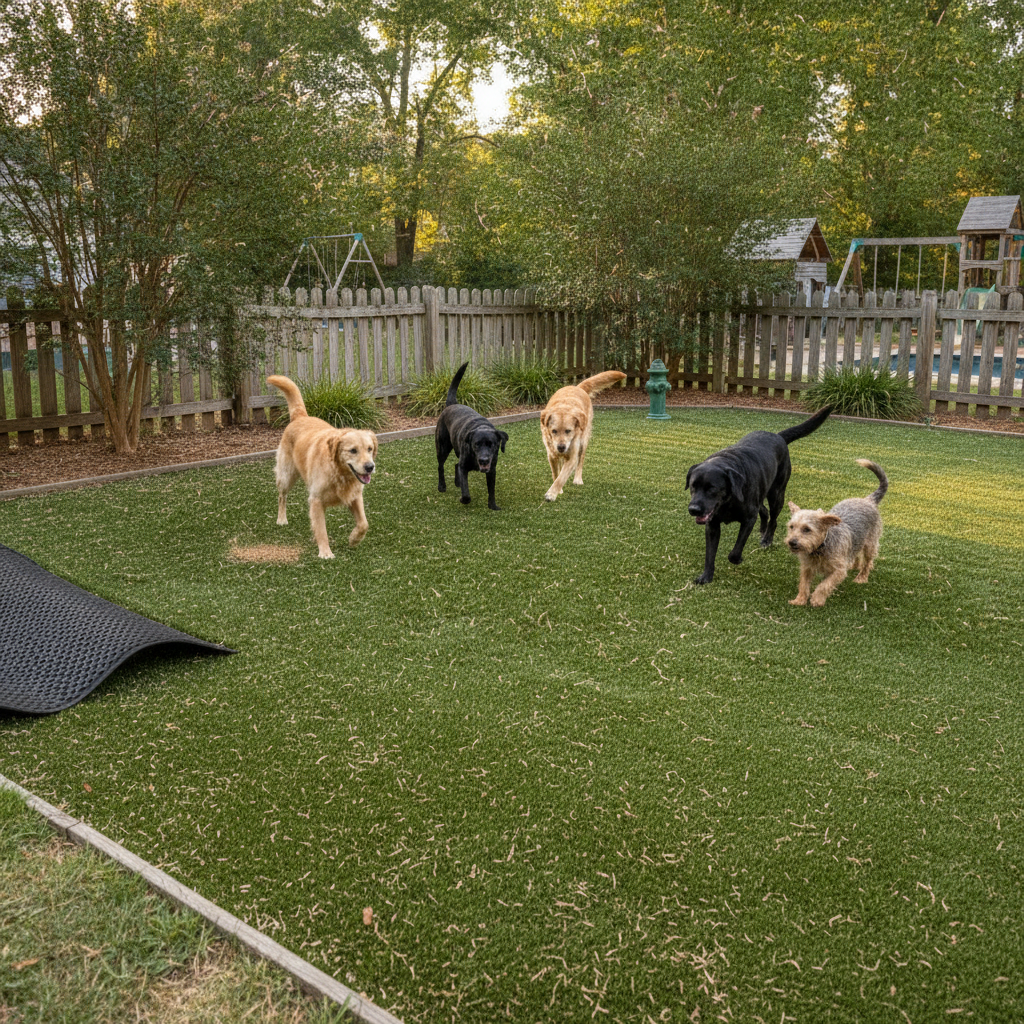
How Do You Install Artificial Turf in a Backyard Dog Run in Burke, VA? What Pet Owners Need to Know About Layout, Drainage, and Long-Term Performance
If you have one or more dogs tearing through a dedicated run in your backyard in Burke, VA, you already know what natural grass looks like after six months of that kind of traffic — dirt, mud, bare patches, and a smell that follows you indoors. A well-built artificial turf dog run solves all of that, but the keyword is well-built. A dog run is not the same as a standard lawn installation. The drainage demands are completely different, the infill system has to actively fight odor rather than just let liquid pass through, and the layout needs to be designed around how your dog actually uses the space. This guide breaks down exactly what that looks like.
Why a Dog Run Demands a Different Installation Approach
Most general landscapers and national turf franchise installers treat pet turf as just another residential lawn job with a slightly different infill topping. That’s where problems start. A dog run concentrates urine, bacteria, and organic waste in a confined area repeatedly — sometimes multiple times per day. Without a drainage system engineered specifically for that volume and frequency, you end up with ammonia buildup in the infill layer that no amount of rinsing will fix.
At Grassify, our pet-friendly turf installations use a 5-layer drainage system that handles more than 400 inches per hour of drainage capacity. That’s not a marketing number — it’s the actual throughput rate required to prevent any liquid from pooling or sitting in the infill between uses. Below the turf itself, we engineer a properly compacted aggregate base with a minimum 1-2% grade toward a natural or constructed drain point. In a tight Burke backyard, that grade has to be deliberate — the land doesn’t always cooperate.
Odor Control: What Actually Works and What Doesn’t
This is the section most competitor sites skip or gloss over with a single line about “antimicrobial infill.” Let’s be specific about what that means in practice.
There are three components to a real odor-control system in a pet turf installation:
- Zeolite infill layer: Zeolite is a naturally porous mineral that actively captures and neutralizes ammonia molecules at the molecular level. It doesn’t just dilute odor — it bonds with the ammonia and holds it until the next rain or rinse flushes the system. A proper pet turf installation uses a dedicated zeolite layer separate from the primary infill, typically applied at 1-2 lbs per square foot.
- Antimicrobial primary infill: Below the zeolite, the base infill — usually a coated crumb rubber or silica sand blend — should carry an antimicrobial agent to prevent bacterial colonization in the infill bed. Bacteria are what produce the secondary odor that persists even after the liquid drains.
- Permeable backing with true drainage channels: The turf itself needs a backing with a high perforation rate. Budget products and DIY rolls often have backing perforation rates under 30 in/hr, which creates a reservoir effect during heavy use or heavy rain. Our pet turf products use fully permeable backing with flow rates that won’t bottleneck even in summer heat.
We stand behind that system with a 90-day odor-free guarantee. If you’re getting quotes from other installers, ask them specifically about their odor-control guarantee and their drainage rate spec — not just that they use “pet-friendly turf.”
Designing the Layout for Your Specific Dog and Yard
Dog run layout matters more than most homeowners realize going in. The shape and dimensions of the run, where you position it relative to the house and fencing, and how it connects to the rest of the yard all affect how useful — and how manageable — the space ends up being.
Here’s what to think through before installation:
- Size relative to your dog’s activity level: A high-energy breed in a 6×10 foot strip will pace and wear specific turf paths heavily. For dogs that run, you want a minimum 10-foot run length — ideally more — to distribute impact and waste across a larger area. Smaller spaces are fine for toy breeds or dogs that use the run primarily for bathroom purposes rather than exercise.
- Fencing and containment: If you’re adding a fence or modifying an existing one, coordinate that work before the turf goes in. Post footings dug after installation damage base prep and create low spots that collect water. In Burke Centre and similar Fairfax County HOA neighborhoods, fence modifications may need architectural approval — handle that before the turf project, not after.
- Shade and heat exposure: Synthetic turf can get warm in direct summer sun. Burke’s humid summers push surface temps up, particularly on south-facing runs with no canopy. If your run is in full sun, we’ll recommend a heat-resistant fiber product and discuss shade options. A shaded dog run is more comfortable for your pet and extends the life of the turf surface.
- Access to a water source: You should be able to rinse the run with a hose at least once or twice a week. Good drainage means that rinse water exits cleanly without pooling. If you’re more than 40-50 feet from a spigot, plan for a hose extension before we finalize the layout.
Base Prep: What Happens Under the Turf Is What Determines Performance
Northern Virginia’s freeze-thaw cycle through winter is one of the most underappreciated factors in turf installation longevity. Fairfax County soil shifts through repeated freeze and thaw cycles, and a poorly compacted base will heave, settle unevenly, and create drainage dead zones within a season or two. That’s especially true in tight dog runs where foot traffic (and paw traffic) concentrates in predictable patterns.
Our standard base for pet turf dog runs includes excavation to at least 4 inches below final grade, a 3-inch compacted Class II road base aggregate layer, and a weed barrier membrane installed before the turf is laid. On runs with known drainage issues or clay-heavy soil — common in Springfield, West Springfield, and Fairfax Station — we sometimes go deeper or add a French drain channel before the base layer goes in. That’s a conversation we have upfront during site evaluation, not a surprise on install day.
What Does a Professional Dog Run Installation Cost?
Pet turf dog run installations at Grassify typically fall in the $15–$22 per square foot range depending on the size of the run, site conditions, drainage engineering required, and infill specification. Smaller runs have a higher per-square-foot cost because fixed mobilization and base prep costs spread over less area. A 200-square-foot run will cost more per square foot than a 500-square-foot installation.
That range includes full base preparation, the 5-layer drainage system, zeolite and antimicrobial infill, professional seaming, and perimeter edge finishing. It does not include fencing or modifications to existing structures.
Most installations in the Burke and greater Fairfax County area are completed in one to two days once materials are on-site. The run is typically ready for light use within 24 hours and fully ready for normal dog activity within 48 hours.
HOA Considerations for Dog Runs in Fairfax County
If you live in a Burke Centre, Rolling Valley, or Signal Hill HOA community, check your CC&Rs before committing to a design. Some HOAs in Fairfax County have specific rules around artificial turf visibility from the street, pile height requirements, and perimeter finishing standards. Fencing around a dog run almost always requires separate architectural review board approval. Grassify has worked through this process with dozens of local homeowners — we can help you understand what documentation to submit and how to frame the application, but the approval is your responsibility before installation begins.
Frequently Asked Questions
How often do I need to clean a turf dog run?
Solid waste should be removed daily, the same as any dog area. A light hose rinse two to three times per week is sufficient for most single-dog runs. During the hot, humid summers common in Northern Virginia, more frequent rinsing — especially mid-week — helps prevent any odor from building up between zeolite cycles.
Will the turf hold up to a large or aggressive chewer?
Most dogs adapt quickly to turf and stop trying to dig or chew at it once the novelty wears off. For persistent diggers, we recommend a border of artificial edging or a concrete mow strip around the perimeter to eliminate the exposed edge that dogs tend to target. The turf fibers themselves are UV-stabilized and durable, but no installation is chew-proof if a dog is determined.
Does the zeolite infill need to be replaced?
Zeolite has a saturation point, but it recharges naturally when exposed to sunlight and air. In most residential dog runs, you won’t need a zeolite replacement for 5-7 years under normal conditions. High-volume runs with multiple large dogs may benefit from a partial topdress refresh at the 3-4 year mark. We’ll let you know what’s appropriate based on your specific setup.
Can I add a dog run to an existing turf lawn installation?
You can, but it requires pulling back the existing turf, re-engineering the base and drainage in that zone, and re-laying with pet-specific product and infill. It’s more cost-effective to plan a dog run as part of the original installation scope. If you’re starting from scratch, we can design the full yard to include both a lawn area and a dedicated pet zone with separate drainage specifications under one project.
Is artificial turf safe for dogs year-round in Burke’s climate?
Yes, with appropriate product selection. Our pet turf uses UV-stabilized, lead-free fibers with non-toxic infill. In winter, synthetic turf drains better than natural grass and doesn’t create muddy paws after freeze-thaw cycles — one of the biggest practical benefits for dog owners in Fairfax County. In summer, keeping the run partially shaded or rinsing it with cool water on hot days keeps surface temperatures comfortable for your pet.
Ready to Build a Dog Run That Actually Works?
A well-designed turf dog run is one of the most practical investments a dog owner in Burke, VA can make. No more mud tracked through the house, no more bare patches, no more odor problems that outlast the rain. But it only delivers on those promises if the drainage and infill systems are built correctly from the start.
Grassify is based right here in Burke and has been engineering pet turf installations across Fairfax County and the broader DMV area for years. We know how the soil behaves through a Virginia winter, how HOA communities in this area approach turf approval, and exactly what your dog’s dedicated space needs to stay clean, comfortable, and odor-free for the long haul.
Contact us today to schedule a free on-site consultation. We’ll evaluate your yard, talk through layout options, and give you a detailed quote — no pressure, no generic pitch.


