
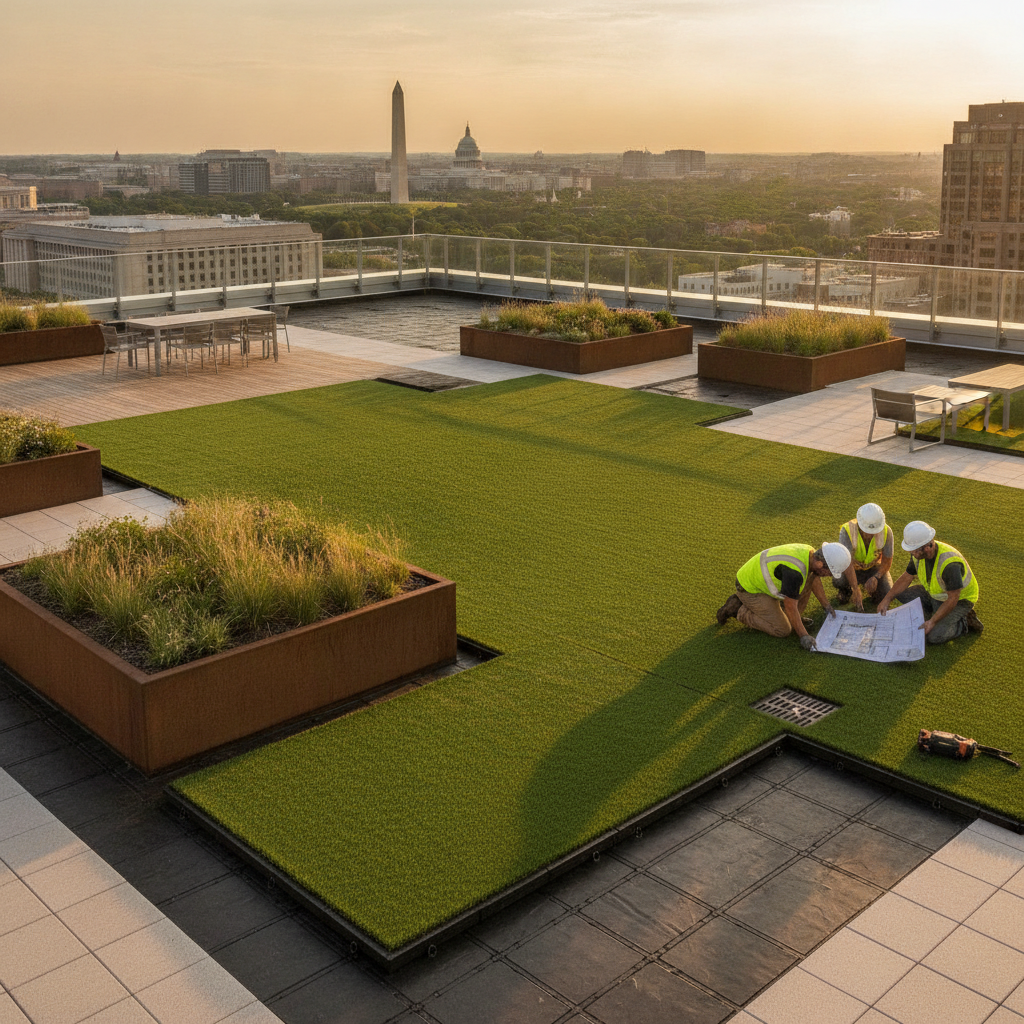
How Do You Install Artificial Turf on a Commercial Rooftop or Elevated Common Area in Washington, D.C.? The short answer is carefully — and with a team that understands building structure, waterproofing systems, and urban drainage before they ever unroll a single piece of turf. D.C. commercial rooftop projects are some of the most technically demanding artificial grass installations in the entire DMV market, and the gap between a contractor who handles basic suburban lawns and one who can properly execute a rooftop amenity build is significant.
If you manage a mixed-use building, a Class A office complex, a boutique hotel, or a residential high-rise with a rooftop lounge or terrace, this guide is for you. We’re going to walk through what a legitimate commercial rooftop turf project actually involves — the structural questions, the waterproofing considerations, the drainage design, and what most installers in this market aren’t telling you upfront.
Why Commercial Rooftop Turf Is a Different Animal Than a Backyard Lawn
Most turf companies operating in the DMV — and several of Grassify’s direct competitors — focus almost entirely on residential backyards and pet runs. Their content, their crews, and their product recommendations are built around digging out sod, compacting a crushed stone base, and rolling turf over a flat suburban lot. That approach doesn’t translate to a 3,000-square-foot rooftop deck on a D.C. commercial building, and treating it like it does is how expensive problems happen.
On an elevated surface, you’re working with a set of constraints that simply don’t exist at ground level:
- Structural load limits: Every rooftop deck has a live load rating, typically expressed in pounds per square foot (psf). A crushed aggregate base — the standard approach for ground-level turf — can weigh 15 to 25 lbs per square foot depending on depth. That’s often incompatible with a commercial rooftop’s load tolerance. The base system has to be rethought entirely.
- Existing waterproofing membrane: Most commercial rooftops have a waterproofing layer — TPO, EPDM, modified bitumen, or a fluid-applied system — that cannot be penetrated, abraded, or chemically compromised. Any mechanical fastening method that works on the ground is off the table unless it’s specifically designed to protect the membrane beneath it.
- Drainage must route to existing scuppers or drains: You can’t just let water run off the edge. The turf system has to integrate with the building’s existing drainage points, which means flow paths, perforated drainage boards, and turf backing permeability all need to work together as a system — not as individual components.
- Surface temperature in a D.C. summer: Urban rooftops in Washington absorb significantly more radiant heat than shaded suburban yards. Without heat-resistant turf fiber technology and appropriate infill selection, a rooftop surface can reach temperatures that make the space unusable from June through August — which defeats the entire purpose of the investment.
What the Base System Should Look Like on an Elevated Commercial Surface
For commercial rooftop and elevated terrace applications, the right base system is typically a lightweight drainage board — a geocomposite or dimple mat — installed directly over the waterproofing membrane. These products are engineered to allow water to flow laterally to drain points without penetrating the membrane or adding significant dead load to the structure. The turf is then secured using perimeter adhesive and weighted banding systems rather than mechanical fasteners.
Pile height selection matters here too. For a rooftop lounge or amenity terrace where people are standing, walking, and placing furniture, a 35mm to 40mm pile with a moderate face weight performs better than a lush 50mm lawn product. It holds up under foot traffic, looks clean, and doesn’t require the same grooming schedule as a higher pile residential product.
Infill on a rooftop install also needs to be chosen with structural weight in mind. A sand-and-rubber infill combination adds more load than a silica sand-only or infill-light system. For many rooftop projects, a low-infill or no-infill approach using a thatch-layer product is the smarter call — and your installer should be advising you on this before the job is scoped, not after.
Drainage Engineering That Actually Serves the Building
D.C. and the broader Beltway corridor deal with serious spring and summer rain events. A rooftop turf system needs to move water efficiently — not just drain through the turf backing, but route that water to the building’s existing scuppers or interior drains without pooling. That requires mapping the existing drainage points, calculating flow volumes, and designing the substrate system to direct water appropriately.
The turf products Grassify uses for elevated commercial applications have backing permeability rates exceeding 30 inches per hour — well above what a D.C. rain event will produce. But the backing alone isn’t sufficient. The drainage board beneath it, the slope of the deck, and the placement of edge transitions all affect whether water exits the system cleanly or finds its way under the membrane.
This is a gap that most competitor content in this market simply doesn’t address. You’ll find plenty of information about residential lawn drainage. What you won’t find from most local turf companies is a clear explanation of how their commercial rooftop drainage integrates with an existing building system — because most of them aren’t set up to do that work. Commercial and outdoor sports turf applications require a fundamentally different level of project scoping, and rooftop builds are no exception.
HOA and Building Management Approval in the DMV
Even in a commercial context, elevated terrace and rooftop turf projects in D.C., Arlington, and Bethesda often require approval from building ownership, condo associations, or historic preservation review — especially in areas near the Capitol Hill corridor or Embassy Row where aesthetic standards are enforced. If your building is managed by a property management company, you’ll likely need written approval from ownership and possibly a licensed structural engineer’s sign-off on the load analysis before any installation work begins.
Grassify handles this documentation process as part of commercial project scoping. We provide load calculation summaries, product spec sheets, and waterproofing-compatibility letters from product manufacturers that your building engineer or property manager can review and approve. That paperwork step is often what separates a project that moves forward cleanly from one that stalls for months.
What to Ask Any Turf Installer Before Signing a Commercial Rooftop Contract
If you’re evaluating installers for a D.C. commercial rooftop or elevated terrace project, these are the questions that separate qualified teams from residential-only contractors who’ve taken on more than they should:
- Have you completed rooftop or elevated deck installs on commercial properties before, and can you provide project references?
- What drainage board or geocomposite system do you use, and how does it connect to our existing drain points?
- What is the total dead load of your proposed system in pounds per square foot?
- How do you secure the turf without penetrating the waterproofing membrane?
- What is your warranty coverage, and does it include the membrane-compatibility of your adhesive system?
Grassify backs commercial rooftop installations with a lifetime warranty on seams, edges, and base system performance. Our crews are licensed, insured, and background-checked — a standard we hold for every project, from a Burke, VA pet run to a Fairfax County school playground to a D.C. rooftop lounge. Learn more about how we work and who we are.
Frequently Asked Questions
How much does commercial rooftop turf installation cost in Washington, D.C.?
Commercial rooftop and elevated terrace projects typically run $18 to $28 per square foot depending on drainage board requirements, membrane protection measures, infill selection, and project logistics. Urban D.C. projects often carry a modest premium over suburban installations due to building access, permitting coordination, and material lift costs.
Can rooftop turf be installed over an existing EPDM or TPO membrane without voiding the warranty?
Yes — when installed with the right drainage board and membrane-compatible adhesive system. Grassify uses products and methods that are tested for compatibility with common commercial roofing membranes. We provide documentation to your building engineer confirming this compatibility before work begins.
How hot does rooftop turf get in a D.C. summer?
Urban rooftop surfaces can generate significantly more radiant heat than ground-level installations due to reflected heat from adjacent structures and reduced air circulation. We specify heat-attenuating turf fibers and lighter-colored infill options for rooftop projects to reduce surface temperatures and keep the space usable through D.C.’s humid summer months.
Does rooftop turf require a permit in Washington, D.C.?
It depends on the scope and the building. Some rooftop modifications in D.C. require a building permit or structural engineering review, particularly in historic districts or for buildings where the rooftop is classified as an occupied floor. Grassify coordinates with building management on this review as part of the project scoping process.
How long does a commercial rooftop turf installation take?
A typical commercial rooftop project — including drainage board installation, turf layout, cutting, adhesive setting, and infill application — takes two to four days depending on square footage and site access. Projects requiring custom drainage routing or significant substrate prep may take longer. We provide a detailed project timeline during the consultation phase.
Ready to Turn Your Rooftop Into a Real Amenity?
A well-installed turf surface on a commercial rooftop or elevated terrace can transform an underused building asset into a genuine amenity that attracts tenants, guests, and revenue. But it has to be done right — with real structural awareness, proper drainage engineering, and products that perform in the urban DMV climate. Grassify has the commercial installation experience to do this work correctly the first time.
If you’re a property manager, building owner, or asset manager in Washington, D.C., Arlington, Bethesda, or anywhere across the Beltway corridor, reach out to Grassify today for a free commercial consultation. We’ll review your site, assess your structural and drainage requirements, and give you a clear scope and cost estimate — no pressure, no guesswork.


