
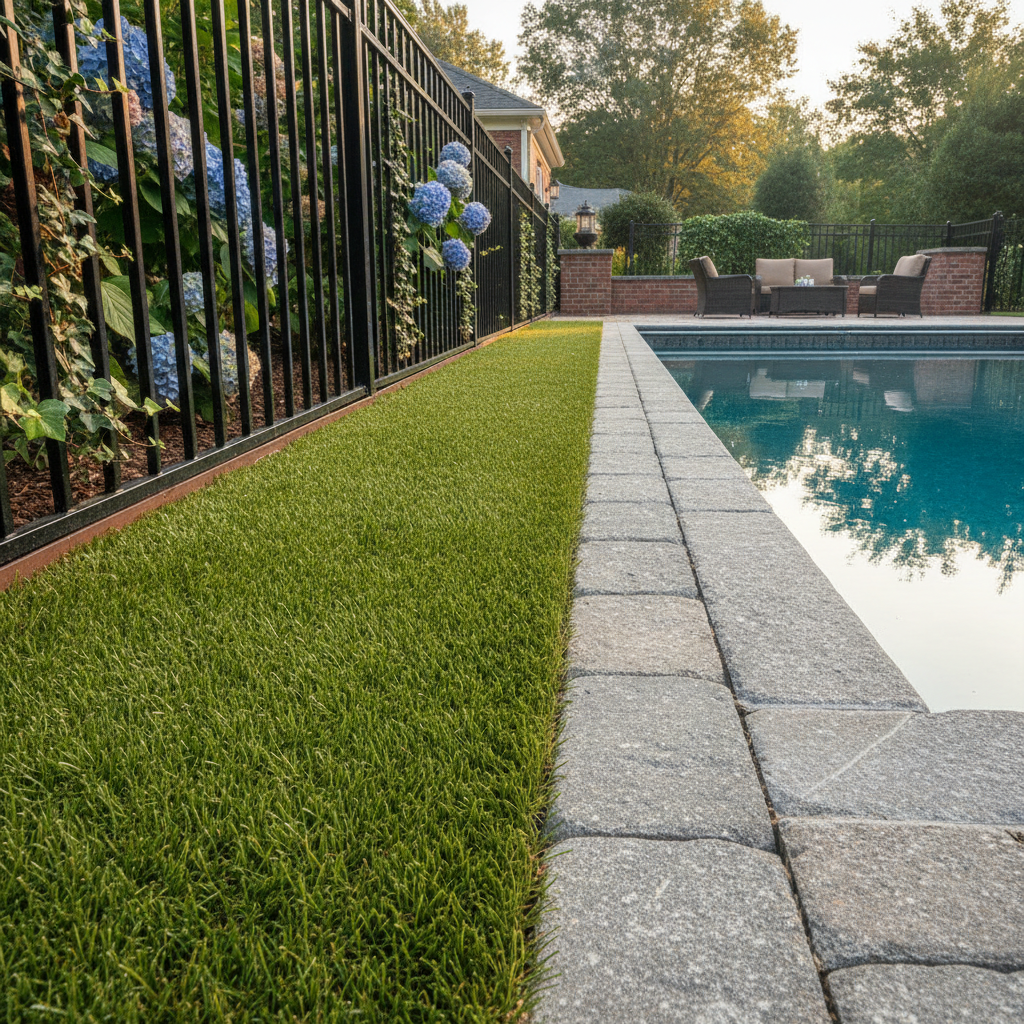
How Do You Install Artificial Turf Along a Fence Line or Property Edge in Burke, VA? What Homeowners Need to Know About Edge Finishing
If you’re planning to install artificial turf in your Burke, VA backyard, there’s one detail that separates a beautiful, long-lasting installation from one that starts curling, lifting, or growing weeds within a year — and it happens right at the edge. Finishing the perimeter along your fence line or property boundary correctly isn’t glamorous work, but it’s arguably the most critical part of the entire job. Get it right, and your turf stays flat, clean, and locked in place through Northern Virginia’s freeze-thaw winters and heavy spring rain seasons. Get it wrong, and you’ll be pulling up corners and fighting weed intrusion before you’ve even broken even on the investment.
Why Edge Finishing Is the Most Overlooked Part of Turf Installation
Most homeowners focus on the visible surface of their turf — the pile height, the color, how natural it looks from the back porch. That’s understandable. But if you spend time reading competitor content or watching installation videos online, you’ll notice that edge treatment is almost never addressed in detail. It gets a single vague sentence like “secure edges with nails” and then nothing. That’s a problem, because edge failure is one of the top reasons turf installations need premature repairs.
Along a fence line specifically, you’re dealing with a few compounding challenges: the soil right against a wood or vinyl fence is typically disturbed, compacted unevenly, or prone to moisture retention. Fence posts interrupt a straight edge. And in communities like Burke Centre or West Springfield, fences often sit close to neighbors, leaving almost no margin for error when cutting and securing the turf border.
The Two Main Edge Finishing Methods — and When to Use Each
Bender Board Edging
Bender board — a flexible, high-density composite or treated lumber board installed vertically into the ground along the turf perimeter — creates a solid, defined border that the turf rolls over and tacks into cleanly. It’s the preferred method when your fence line meets an open soil edge or a landscaping bed, because it creates a physical barrier between the turf and any adjacent dirt, mulch, or tree root zones. Good bender board installation means the board is set at the correct depth relative to your aggregate base, leaving no gap between the turf edge and the board face.
In Fairfax County, where clay-heavy soil is common and roots from established trees and shrubs can push and shift over time, bender board gives you a fighting chance against edge migration. Without it, the turf edge can slowly work loose as the ground moves through seasonal cycles.
Nail Strip and Galvanized Staple Edging
When your turf terminates against a hard surface — a concrete fence footer, a paver edge, a retaining wall — a nail strip system works better. Galvanized nails or staples are driven through the turf backing into the sub-base at close intervals (typically every 3–4 inches around the perimeter), and the edge is then trimmed cleanly and tucked or glued down. The key word here is galvanized. In the DMV’s humid summers and wet springs, standard steel nails rust out faster than you’d expect, and rusty fasteners mean loose edges. Any installer who doesn’t specify galvanized or stainless hardware along fence perimeters isn’t accounting for our regional climate.
What Good Fence-Line Base Prep Actually Looks Like
The edge is only as good as what’s under it. Before any turf rolls out, the base along a fence line needs specific attention:
- Excavation depth: Typically 3–4 inches, sometimes more if existing grass roots are deep. In Burke and Springfield, where yards see significant freeze-thaw cycling, a shallower base along the edge will heave and shift come February.
- Crushed aggregate compaction: Class II road base or decomposed granite, compacted to at least 95% density. Loose base near a fence edge is what causes that soft, spongy border feel after a year.
- Weed barrier fabric: A commercial-grade geotextile fabric below the aggregate, not landscape fabric from a hardware store. The latter degrades quickly and allows weed rhizomes to punch through from below — especially in Alexandria and Kings Park neighborhoods where established landscaping means aggressive root systems nearby.
- Drainage slope: The base along a fence line should slope slightly away from the fence structure — typically 1–2% grade — to push water toward the yard’s natural drainage path. Trapping water at the fence base accelerates wood rot, undermines fence post footings, and can saturate the infill layer of your turf over time.
For pet owners specifically, this drainage slope matters even more. If you’re installing pet-friendly turf in a fenced yard, you need water and liquid waste moving away from the perimeter, not pooling against the fence where it can concentrate odors and bacteria in the infill near the edges.
Fence Posts: The Interruption Nobody Plans For
Fence posts are a real complication that most installation guides completely ignore. If your fence has posts every 6–8 feet, each one breaks the straight edge of your perimeter and requires an individual cut and fit. Done poorly, those gaps around the post bases become entry points for weeds, allow the turf edge to fray over time, and look unfinished even from a distance.
The right approach is to cut the turf as close to each post as possible, apply a bead of polyurethane-based turf adhesive around the post base, and press the cut edge down firmly before the infill goes in. In some cases, a small amount of flexible sealant around the post contact point prevents weed intrusion without creating a rigid bond that cracks when the post shifts seasonally. This is the kind of detail that separates a crew with real local installation experience from a general landscaping company that added turf to their service menu last year.
HOA Considerations for Edge Visibility in Fairfax County
If you’re in an HOA-governed community — and a large portion of Burke, Fairfax, and the surrounding Fairfax County suburbs are — your perimeter treatment may actually be part of what gets reviewed during the architectural approval process. Some HOA architectural guidelines specify that turf edges must be finished with a border material that matches existing landscape hardscape, or that the turf cannot be installed flush against a fence in a way that’s visible from the street or common area.
Before you commit to a specific edging method, pull your HOA’s architectural guidelines and check whether they address turf borders specifically. If they don’t, that doesn’t mean approval is automatic — it means you may need to present your installation plan and describe the perimeter treatment in your application. An experienced local installer familiar with Fairfax County HOA processes can help you put together documentation that gets approved on the first submission rather than going back and forth for weeks. You can explore what goes into a full residential turf project at Grassify’s residential lawn turf page.
What to Ask Your Installer About Edge Finishing Before You Sign
Most homeowners never ask about this, and most installers don’t volunteer the information. Here are the questions worth asking directly:
- What edging system do you use along fence lines — bender board, nail strip, or a combination?
- Are your perimeter fasteners galvanized or stainless? (If they say “standard nails,” that’s a flag.)
- How do you handle fence post interruptions? Will I see gaps at the posts?
- What adhesive do you use at the perimeter edge, and is it UV and moisture resistant?
- How is the base graded along the fence line for drainage?
- Is the edge finishing covered under your installation warranty, and for how long?
At Grassify, all edge work is covered under a lifetime installation warranty on seams, edges, and base — because we know that’s where failures happen, and we want you to have recourse if anything shifts. Our crews are licensed, insured, and background-checked, and we’ve been navigating the specifics of Fairfax County soils, HOA requirements, and fence-line logistics for years.
Frequently Asked Questions About Fence-Line Turf Installation in Burke, VA
Can you install turf right up against a wood privacy fence without damaging it?
Yes, but it requires careful drainage planning. The turf edge should slope slightly away from the fence base, and the backing should not be glued directly to the wood. A properly installed bender board creates a small buffer that allows air circulation and prevents moisture from wicking into the fence boards.
What happens if the fence line isn’t perfectly straight?
Most fence lines have at least minor irregularities. A professional installer accounts for this during the cut phase, trimming the turf to follow the actual fence line rather than assuming a straight edge. The bender board, if used, is flexible enough to follow gentle curves. Sharp corners require mitered cuts and additional securing at the joint.
Will weeds grow up through the edge along my fence?
Not if the base is installed correctly with a quality geotextile barrier beneath the aggregate layer. Weeds along fence lines almost always indicate that the fabric was skipped, torn during installation, or overlapped without taping the seam — all common shortcuts in lower-cost installations. Airborne weed seeds can land on top of the turf surface, but they can’t establish root systems through a properly sealed backing.
How long does turf edge finishing take, and does it add to project cost?
Edge work is typically factored into the overall installation cost rather than billed separately. For a standard Burke backyard with a 6-foot privacy fence on two or three sides, perimeter finishing adds a few hours to the crew’s time. Projects with complex fence shapes, many posts, or existing hardscape borders may take longer. General installation pricing for residential turf in the Northern Virginia area typically runs $12–$25 per square foot depending on the application, materials, and site complexity.
Do I need to do anything special along a chain-link fence versus a wood fence?
Chain-link creates a different challenge — the bottom rail sits low to the ground, and the turf edge needs to tuck cleanly under or against it without leaving a visible gap. The approach usually involves trimming the turf backing precisely and securing it with nail strips at close intervals along the bottom rail footprint. Unlike wood fences, chain-link doesn’t trap moisture the same way, so drainage at the base is slightly less critical — but the edge still needs to be firmly secured to prevent lifting from foot traffic or pets running the fence line.
Ready to Get Your Turf Perimeter Done Right?
If you’re planning a turf project in Burke, VA — or anywhere in Fairfax County, Springfield, or Alexandria — and you want a perimeter that holds up for the long haul, we’d love to take a look at your space. Grassify offers free consultations with no sales pressure. We’ll walk your fence line, identify any drainage or access challenges, and give you a clear picture of what the installation will involve before you commit to anything.
Reach out to us at grassify.us/contact-us or call us directly at (609) 727-8635 to schedule your free on-site consultation. Edge finishing done right starts before the first roll of turf hits the ground — and we’re glad to show you exactly what that looks like.


