
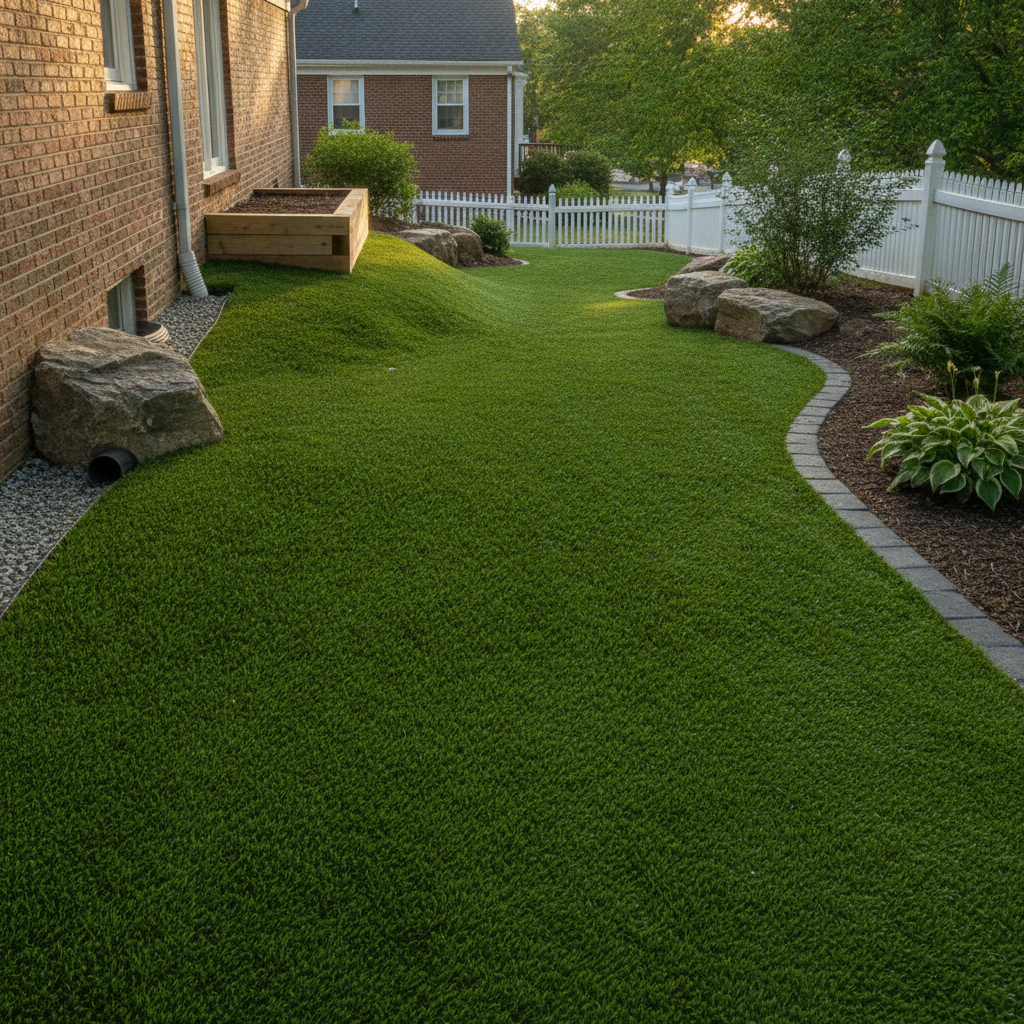
How Do You Install Artificial Turf on a Steep or Uneven Side Yard in Burke, VA? The short answer: carefully, with the right base prep, drainage routing, and edging strategy — because a side yard is not just a smaller version of a backyard install. It’s a different beast entirely, and most general landscapers and franchise turf crews treat it like a simple leftover space rather than one of the most technically demanding areas on a residential property.
If you live in Burke, VA — or anywhere across Fairfax County, from Burke Centre and Rolling Valley down into Sangster and West Springfield — you probably know exactly what we’re talking about. That corridor between your house and your fence line: three to six feet wide, full of compacted clay, a slight or not-so-slight grade dropping toward a neighbor’s yard or your foundation, and currently home to either dead sod, overgrown weeds, or a muddy strip that tracks dirt into your garage every time it rains. Nobody uses it. Nobody wants to deal with it. But it’s there, and in Northern Virginia’s wet spring seasons and humid summers, it becomes a genuine problem.
Installing synthetic grass in that corridor can solve it permanently — if it’s done right. Here’s what that actually looks like.
Why Side Yard Turf Installations Are More Technical Than They Look
On paper, a side yard sounds like an easy install. It’s small, it’s usually rectangular, and there’s no elaborate landscaping to work around. But in practice, these corridors concentrate almost every challenge in residential turf work into one tight space.
First, access. If your side yard gate opens to 36 inches and your neighbor’s fence is 48 inches from your house wall, large compactors, skid steers, and even wheelbarrows become difficult or impossible to maneuver. Base material — typically 3 to 4 inches of decomposed granite or crushed aggregate — has to be moved manually, spread by hand, and compacted with a plate compactor small enough to fit the corridor. That alone changes the labor math significantly compared to an open backyard install.
Second, grade. Side yards in Burke and the broader Fairfax County area are almost never flat. They slope — sometimes gently, sometimes aggressively — either toward the foundation, toward the street, or laterally toward a neighbor’s property line. That grade has to be read accurately before a single shovel goes into the ground. If your base isn’t graded correctly, you’re either directing water toward your foundation (a serious structural problem over time) or pooling it at a fence line where it has nowhere to go.
Third, drainage. This is where most inadequate side yard installations fail. A narrow corridor can become a drainage channel during heavy spring rain — which is common across the DMV from March through May. If the perforated sub-base isn’t designed to move water through and away from the corridor efficiently, you’ll end up with standing water under the turf, base erosion, and seam failures within a few seasons.
What Proper Base Prep Looks Like in a Tight Corridor
A well-executed side yard turf installation in Burke, VA starts well before the turf roll arrives. The base is everything — and it’s the part that most homeowners never see once the job is finished, which is exactly why some installers cut corners there.
Here’s what a legitimate base prep sequence looks like for a narrow side yard:
- Excavation to 3–4 inches: Existing soil, sod, and root material are removed to create a stable, clean substrate. In clay-heavy Fairfax County soils, this sometimes goes deeper if saturation is a recurring issue.
- Weed barrier installation: A commercial-grade geotextile fabric is laid flat to prevent organic material from migrating upward into the base over time.
- Crushed aggregate base layer: Typically 3 to 4 inches of Class II road base or decomposed granite is spread and compacted in lifts. In a tight corridor, this is done in passes with a smaller plate compactor to ensure even density along the full width.
- Grade verification: The base is checked with a level and adjusted before any turf is laid. Drainage should fall at a minimum 1–2% grade away from the foundation and toward an appropriate outlet — a drain, a pervious area, or the street.
- Perimeter bender board or nailer: A rigid edging system is secured along both sides of the corridor — typically aluminum bender board — to give the turf a clean, anchored edge that won’t shift or lift during Fairfax County’s freeze-thaw winter cycles.
If an installer skips any of these steps — or rushes the compaction phase because the space is small — you’ll see the consequences within 12 to 18 months: soft spots, rippling, edge lift, or drainage pooling. Our installation guide covers the full base prep process in detail if you want a deeper look before your consultation.
Drainage Engineering: The Step Most Competitors Skip
Here’s where the gap between a professional turf installer and a landscaper with a roll of fake grass becomes most obvious — and it’s a gap that most competitor sites in this market don’t address at all when they discuss narrow or side yard installs.
A side yard doesn’t just need turf that drains. It needs a drainage system that accounts for the volume of water moving through that corridor during a real DMV rainstorm. Northern Virginia regularly sees 1.5 to 2 inches of rain in a single storm event during spring, and that water has to go somewhere. In a narrow corridor flanked by a house wall on one side and a fence on the other, there are limited outlet options.
Depending on your site conditions, the right drainage solution might be:
- A perforated drain pipe running the length of the corridor, daylighting at the street or a lower yard area
- A French drain system integrated into the aggregate base layer
- A channel drain at the downhill terminus of the corridor, tied into an existing stormwater system
- A gravel percolation bed at the outlet end if the soil conditions and local code allow it
The turf itself — when properly specified — should drain at 30 inches per hour or more through its backing perforations. But the backing drainage rate is meaningless if the sub-base beneath it is saturated or has nowhere to move water. Both layers have to work together.
Turf Selection for a Side Yard: Pile Height, Durability, and Realism
Not every turf product is the right fit for a side yard. If the corridor gets foot traffic — people walking through to access a backyard gate, kids cutting through, dogs using it as a run — you need a product with a high face weight and a dense, resilient fiber that bounces back under repeated compression.
For most residential side yards in Burke and the surrounding Fairfax County area, we typically spec a turf in the 38mm–42mm pile height range with a face weight of 60 oz or higher. That gives you the visual density of a well-maintained lawn without the taller fibers that mat down quickly in a high-traffic linear path.
If your side yard also serves as a dog run or pet corridor, the calculus shifts. You’ll want a pet-friendly turf system with antimicrobial infill, a zeolite deodorizer layer, and drainage engineering capable of moving liquid at 400+ inches per hour — because concentrated pet use in a narrow corridor creates odor and sanitation problems that standard residential turf is not designed to handle.
HOA Considerations in Burke Centre and Rolling Valley
If you live in an HOA-governed neighborhood — which covers a significant portion of Burke, from Burke Centre to Rolling Valley and across into Sangster — side yard turf installations may require architectural review board (ARB) approval before work begins. The specific requirements vary by community, but common HOA conditions include:
- Turf must be installed to a minimum 40mm pile height to meet visual standards
- Color must fall within a defined green spectrum (no lime or blue-toned products)
- Installation must be completed by a licensed contractor, not DIY
- Edging must be concealed or finished flush with adjacent hardscape
Working with a local installer who has navigated Fairfax County HOA approvals before is a material advantage here. We’ve helped homeowners across Burke, West Springfield, and Fairfax prepare the documentation, product specs, and site plans that ARBs typically request — and we know which product specifications are most likely to pass review on the first submission.
What Does a Side Yard Turf Installation Cost in Burke, VA?
Side yard projects are typically priced per square foot like any other turf install, but the labor component tends to run higher per square foot than an open backyard job because of the access limitations and precision work required in tight spaces. Depending on the scope, drainage complexity, and product selection, residential turf projects in this region generally range from $12 to $25 per square foot installed. Side yards with drainage infrastructure on the higher end of that range are common, particularly where a perforated drain line or channel drain is part of the system design.
The square footage may be small, but the labor, materials, and engineering required to do it correctly are not proportionally reduced. A 60-square-foot side yard done right still requires the same excavation, base work, drainage routing, and edge finishing as a much larger space — it just gets done in a narrower window with more restricted movement.
Frequently Asked Questions: Side Yard Turf in Burke, VA
Can artificial turf be installed in a side yard that only gets partial or no sunlight?
Yes — synthetic grass doesn’t need sunlight to maintain its appearance or structural integrity. In shaded side corridors, UV-stabilized fibers remain colorfast without photosynthesis. The bigger concern in shaded areas is moisture retention under the turf, which makes proper drainage engineering even more important.
How do you keep the turf from shifting or lifting in a narrow corridor over time?
Proper perimeter anchoring is the key. We use aluminum bender board or a nailer board system secured at both edges of the corridor, with the turf face-nailed or stapled into it at regular intervals. This holds the turf flat against Fairfax County’s freeze-thaw cycle without edge lift or bubble formation.
Will my HOA require approval for a side yard turf install in Burke Centre?
Likely yes, if your community has an active architectural review board. Burke Centre and many surrounding communities in Fairfax County require ARB approval for any visible landscape modification, including synthetic grass. We can help you prepare the application and product documentation before work begins.
Does artificial turf in a side yard increase property value?
In most cases, yes — particularly for a side yard that was previously an unusable muddy corridor. Buyers respond positively to zero-maintenance outdoor spaces that are clean, functional, and professionally finished. The ROI is strongest when the install quality is high and the product spec matches the broader aesthetic of the home.
How long does a side yard turf installation typically take?
Most residential side yard projects in Burke complete in one to two days. Larger corridors with drainage infrastructure added to the scope may run two to three days depending on site conditions and access logistics. You’ll get a specific timeline estimate during your on-site consultation.
Ready to Finally Fix That Side Yard?
If you’ve been walking past that muddy, overgrown side corridor for another season and telling yourself you’ll deal with it eventually — this is the year to deal with it. A properly installed synthetic grass system in your side yard eliminates the mud, the maintenance, and the wasted space for good, and it holds up through DMV winters, wet springs, and everything in between.
Grassify serves Burke, Springfield, Fairfax, and communities across Fairfax County with licensed, insured crews and a lifetime warranty on seams, edges, and base work. Request a free consultation and we’ll come out, walk the corridor with you, and give you a straight assessment of what the right installation looks like for your specific site — no pressure, no upselling, just honest local expertise.


