
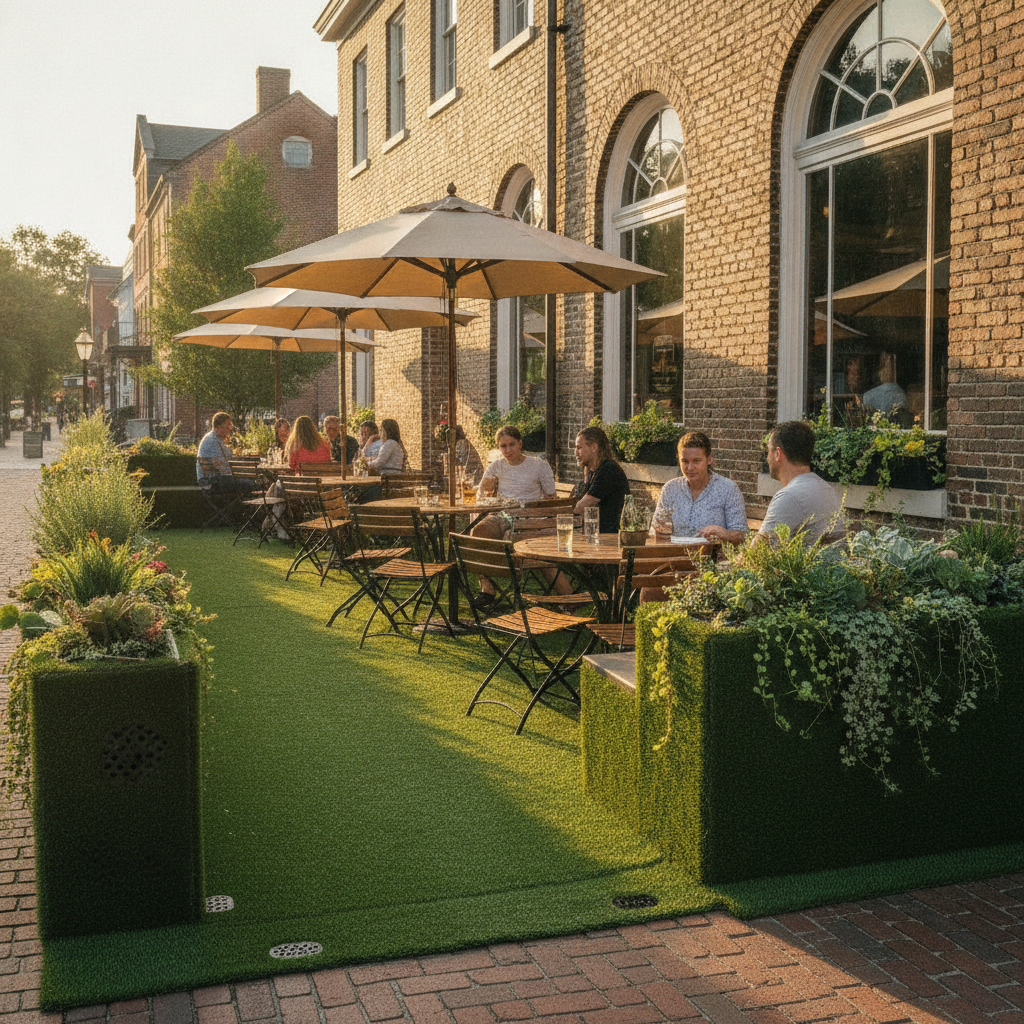
How Do You Choose Artificial Turf for a High-Traffic Retail or Restaurant Outdoor Space in Alexandria, VA? If you own or manage a restaurant, brewery, boutique shop, or street-level retail space in Alexandria — especially in areas like Old Town, Del Ray, or along the Route 1 corridor — you’ve probably watched the foot traffic outside your storefront and wondered whether synthetic grass could make your outdoor space work harder for your brand. The short answer is yes, it absolutely can. But commercial turf for customer-facing environments is a fundamentally different product from what you’d install in a backyard. The pile weight, drainage capacity, fiber chemistry, and subbase engineering all need to be spec’d for real-world business use — not just aesthetic appeal. Here’s what you need to know before signing anything.
Why Restaurants and Retail Shops in Alexandria Are Turning to Artificial Turf
The appeal is straightforward. Natural grass in an outdoor dining area or retail entrance is essentially a liability: it turns to mud after Alexandria’s heavy spring rains, dies under foot traffic within a season, and demands irrigation, fertilization, and weekly maintenance that most business owners simply don’t have time to manage. Artificial turf eliminates all of that while delivering a consistent, polished look that photographs well, holds up under patio furniture, and stays green whether you’re hosting a Saturday lunch rush or a weekday private event.
Across the DMV area — from Old Town Alexandria to Pentagon City in Arlington to the emerging dining corridors in Fairfax — commercial property owners are also recognizing that well-installed turf raises perceived property value and can be a genuine differentiator when customers are choosing between venues. A well-designed outdoor space with clean, lush-looking turf signals that your business sweats the details.
Commercial Turf vs. Residential Turf: The Specs That Actually Matter
This is the section that most competitors in the Northern Virginia market gloss over — and it’s exactly where business owners get burned by generic installers who treat a restaurant patio the same way they’d treat a suburban backyard.
For a high-traffic commercial application, you need turf engineered for the job. Here’s what that actually means in technical terms:
- Pile weight and density: Residential turf typically runs 40–60 oz face weight. For a restaurant patio or retail entrance with daily foot traffic, chair dragging, and outdoor furniture, you want 70–90 oz face weight minimum. Lower-density turf will mat down and show wear lanes within a year of commercial use.
- Fiber type: Nylon fibers outperform polyethylene in high-abrasion environments. If the space will see rolling carts, heavy planters, or stacked furniture, nylon’s superior tensile strength is worth the additional cost per square foot.
- Drainage rate: This is non-negotiable in Alexandria. The city gets an average of 40+ inches of rain per year, with significant volume concentrated in spring and summer. A commercial turf system for an outdoor dining area needs a drainage rate of at least 30 inches per hour through the backing — and the subbase aggregate underneath needs to be graded correctly so water moves away from the building foundation and toward existing drainage channels.
- UV stabilization: Cheap imported turf fades and becomes brittle within two to three years under direct sun. Quality commercial turf uses UV-inhibited polyethylene or nylon fibers that hold color for 15+ years under normal conditions.
- Heat mitigation: This one surprises business owners. Synthetic grass in direct sun can reach surface temperatures 30–50°F above ambient air temperature on a hot July afternoon. For a restaurant patio where barefoot guests or children might be present, you should ask your installer specifically about heat-mitigation fiber technologies or infill options that reduce surface temperature. Some products incorporate heat-reflective coatings; others rely on evaporative cooling infill systems.
The Subbase Problem: Why This Is Where Cheap Installs Fail
Most of the horror stories you’ll hear about commercial turf installations — bubbling seams, water pooling, turf lifting at the edges — trace back to the subbase, not the turf itself. In Alexandria and across Northern Virginia, freeze-thaw cycles during winter put enormous stress on any compacted base layer. If the installer skimped on base depth, used the wrong aggregate, or failed to account for the site’s existing drainage, you’re looking at base heaving by March and seam failure by the following summer.
A properly engineered commercial subbase for a restaurant patio or retail space typically involves removing 3–4 inches of existing material, installing a weed barrier membrane, compacting a crushed aggregate base (Class II road base or decomposed granite), and verifying grade toward existing drains before the turf ever touches the ground. This isn’t optional — it’s the difference between a 10-year installation and a 3-year replacement.
At Grassify, every commercial installation starts with a site assessment that maps existing drainage, evaluates load-bearing requirements (do you have heavy planters or outdoor furniture anchors?), and builds the base spec before any product gets selected. You can review our full approach on the Grassify installation guide.
Permits, Zoning, and Landlord Approval in Alexandria
This is another area competitors rarely address — and it catches business owners off guard. If you’re a commercial tenant (which most restaurant and retail operators are), you need written approval from your landlord before any exterior modification, including turf installation. Many commercial leases in Alexandria explicitly require this for anything that alters the grade, drainage, or appearance of the property.
Beyond the lease, the City of Alexandria may require a permit for certain exterior modifications depending on the scope of work and whether the space abuts public sidewalk or right-of-way. If your outdoor dining area is a licensed sidewalk café, there may be additional requirements from the city’s Department of Planning and Zoning. Your turf installer should be able to advise you on what’s typically required — and they should be licensed and insured to work on commercial properties in Virginia.
In neighboring Arlington, similar rules apply along the Clarendon and Columbia Pike corridors where outdoor dining has expanded significantly in recent years. If you operate in multiple DMV locations, the permitting landscape varies by jurisdiction and you want an installer who knows the difference.
What Commercial Turf Actually Costs for a Restaurant or Retail Space
Expect commercial-grade turf installation to run $15–$25 per square foot for most outdoor dining or retail entrance applications in the Alexandria market, depending on base conditions, accessibility, drainage complexity, and product spec. That’s a wider range than residential installs because commercial sites vary enormously — a flat, well-drained patio with simple geometry costs considerably less to install than a terraced outdoor space with multiple drain points, furniture anchor plates, and an aggressive layout cut around HVAC equipment or structural columns.
That said, the ROI math for most business owners works out quickly. Eliminate your sod maintenance contract, your irrigation costs, your spring re-seeding, and your mud-season cleanup — and a 500 square foot commercial turf installation often pays for itself inside three to four years. For properties where the outdoor space drives meaningful revenue (private events, expanded seating capacity, branding impact), the payback window is even shorter.
For businesses looking at outdoor commercial turf options, Grassify offers free site assessments with no obligation — which is the right starting point before you budget anything.
What to Ask Before Hiring a Commercial Turf Installer in Alexandria
Not every company that installs backyard turf in Burke or Fairfax is equipped to handle a commercial project with real foot traffic, landlord coordination, and permit requirements. Before you sign a contract, ask these specific questions:
- What is the face weight and fiber composition of the turf you’re proposing for this application?
- What is the drainage rate through the backing, and how are you engineering the subbase to move water off the site?
- Are you licensed and insured for commercial work in Virginia?
- What does your warranty cover — turf product, installation workmanship, base, and seams — and for how long?
- Have you worked on commercial restaurant or retail projects in Alexandria or the broader DMV area? Can you provide references?
- Will you assist with permit coordination or landlord documentation if required?
An installer who can’t answer these clearly — or who tries to redirect to residential portfolio work when you ask for commercial references — isn’t the right partner for a customer-facing business installation.
Frequently Asked Questions: Commercial Turf for Restaurants and Retail in Alexandria, VA
Can artificial turf hold up under outdoor patio furniture and heavy planters?
Yes — with the right product spec. High-density commercial turf with nylon or heavy-weight polyethylene fibers handles static loads from furniture and planters well. The key is making sure the subbase underneath is properly compacted so heavy furniture doesn’t create depressions over time. For very heavy loads, your installer may recommend furniture anchor plates or base reinforcement in specific zones.
Will the turf get too hot for customers on a summer afternoon in Alexandria?
It can, depending on sun exposure and product choice. Standard synthetic grass in direct sun can reach surface temperatures significantly above air temperature on a hot DMV summer day. If your space has significant sun exposure and you expect guests to be barefoot or seated close to the surface, ask your installer specifically about heat-mitigating fiber coatings or cooling infill options. Shaded areas are generally not a concern.
How do I keep the turf clean with food and drink spills from outdoor dining?
Commercial-grade turf is surprisingly easy to clean. Most food and beverage spills rinse away with water, and the turf dries quickly due to its permeable backing. For heavier spills, mild soap and a stiff brush handle the job. The bigger concern is grease — if your outdoor space is adjacent to a kitchen exhaust or grill station, make sure your installer accounts for that in the product selection and considers an antimicrobial infill.
Do I need a permit to install turf on my restaurant patio in Alexandria?
It depends on the scope of work and whether the installation involves grading changes, proximity to public sidewalk, or structural modifications. As a tenant, you’ll almost certainly need written landlord approval first. Your turf installer should be familiar with local commercial requirements and able to advise you on what’s needed for your specific site.
How long does a commercial turf installation typically take?
Most outdoor restaurant patio or retail entrance installations in the 300–1,000 square foot range can be completed in one to two days, depending on site prep complexity. If base excavation, drainage work, or custom cutting around fixed obstacles is involved, budget for two to three days. A good installer will give you a realistic timeline upfront so you can minimize disruption to business operations.
Ready to Turn Your Outdoor Space Into a Business Asset?
At Grassify, we’ve been installing commercial and residential turf across the DMV — Alexandria, Burke, Arlington, Fairfax, Washington D.C., and beyond — for over a decade. We know the drainage requirements, the freeze-thaw realities of Northern Virginia winters, the permit landscape in Alexandria, and the product specs that actually hold up under daily commercial use. Every project starts with a free, no-obligation site assessment so you know exactly what you’re getting before any money changes hands.
If you’re ready to stop managing mud, irrigation repairs, and dead grass — and start using your outdoor space to drive real business results — contact Grassify today and request your free consultation. We’ll come to your site, evaluate your space, and give you a straight answer on what’s possible.


