
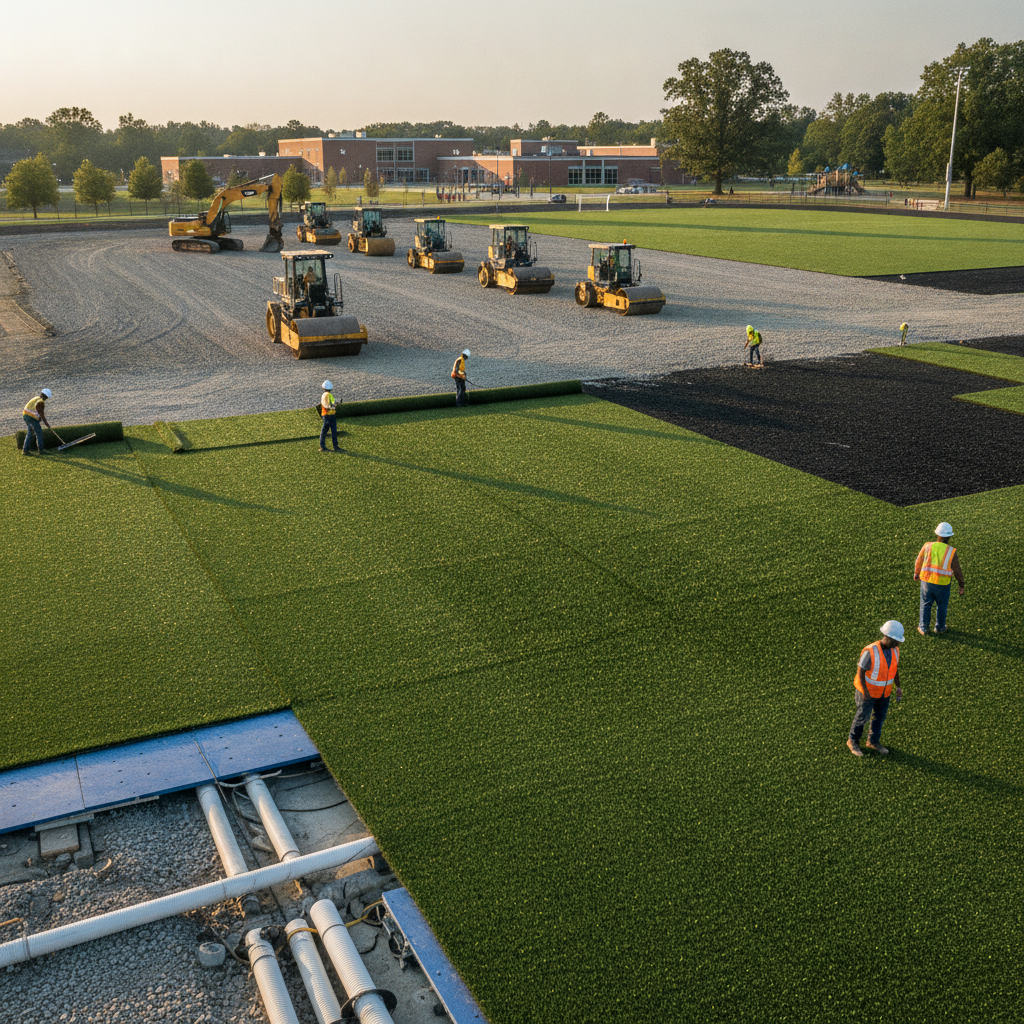
How Do You Install Artificial Turf on a School Athletic Field or Shared Recreational Space in Waldorf, MD? If you manage a school, community recreation center, or multi-use athletic complex in Waldorf, the short answer is this: it takes significantly more planning, more engineering, and more product specification than a residential backyard install — and the stakes for getting it wrong are much higher. A poorly built field that fails drainage tests or doesn’t meet fall-height certification standards isn’t just a wasted investment; it’s a liability. Here’s what administrators, facilities directors, and community organization leaders in Charles County actually need to know before signing a contract.
Why School Athletic Fields Are a Different Category Entirely
Most of the artificial turf content you’ll find online — from competitors and national franchise sites alike — focuses on residential lawns and pet runs. When those same providers pivot to schools and athletic spaces, they often recycle the same general language without addressing the specifics that matter most to public institutions and community organizations.
School athletic fields have to meet two separate safety certification standards: CPSC (Consumer Product Safety Commission) guidelines for surface impact, and IPEMA (International Play Equipment Manufacturers Association) certification, which independently verifies that the turf system achieves the critical fall height rating specified for the application. If a child falls on a field with turf that wasn’t installed to these standards, you have a real problem — both physically and legally.
IPEMA certification isn’t something a contractor can claim verbally. It has to be backed by third-party test documentation for the specific turf product and infill combination you’re using, at the specific pile height and compaction rate being installed. Any contractor bidding on your project who can’t hand you that paperwork upfront is a contractor you should walk away from.
Base Preparation on a Large-Scale Field: What’s Actually Required
On a residential install, base prep typically means excavating 3–4 inches, compacting a crushed aggregate sub-base, and installing a weed barrier. On a school athletic field or shared recreational space, that framework scales up dramatically — and the margin for error shrinks.
Large fields in Waldorf and the broader Charles County area deal with the same heavy spring rainfall patterns that affect the rest of the DMV corridor. A field that holds water isn’t just unusable — it’s a standing safety hazard that breeds turf damage and accelerates infill displacement. Proper drainage engineering on a full-size athletic field means grading the sub-base to a minimum 1–2% cross-slope, installing a perforated drainage aggregate layer, and in many cases running perforated drain lines to a daylight outlet or storm system connection.
The base itself typically requires a minimum 4-inch compacted Class II aggregate base, but depending on your soil composition — and Maryland’s clay-heavy soils are notorious for poor percolation — you may need to go deeper. If the native soil beneath the field has standing water issues, a geotextile separation fabric placed between native soil and aggregate is non-negotiable. Skipping it allows fine particles to migrate upward over time, clogging the drainage layer and causing localized soft spots that compromise both safety and playability.
Choosing the Right Turf System for Multi-Use Athletic Spaces
Not all turf products are built for the demands of an athletic field that sees hundreds of students per day. The key variables to evaluate when specifying turf for a school or community recreational space include pile height, fiber denier, backing weight, and infill type.
- Pile height: Athletic fields typically use turf in the 40mm–55mm range depending on the sport. Multi-use surfaces that accommodate soccer, flag football, and general PE tend to perform best at 45mm–50mm with a dense stitch rate.
- Fiber type: Polyethylene fibers offer the best combination of durability and player comfort. Polypropylene fibers are cheaper but wear faster under high-traffic conditions and can become abrasive over time — a serious concern when you have children running and falling on the surface daily.
- Infill system: Crumb rubber (SBR) has been a subject of ongoing health scrutiny in school settings. Many Charles County schools and organizations are now specifying cleaner alternatives like TPE (thermoplastic elastomer) or sand/organic hybrid infills that deliver comparable shock absorption without the composition concerns. For pure safety certification, the infill depth and compaction must match what was used in the IPEMA test.
- Backing: Look for a double-layer reinforced backing with drainage perforations rated for high-traffic applications. Backing failure — delamination, tearing at seams, or fiber loss — is the most common long-term failure mode on poorly specified commercial fields.
For schools and community organizations that want a surface that holds up under sustained use, Grassify’s outdoor sports turf systems are engineered specifically for multi-use athletic applications, with certified backing options and infill systems that meet current school safety standards.
The Seaming Problem Nobody Talks About on Large Fields
This is the content gap that most competitor sites gloss over entirely: seam management on large athletic fields is one of the highest-risk failure points in the entire installation. On a 10,000 square foot field, you’re going to have multiple seam runs. Each one needs to be bonded correctly — typically with a 6-inch seaming tape and a two-part polyurethane adhesive — and oriented so that the pile direction runs consistently across the full playing surface.
Seams that are rushed, bonded in cold or wet conditions, or placed across high-traffic zones like goal mouths and center circles will start to lift within 12–18 months. Once a seam lifts on an athletic field, it creates a tripping hazard, allows infill to migrate out, and accelerates turf wear at the edges. Proper seam placement is a planning decision made during the design phase, not an afterthought on installation day.
At Grassify, every installation comes with a lifetime warranty on seams, edges, and base integrity. For a school or community organization making a capital investment in this scale, that warranty language matters — and you should ask every contractor you’re considering whether their warranty explicitly covers seam failure on large-format fields.
Shared-Use Fields: Coordinating Access, Downtime, and Long-Term Maintenance
Schools and community recreational spaces in Waldorf often operate on tight scheduling — athletics in the afternoon, community leagues in the evenings, event rentals on weekends. That means installation scheduling has to account for realistic field downtime. A proper large-field installation typically takes 5–10 business days depending on square footage, site conditions, and weather. Trying to compress that timeline to avoid interrupting spring programming is one of the most common reasons large-field installs go sideways.
Post-installation, synthetic athletic fields need regular grooming — typically monthly during heavy use seasons — to redistribute infill, keep fibers standing upright, and clear debris that accumulates at the perimeter. Budgeting for annual professional maintenance is part of responsible ownership. The good news: you’re eliminating irrigation costs, fertilizer, pesticide applications, overseeding, and the ongoing labor that a natural grass field demands. For most schools and organizations, the total cost of ownership on a well-built synthetic field is significantly lower over a 10–15 year lifespan.
If your project also involves adjacent playground or recreation zones, Grassify’s playground turf systems can be integrated into the same installation plan, keeping the safety certification, drainage design, and base engineering consistent across the entire site.
Frequently Asked Questions: School Athletic Field Turf in Waldorf, MD
Does our school need to get county approval before installing artificial turf on an athletic field?
In most cases, yes. Charles County Public Schools and municipal recreational organizations will typically need to go through a capital project approval process, which may involve facilities department review, environmental compliance (especially for stormwater management), and potentially a school board or parks authority vote. Grassify can provide project documentation, product spec sheets, and certification paperwork to support your approval process.
What’s the realistic cost range for a school athletic field turf installation?
Large-scale athletic field installations generally run $12–$22 per square foot installed, depending on turf product grade, infill specification, drainage requirements, and site prep complexity. A full-size soccer field or multi-purpose athletic space in the 40,000–80,000 square foot range will be a significant capital investment — but it replaces ongoing natural grass maintenance costs and delivers a consistent, safe playing surface year-round. Contact Grassify for a site-specific assessment and quote.
Can an artificial turf athletic field handle heavy Maryland rainfall without flooding?
A properly engineered synthetic turf field should drain at a rate of 30 or more inches per hour through the turf face alone, far exceeding anything Maryland’s spring rain events produce. The critical factor is whether the sub-base drainage system beneath the field can move that water to an outlet fast enough. That’s the engineering conversation you need to have before installation begins — not after the field is down.
How long does a commercial athletic field turf system last?
Most quality athletic field turf systems have a product lifespan of 10–15 years under normal use conditions, with some manufacturers offering 8–10 year product warranties on fiber and backing integrity. Proper installation and annual maintenance can push that lifespan toward the higher end. Base prep and drainage infrastructure, done correctly, can outlast multiple turf generations.
What’s the difference between CPSC and IPEMA certification, and do we need both?
CPSC sets the federal guidelines for safe playground and athletic surface impact attenuation. IPEMA is the third-party certification body that independently tests and verifies that a specific turf system meets those guidelines at a specified fall height. For school and community athletic fields, you want both — CPSC compliance tells you the standard, IPEMA certification proves the product actually meets it. Any turf contractor working on a school project should be able to provide current IPEMA documentation for the exact product they’re installing.
Ready to Plan Your Waldorf Athletic Field or Recreational Space?
Grassify serves schools, community organizations, and commercial clients across Charles County, Fairfax County, Washington, D.C., and the full DMV corridor. Our crews are licensed, insured, and background-checked — a requirement for any contractor working on school or youth-serving property. We bring 12+ years of regional installation experience, full CPSC/IPEMA-compliant product options, and a lifetime installation warranty that covers seams, edges, and base integrity.
If you’re in the early planning stages or ready to get a formal project assessment, we’d welcome the conversation. Request a free consultation with Grassify and let’s talk through what your field actually needs — from soil conditions and drainage design to turf product selection and installation timeline.


