
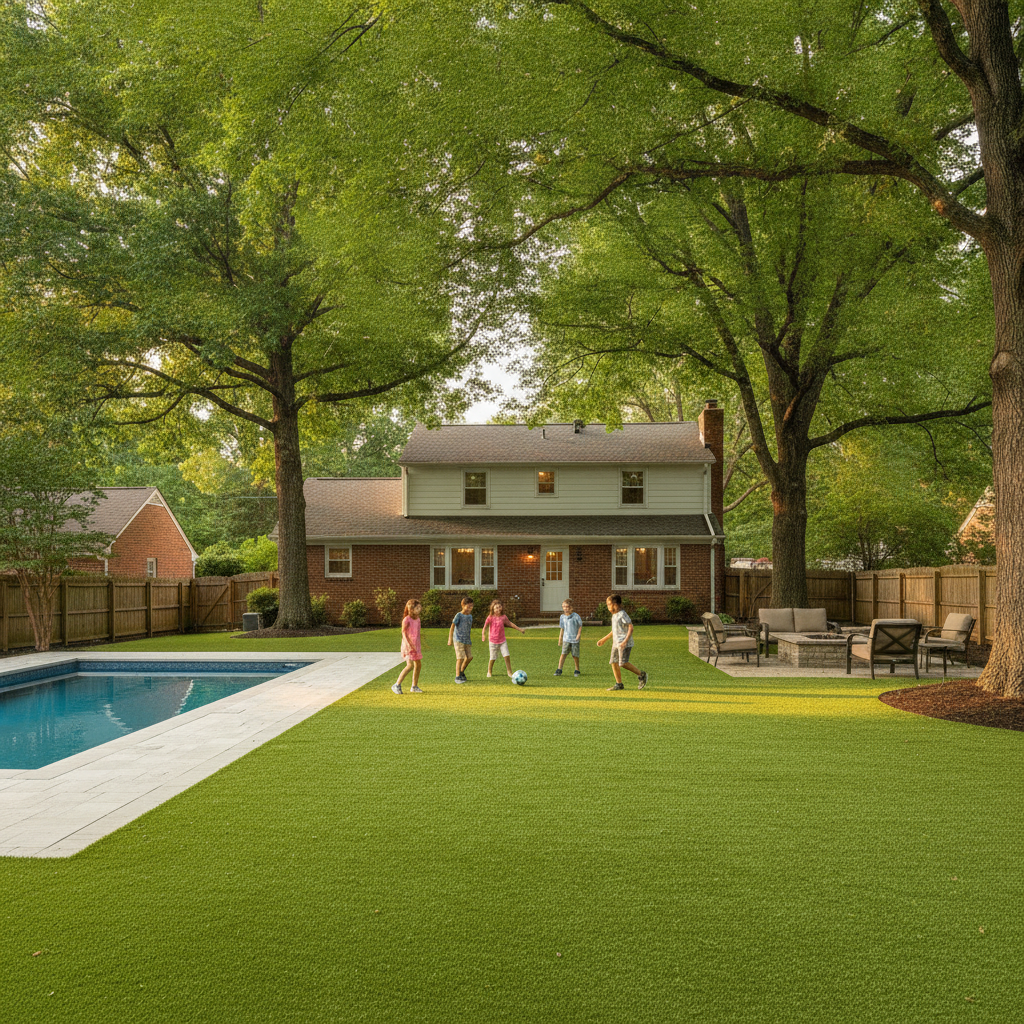
Can You Install Artificial Turf in a Shaded Backyard in Burke, VA? What Homeowners Need to Know
Yes — and in many ways, a shaded backyard in Burke, VA is exactly where artificial turf makes the most sense. If you’ve been fighting a losing battle against patchy, muddy, moss-covered grass under a canopy of mature oaks or red maples, you already know the problem: shade doesn’t give natural grass enough light to recover from foot traffic, pet activity, or even a routine backyard gathering. Artificial turf doesn’t need sunlight to stay green. But installing it correctly under trees and in heavily shaded spaces requires a different set of decisions than a standard sunny lawn installation — and that’s where a lot of homeowners (and some installers) get it wrong.
Why Shaded Yards in Northern Virginia Are Particularly Tough on Natural Grass
Northern Virginia’s mature tree canopy is one of its defining characteristics. In established neighborhoods across Burke Centre, Rolling Valley, and Kings Park, you’ll find backyards shaded for six to eight hours a day or more by tall hardwoods that have been growing for decades. That shade, combined with the DMV’s humid summers and heavy spring rainfall, creates conditions where even shade-tolerant grass varieties struggle to establish and maintain density. You end up with bare dirt paths, mud after every rain, and a lawn that looks worse every season no matter how much you seed, fertilize, or water it.
The core problem isn’t just sunlight — it’s competition. Tree roots and turf grass fight for the same moisture and nutrients in the top few inches of soil. The tree almost always wins. Add in the fact that shaded areas in Fairfax County tend to stay damp longer after rain, which promotes moss and fungal growth, and you have a surface that’s genuinely difficult to keep looking decent with natural grass.
Artificial turf sidesteps all of that. It doesn’t compete with tree roots. It doesn’t need photosynthesis. And installed correctly, it stays visually consistent year-round regardless of how much sun hits it.
What’s Actually Different About Installing Turf in a Shaded Area
This is the part most competitors gloss over, and it’s the most important thing to understand before you commit to an installation. Shaded yards have specific challenges that affect base preparation, drainage design, and product selection. Here’s what matters:
Root Zone Management
Before any turf goes down, the existing organic layer — soil, roots, moss, decomposing leaves — has to be addressed. In heavily shaded areas, that organic layer is often thicker and wetter than in open sun zones. A proper excavation goes down at least 3 to 4 inches to remove it entirely. If surface roots from nearby trees are present, they need to be assessed. Cutting them carelessly can damage the tree; leaving large roots unaddressed creates an uneven base that will telegraph through the turf within a season or two. An experienced installer knows how to grade around root structures without compromising either the turf surface or the tree’s health.
What you don’t want is an installer who skips this step or does a shallow excavation to save time. In a shaded yard where organic material decomposes slowly and moisture sits longer, a compromised base will become a drainage and odor problem within a year.
Drainage Design in Shaded, Low-Evaporation Zones
Shaded areas don’t dry out as fast as sunny ones. That means drainage isn’t just a nice-to-have — it’s the engineering centerpiece of a shaded turf installation. A well-built base uses crushed angular aggregate (typically a compacted crushed stone layer over a weed barrier fabric) with drainage channels oriented to move water away from the yard efficiently. In areas like Springfield or Burke where clay soil is common in Fairfax County, a perforated drain line may be needed to prevent subsurface saturation.
The turf product itself should have a perforated or hole-punched backing with drainage rates capable of handling Northern Virginia’s spring storms — we’re talking 400 or more inches per hour through the turf face. That spec matters more in shaded installations than almost anywhere else.
Choosing the Right Turf Product for Low-Light Areas
Not every turf product is equally suited for shaded installations. In a sun-exposed yard, UV exposure is actually what tests fiber durability — UV-stabilized polyethylene fibers are designed specifically to resist that. In a shaded yard, UV degradation is less of a concern, but moisture retention and pile resilience become more important. You want a turf with good drainage backing, a fiber blend that resists matting from foot traffic and leaf debris, and a pile height in the 35mm to 40mm range — dense enough to look natural and stand up over time, but not so long that debris accumulates and creates maintenance headaches under tree canopies.
For most residential shaded backyards in the Burke area, a quality residential lawn turf with a polyethylene or nylon-blend fiber works well. The key is pairing the right product with the right base — one doesn’t work without the other.
What About Leaves and Tree Debris?
This is a question that comes up constantly from homeowners in wooded neighborhoods like Longwood Knolls and Cherry Run, and it’s one that almost no competitor addresses directly. Yes, leaves will fall on artificial turf. No, it’s not a disaster. Artificial turf actually makes leaf cleanup easier than natural grass because leaves sit on top of the surface rather than embedding in thatch. A leaf blower or a flexible rake clears most debris in minutes without damaging the fibers.
Where debris management does matter is in the perimeter and drainage zones. If leaves accumulate heavily at the edges of your turf installation and are left for extended periods, they can slow drainage and create localized organic buildup. A quick periodic rake-out around the edges — especially in autumn — keeps everything functioning properly. This is a manageable maintenance ask compared to raking, reseeding, and fighting mud every spring on natural grass.
Will Turf Look Good in Shade All Year?
Yes, and this is actually one of the underappreciated advantages of turf in a shaded Northern Virginia yard. Natural grass in shade looks its worst in late summer and early fall when heat stress compounds sun deprivation. Artificial turf looks exactly the same in August as it does in April. The color consistency — particularly with UV-stable fibers — holds through Fairfax County’s full seasonal range, from humid July afternoons to January freeze-thaw cycles. Properly installed seams and a well-compacted base hold up through winter ground movement in ways that cut-rate installations simply don’t.
For homeowners whose shaded yard backs up to a fence line or borders common HOA-managed green space, that visual consistency year-round is a significant quality-of-life improvement. It also eliminates the mud and erosion issues that plague shaded slopes — a common scenario in hilly parts of Burke and across Fairfax County.
Frequently Asked Questions About Turf in Shaded Yards
Will tree roots damage artificial turf after installation?
Surface roots that are properly graded around during installation won’t damage the turf. However, if large roots continue to grow and lift the base over time, you may see minor surface irregularities years down the line. An experienced installer will assess root proximity and either adjust the base depth or create a slight buffer to allow for this. It’s a solvable engineering problem, not a reason to avoid turf under trees.
Does artificial turf get moldy or mildewy in a shaded, damp yard?
Not when it’s installed with proper drainage and the correct base materials. Mold and mildew on turf are almost always caused by trapped organic material or inadequate drainage — both of which are installation quality problems, not product problems. Antimicrobial infill options are available for added protection in especially damp or pet-heavy applications.
How much does turf installation typically cost in a shaded backyard?
Shaded installations often cost slightly more than a standard open-lawn install because of the additional base prep involved — excavating around roots, managing drainage, and ensuring proper compaction on organic-rich soil. Expect a range of roughly $12 to $20 per square foot for a residential shaded yard installation, depending on yard size, access, and base complexity. Getting a site-specific quote is the only way to get an accurate number.
Does my HOA in Burke or Fairfax County need to approve this?
Many HOA-governed communities in Burke Centre, Signal Hill, and similar neighborhoods require an Architectural Review Committee (ARC) approval before any turf installation. Requirements vary by community. Grassify is familiar with the approval process for dozens of HOAs across Fairfax County and can help you understand what documentation and material specs are typically required.
Can you install pet turf in a shaded yard?
Absolutely. Pet-friendly turf systems with 5-layer drainage and zeolite deodorizer layers are fully compatible with shaded installations. In fact, shaded pet zones benefit especially from high-drainage systems because the lower evaporation rate in shade means liquids need an engineered path out rather than relying on sun exposure to help.
Ready to Fix That Shady Patch for Good?
If your Burke, VA backyard has been a muddy, patchy mess for years because of shade, you’ve probably already tried the “add more seed” solution more than once. Artificial turf is the permanent answer — but only when it’s installed by a crew that understands the specific demands of shaded environments. Grassify has been solving exactly these kinds of installation challenges across Northern Virginia for over a decade, and we’d rather spend 30 minutes walking your yard with you than hand you a generic quote over the phone.
Contact us at grassify.us/contact-us to schedule your free consultation. We’ll assess your shade conditions, soil type, root situation, and HOA requirements — and give you a straight answer about what the right installation looks like for your specific yard.


