
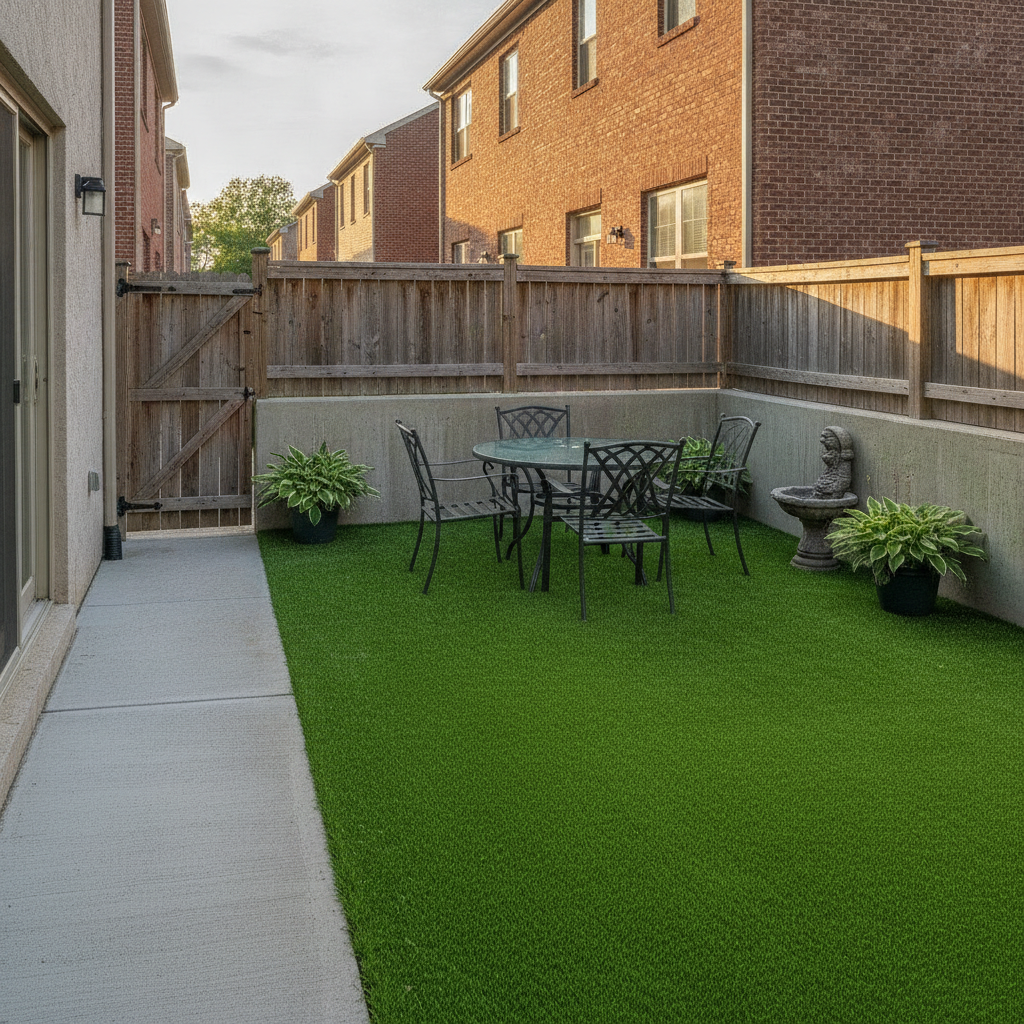
How Do You Install Artificial Turf on a Townhome Patio or Courtyard in Springfield, VA? What Residents Need to Know
Yes, you can absolutely install artificial turf on a townhome patio or enclosed courtyard in Springfield, VA — but it is not a one-size-fits-all process, and several factors specific to this type of space will determine whether the job comes out looking sharp or falls apart within a season. The sub-base situation, HOA sign-off, drainage design, and how your installer physically gets material into a tight enclosed area all matter more here than they do in an open backyard. Get any one of those wrong and you are dealing with bubbling turf, standing water, or an HOA violation letter before summer is over.
Townhome communities in Springfield, West Springfield, and across Fairfax County represent one of the highest-demand segments for artificial turf in the DMV. Residents in these neighborhoods typically have small, partially or fully hardscaped outdoor spaces — a rear patio, a fenced side yard, or an interior courtyard that gets beaten down by foot traffic and gets no cooperation from natural grass. Turf is a genuinely practical solution for these spaces. But the installation details are different enough from a standard backyard job that they deserve their own honest explanation.
What Makes Townhome Patio and Courtyard Installs Different
The biggest difference is the sub-base. In a standard residential lawn installation, you are typically removing natural grass, excavating three to four inches of native soil, compacting a crushed aggregate base, and then laying the turf system on top. On a townhome patio or courtyard, you are almost always starting with an existing concrete or paver surface. That changes the entire approach.
When your patio is concrete, the turf goes directly over that slab — but not without prep. The concrete has to be swept clean of debris, any cracked or heaved sections have to be addressed so you do not end up with lumps telegraphing through your turf, and if the slab has no slope for drainage, that has to be factored into your system design. In enclosed courtyards, water has nowhere to escape unless drainage is deliberately built in. A pad layer or shock-absorbing underlayment is often added both for comfort underfoot and to improve drainage flow to perimeter edges or existing drains.
Turf bonded directly to concrete uses a specific adhesive method along the perimeter and at any seams. Nailing or stapling into concrete — the way you would anchor turf to a compacted gravel base — is not the right approach on a solid slab. Installers who primarily work open residential lawns sometimes miss this, which is one reason it matters who you hire for this type of job.
Drainage in an Enclosed Courtyard: The Detail Most Installers Skip
This is where a lot of generic turf installs in townhome settings quietly fail. Enclosed courtyards often have a single floor drain or a narrow gap along a fence base as the only drainage exit. Northern Virginia gets real rainfall — several inches at a time during spring and fall storm events — and if your turf system is not properly engineered to channel water toward that exit point, you end up with pooling underneath the surface and, eventually, mold, odor, and turf that separates from the perimeter edges.
A well-designed install on a concrete patio or courtyard uses a perforated drainage mat or an open-cell foam pad beneath the turf to let water pass through the backing and flow to the perimeter. The turf itself also needs a permeable backing — not a solid rubber backing, which would trap water. At Grassify, our pool deck and patio turf systems use backing engineered for exactly this kind of drainage demand, with flow-through rates that handle DMV-level rain events without puddling.
If you have a dog who uses the courtyard, drainage matters even more. A five-layer pet drainage system with a zeolite deodorizer layer and antimicrobial infill is the right call for any enclosed outdoor space where a pet spends regular time. Enclosed areas trap odor more aggressively than open yards, and standard infill will not keep up.
HOA Approval: What Springfield and Fairfax County Townhome Residents Actually Need to Do
Most townhome communities in Springfield, West Springfield, and the broader Fairfax County area are governed by HOAs with Architectural Review Boards. Before you schedule any installation, you need to submit for approval — and that submission needs to be more detailed than most homeowners expect.
Typical ARB submission requirements for artificial turf include:
- A product specification sheet showing the turf’s pile height, color, and fiber type
- A site plan or rough diagram showing where turf will be installed relative to your unit’s footprint
- Confirmation that the installation will not alter drainage patterns onto neighboring units or common areas
- Sometimes, a photo of an approved installation from a neighboring property or comparable project
HOA boards in Fairfax County are increasingly approving turf for patios and courtyards because it is low-maintenance, does not attract pests the way overgrown natural grass does, and keeps shared fence lines looking clean. The key is submitting a professional, complete application rather than a vague request. We help our clients navigate this process as part of every townhome project.
Tight-Access Installation: How the Work Actually Gets Done
One thing almost no competitor website addresses for townhome projects is the physical logistics of the install itself. Getting a roll of artificial turf — which can weigh several hundred pounds and come in widths of 12 to 15 feet — through a standard townhome gate, around a corner, and into an enclosed 150- or 200-square-foot courtyard is a legitimate operational challenge.
Professional crews doing this regularly know how to cut and pre-fit rolls off-site or in a driveway before carrying sections into the space. They carry tools in rather than rolling equipment through. They work methodically so that one bad seam in a tight space does not mean ripping everything back out. If your installer has never worked a townhome courtyard job, this is the kind of detail that catches them off guard on installation day.
Grassify crews are licensed, insured, and background-checked, and we have done dozens of small-space courtyard and patio installs across Springfield, Burke, and surrounding Fairfax County neighborhoods. We know how to plan the job before we show up so the day itself runs clean.
What This Type of Installation Typically Costs
Patio and courtyard turf installations generally run between $14 and $22 per square foot depending on the complexity of the sub-base prep, whether a drainage mat is needed, the product selected, and the access difficulty of the space. A 200-square-foot enclosed courtyard is a different job than a 200-square-foot open side yard, and pricing reflects that. Most townhome courtyard projects in Fairfax County fall in the $2,500–$4,500 range for supply and installation. That said, every space is different and a site visit is the only accurate way to price the work.
Frequently Asked Questions
Can artificial turf be installed directly on concrete in a townhome patio?
Yes. Concrete is a common sub-base for patio turf in Springfield and Fairfax County townhomes. The turf is adhered with perimeter bonding adhesive and typically installed over a drainage pad or foam underlayment. Existing cracks or uneven sections should be addressed before installation.
Will my HOA approve artificial turf for my rear patio or courtyard?
Many HOAs in Fairfax County and the Springfield area now approve turf for patios and courtyards, particularly when installed professionally and maintained to look clean and natural. You will need to submit a formal ARB request with product specs. We can help you prepare that documentation.
What happens to drainage if my courtyard has no floor drain?
A well-designed turf system channels water to perimeter edges where it can escape through fence gaps, under gates, or along the base of the structure. In fully enclosed spaces with no natural exit, a French drain or channel drain addition may be recommended before turf goes down.
Is turf on a concrete patio safe for kids and pets?
Yes, with the right product and base. A permeable backing and drainage pad prevent moisture buildup, antimicrobial infill controls bacteria, and UV-stabilized fibers stay safe and color-stable through Northern Virginia summers. For pet-heavy households, a zeolite deodorizer layer is strongly recommended in any enclosed space.
How long does a townhome patio turf installation take?
Most patio and courtyard installations in the 150–400 square foot range are completed in a single day. Access complexity and any needed sub-base work can extend the timeline slightly. We typically complete a site assessment and firm up the project plan before scheduling the install day.
Ready to Transform Your Townhome Patio?
If you have a Springfield townhome patio, courtyard, or small enclosed outdoor space that you have been staring at for years wishing it looked better — artificial turf is one of the most effective and durable solutions available. Done right, it handles rain, pets, foot traffic, and DMV summers without asking anything from you but an occasional rinse. Done wrong, it is a soggy, smelly mess by August.
Grassify has been installing turf across Fairfax County, Springfield, Burke, and Northern Virginia for years, and we know exactly what these small-space projects require. Request a free consultation and we will come out, assess your space, walk you through product options, and give you a clear, honest scope of work — no pressure, no vague estimates.


