
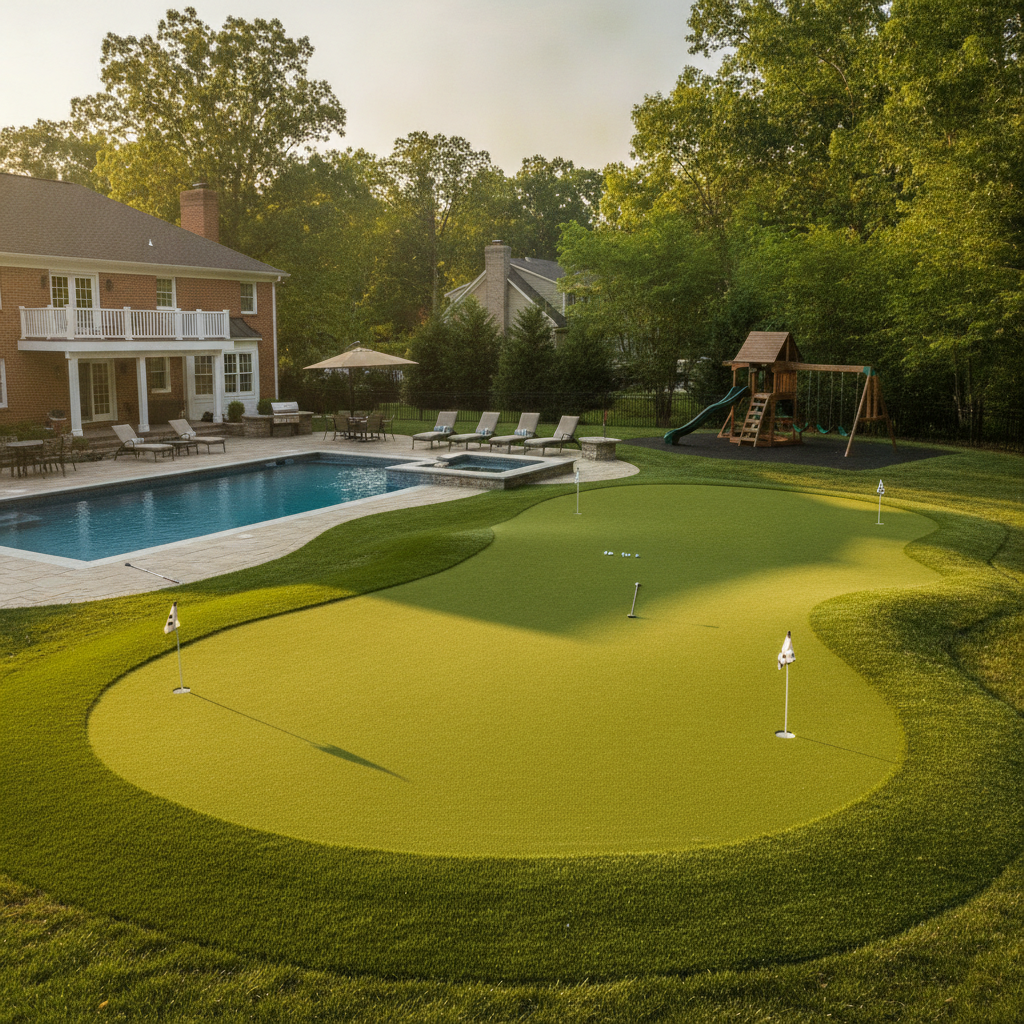
How Do You Install Artificial Turf on a Backyard Putting Green in Burke, VA? What Golf Enthusiasts Need to Know About Design, Performance, and Installation
Yes, a backyard putting green in Burke, VA is absolutely achievable — and when it’s built correctly, it performs closer to a real golf course than most homeowners expect. The difference between a putting green you’ll actually use and one that collects leaves and gathers dust comes down to three things: the right turf product, real base engineering, and thoughtful green contouring. Skip any one of those, and you’ve got a lawn ornament. Get all three right, and you’ve got a practice surface that improves your short game year-round without leaving your neighborhood.
Why Backyard Putting Greens Are Having a Moment in Northern Virginia
Fairfax County has no shortage of serious golfers. Between the demanding work schedules that make regular course time hard to come by and the number of families who’d rather spend a Saturday afternoon in the backyard than sitting in traffic on Route 123, the demand for home golf setups has grown considerably over the last several years. Neighborhoods like Burke Centre, Fairfax Station, and Rolling Valley tend to have enough usable backyard space to accommodate a compact green — typically anywhere from 150 to 500 square feet — without major disruption to the rest of the yard.
What most people don’t realize until they start researching is that putting green turf is a completely different product category than residential lawn turf. The fiber structure, pile height, infill system, and backing are all engineered specifically to produce consistent, predictable ball roll. Grabbing a roll of budget synthetic grass from a home improvement store and calling it a putting green won’t get you there.
Choosing the Right Putting Green Turf: Pile Height, Nap Direction, and Stimp Speed
Putting green turf runs at a significantly lower pile height than residential lawn turf — typically between 10mm and 15mm, compared to the 30mm–50mm range you’d use for a backyard lawn. That shorter pile is what allows the ball to roll cleanly rather than getting caught in the fibers. The nap direction of the turf (the direction the fibers are laid) also affects ball speed, so a well-designed green accounts for how different shots will behave depending on the angle of approach.
Stimp speed — the measurement used to describe how fast a putting surface plays — is something worth asking your installer about directly. A professionally installed backyard green using the right sand-infill system can typically be dialed in to play in the 9–11 Stimp range, which is consistent with many standard course greens. If you want it faster or slower, that’s largely a function of infill depth and turf specification, both of which a qualified installer can adjust.
At Grassify, our Pro Putt turf is purpose-built for putting and chipping applications, with a tight, dense fiber system designed to hold infill evenly and deliver true, consistent ball roll across the entire surface.
The Part Most Competitors Don’t Talk About: Base Prep and Contouring
This is where most generic turf installs fall apart — and honestly, it’s where the majority of competitor websites go silent. Installing a flat putting green on a poorly graded base will give you puddles after every rain. Northern Virginia’s spring rain seasons are aggressive, and Burke backyards deal with a lot of surface runoff, particularly in yards that slope toward the house or fence line. A proper crushed aggregate base — typically 4 to 6 inches of compacted decomposed granite or crushed stone — solves that drainage issue while also creating a stable foundation that won’t shift during the freeze-thaw cycles we get every winter.
Contouring is the design element that separates a practice green from a good practice green. Even minor elevation changes of 1 to 3 inches across the putting surface create breaks and slope variance that make your practice more realistic and more challenging. This is done by shaping the base layer before turf is ever rolled out — and it requires an installer who has actually built greens before, not just laid flat lawn turf. At Grassify, we’ve built custom putting greens across Burke, Springfield, Great Falls, and Fairfax with multi-hole layouts, chipping surrounds, and integrated cup placements.
Sand Infill: Why It Matters More Than People Think
The infill system on a putting green is what gives the surface its playing characteristics. For greens, you want a fine, kiln-dried silica sand — not rubber crumb, not zeolite, not coated infill blends designed for lawn or pet applications. The sand is applied at a precise rate (typically 1–2 lbs per square foot for putting greens) and worked into the fibers with a power brush to ensure it’s distributed evenly. Too much sand and the ball gets sluggish. Too little and the fibers stand too upright, which also disrupts consistent roll.
This is a calibration process, and getting it right requires experience. It’s also worth noting that your infill depth may need minor adjustments over the first season as the turf settles — something a qualified installer will walk you through upfront rather than leaving you to figure out on your own.
HOA Considerations for Putting Greens in Fairfax County Communities
If you live in an HOA-governed community in Burke, Fairfax, or Springfield, your putting green likely falls under the same architectural review process as any other backyard hardscape modification. Most HOAs in Fairfax County require a submitted design plan showing dimensions, materials, and drainage approach before approval. A putting green is generally easier to get approved than front-yard turf because it’s not visible from the street, but it’s still worth pulling the covenants before you commit to a design.
Grassify handles the documentation for HOA submissions as part of the design process — dimensions, drainage specs, materials descriptions, and anything else a review committee typically needs. It’s one less thing you have to manage.
What Does a Backyard Putting Green Actually Cost in the Burke Area?
Putting green installations typically run on the higher end of the turf pricing spectrum — roughly $18 to $25 per square foot installed, depending on the complexity of the design, number of cups, contouring detail, and access conditions. A compact 200-square-foot two-hole green is going to come in very differently than a 500-square-foot multi-break layout with a chipping apron. For more detail on how backyard golf greens are priced and designed, that page walks through what’s typically included in a standard Grassify installation.
What you’re paying for isn’t just the turf roll — it’s the excavation, base engineering, grading and contouring, infill calibration, cup hardware, and the installation warranty on seams, edges, and base. A cheap install that skips base prep will cost you more in repairs or full replacement within a few years, particularly in a climate like ours where ground movement from frost is a real variable.
Frequently Asked Questions: Backyard Putting Greens in Burke, VA
How much space do I need for a backyard putting green?
You can build a functional single-hole practice green in as little as 100 to 150 square feet. A more realistic multi-hole layout with varied break typically starts around 300 square feet. Most Burke and Fairfax backyards have enough room for a compact design without sacrificing the entire yard.
Can a putting green be installed on a sloped backyard?
Yes — in fact, a slight slope across the green is often desirable because it creates natural break variation. Steeper slopes require more base excavation and shaping work, but they’re not a dealbreaker. We’ve built greens on some fairly challenging grades in Fairfax Station and Great Falls.
How do I keep leaves and debris off my putting green?
A standard leaf blower works well for routine cleanup. Because putting green turf sits low to the ground and doesn’t have tall fibers to trap debris, it’s actually easier to keep clean than a full lawn turf installation. You’ll want to avoid using metal rakes, which can snag the fibers.
Will a backyard putting green hold up through a DMV winter?
Yes. Properly installed putting green turf is UV-stabilized and designed to handle freeze-thaw cycles. The key is base integrity — if the aggregate base is properly compacted and graded, ground movement won’t cause the turf to buckle or seams to separate. Grassify backs all installations with a lifetime warranty on seams, edges, and base.
Can I add a chipping area or bunker surround to my backyard green?
Absolutely. Many homeowners in the Burke and Fairfax area opt for a synthetic sand bunker surround or a chipping apron using a slightly longer pile turf around the perimeter of the green. It increases the realism of the practice setup and doesn’t add much complexity to the installation if it’s planned from the start of the design process.
Ready to Build Your Backyard Putting Green in Burke?
If you’ve been thinking about a backyard putting green, the best next step is a site visit from someone who can actually look at your yard, talk through design options, and give you a real number — not a generic per-square-foot estimate from a contact form. Grassify serves Burke, Fairfax County, Springfield, and surrounding Northern Virginia communities with licensed, insured installation crews who specialize in golf green builds alongside residential and commercial turf work.
Request your free consultation here and we’ll schedule a time to come out, measure the space, and walk you through exactly what a finished green would look and play like on your property.


