
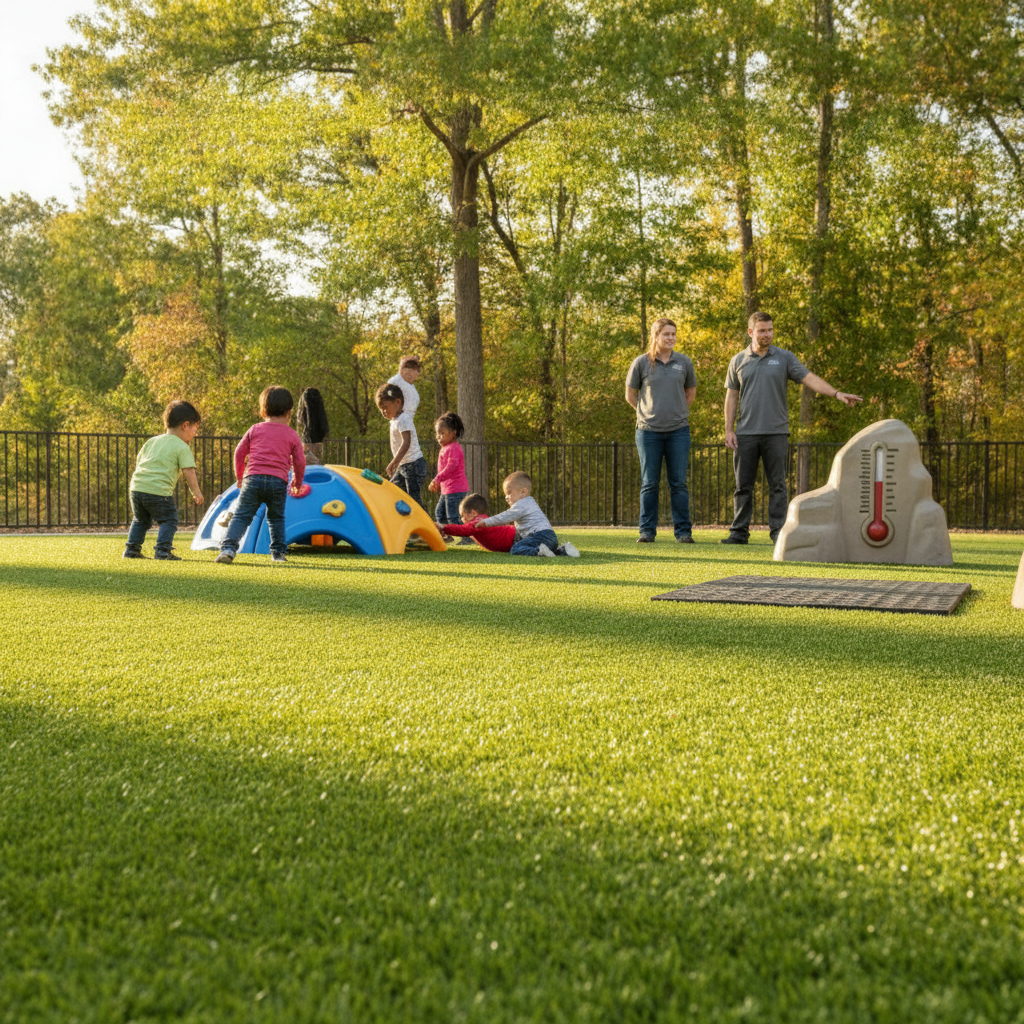
What’s the Best Artificial Turf for a Daycare or Preschool Playground in Loudoun County, VA?
If you’re a daycare director or childcare facility manager in Loudoun County — whether you’re in Ashburn, Sterling, or Leesburg — the short answer is this: you need CPSC-certified, IPEMA-tested artificial turf with a shock-absorbing pad system engineered to meet the critical fall height of your tallest piece of play equipment. That’s the baseline. Everything else — pile height, infill type, drainage capacity, heat performance — gets layered on top of that. And getting any of those layers wrong doesn’t just mean a subpar surface. It means liability exposure, failed inspections, and potentially a child getting hurt.
This isn’t a decision to hand off to a general landscaper who also happens to carry a roll of synthetic grass. Let’s walk through exactly what matters and why.
Why Daycare and Preschool Turf Is a Completely Different Category
Most residential or even commercial lawn turf is not designed to absorb the impact of a child falling from a climbing structure. Standard residential turf products — even high-quality ones — have backing systems built for aesthetics and drainage, not fall attenuation. The moment you’re surfacing a playground, you’re in a different product category entirely.
The Consumer Product Safety Commission (CPSC) sets the guidelines for playground surfacing in the U.S., and the International Play Equipment Manufacturers Association (IPEMA) provides third-party certification that a product actually meets those standards. When you’re shopping for turf for a licensed childcare facility in Loudoun County, Virginia, you should be asking for CPSC-compliant and IPEMA-certified documentation before a single sample board is shown to you.
What does that certification actually mean in practice? It means the turf system — including the pad or underlayment beneath it — has been tested to absorb impact within safe limits at a specific fall height. That fall height rating must exceed the highest point a child can reach on your tallest play structure. A six-foot climber needs a surface rated for at least a six-foot critical fall height. That rating comes from the combined system: turf plus pad, installed correctly, on a properly prepared base.
The Shock Pad Question: What Most Competitors Don’t Tell You
Here’s where a lot of well-meaning facility managers get misled. Some installers will quote you a turf product that carries a CPSC certification and stop there. What they may not disclose clearly is that the certification only holds if a specific shock-absorbing pad is installed beneath it — and that pad must be the right thickness for your fall height requirements.
Pad thickness typically ranges from 1 inch to 3 inches depending on application. For a preschool with modest equipment — think a 4-foot slide and a toddler climbing dome — a 1.5-inch certified pad may be sufficient. For a larger daycare with full play structures over five or six feet, you’re looking at thicker pad systems and potentially a more robust base prep to prevent settling over time.
In Loudoun County and across Northern Virginia, we also deal with freeze-thaw cycles through January and February that can cause base materials to heave if compaction wasn’t done right. That movement underneath the pad affects long-term performance and, more importantly, the integrity of your seams and the evenness of your surface. This is a real-world installation concern that simply doesn’t come up in most of the generic content you’ll find online — or on most competitor websites in the DMV area.
You can see the playground turf systems Grassify installs, including CPSC and IPEMA-compliant options, at our playground turf service page.
ADA Compliance: A Legal Requirement, Not a Bonus Feature
If your childcare facility receives any federal funding — or if you’re building a new playground that’s open to the public — the Americans with Disabilities Act requires that playground surfaces be accessible for children using wheelchairs or mobility aids. Artificial turf, when properly installed over an appropriate base and pad system, can meet ADA accessibility standards. Loose-fill materials like wood chips or pea gravel generally cannot.
This is one of the strongest practical reasons daycare operators across Fairfax County and Loudoun County are moving away from mulch and engineered wood fiber toward synthetic turf systems. Turf doesn’t scatter. It doesn’t wash away during heavy spring rains — and Loudoun County gets its fair share of those. It doesn’t decompose. And it gives wheelchair-using children a firm, stable surface that inclusive playground design requires.
Ask any installer you’re considering whether the product they’re proposing meets ADA accessibility requirements for playground surfacing. If they’re not sure, that tells you something.
Heat Management on a Preschool Playground in Summer
Loudoun County summers are hot and humid. Turf surface temperatures can climb significantly above ambient air temperature on a full-sun day — and on a preschool playground where kids are sitting, crawling, and falling, that matters more than it does on a residential lawn.
There are a few ways to address this. First, look for turf products with UV-stabilized, heat-dispersing fibers. Second, consider shade structures over the play area — both for temperature management and UV protection for the kids themselves. Third, ask about infill options. Some infill materials, including organic alternatives like cork and coconut fiber blends, run cooler than standard crumb rubber. Standard crumb rubber infill is the hottest-running option, and it’s typically not the right choice for a preschool where small bodies are in direct contact with the surface.
Grassify’s Titan Turf product line is specifically designed for high-use applications like playgrounds, pet areas, and batting cages — with a durable backing system and infill compatibility that works in high-traffic, high-impact environments.
Drainage on a Childcare Playground: More Than Just Rain Runoff
Drainage on a commercial playground isn’t just about keeping the surface dry after a rainstorm. It’s also about maintaining surface hygiene. Children on a preschool playground have spills, accidents, and tracked-in debris all day. A turf system with inadequate drainage becomes a hygiene problem quickly.
Properly installed commercial playground turf should drain at a rate that clears standing water within minutes of rainfall — not hours. In Northern Virginia’s climate, where spring can bring extended periods of wet weather, that drainage capacity matters for keeping a licensed facility operational and compliant with state childcare regulations.
The base preparation matters just as much as the turf itself. A compacted crushed stone sub-base — typically 3 to 4 inches depending on site drainage conditions — is what allows water to move through the system and away from the surface. Skip this step or underspec it, and you’ll have standing water, base softening, and surface irregularities within a season or two.
What to Ask Any Installer Before You Sign a Contract
Whether you’re managing a daycare in Ashburn, a church preschool in Leesburg, or a Montessori school in Sterling, these are the specific questions you should put in front of any turf contractor before signing:
- Can you provide CPSC and IPEMA certification documents for the specific product and pad system you’re proposing? Not a general certification — the documentation for that exact system at the thickness you’re installing.
- What is the critical fall height rating of the complete installed system (turf plus pad plus base), and how does that compare to our tallest piece of equipment?
- Does this system meet ADA accessibility standards for playground surfacing?
- What is the drainage rate of the turf backing, and how is the base being engineered for our specific site conditions?
- What infill are you proposing, and what are the surface temperature implications in direct summer sun?
- What warranty covers the installation — specifically seams, edges, and base performance — and for how long?
At Grassify, we install with licensed, insured, background-checked crews and back our installations with a lifetime warranty on seams, edges, and base work. For commercial playground projects, typical investment ranges from $15 to $25 per square foot depending on pad thickness, base prep requirements, and site access. We’ll walk you through an accurate estimate at no cost.
Frequently Asked Questions: Daycare and Preschool Playground Turf in Loudoun County
Does Virginia have specific regulations about playground surfacing for licensed childcare facilities?
Yes. The Virginia Department of Social Services, which licenses childcare centers, requires that outdoor play spaces meet safety standards consistent with CPSC playground surfacing guidelines. IPEMA-certified turf systems that meet fall height requirements for your specific equipment are the most defensible way to satisfy those requirements. Confirm with your licensing specialist before installation.
Is artificial turf safe for toddlers and infants crawling on it?
Modern IPEMA-certified playground turf is designed for exactly this use. The key is specifying the right infill — avoid crumb rubber for crawling areas and choose antimicrobial, non-toxic alternatives. Ask your installer for the specific infill’s safety data sheet and confirm it’s free of heavy metals and hazardous materials.
How long does playground turf last on a high-traffic childcare site?
A quality commercial playground turf system with proper base prep and a certified pad will typically perform well for 10 to 15 years under heavy daily use. The shock pad may need assessment around years 8 to 10 depending on traffic levels, as compression over time can affect fall attenuation ratings.
Can we install turf around existing play equipment, or does everything need to come out first?
In most cases, turf can be installed around existing equipment with proper templating and edge finishing around posts, footings, and fall zones. An on-site assessment is the only way to give you an accurate answer — site geometry matters a lot here.
Do we need HOA approval if our daycare is inside an HOA-governed community?
If your childcare facility is within an HOA-governed development in Loudoun County or Fairfax County, architectural review may be required before exterior surface changes. Your installer should be able to help you prepare a submission package. Grassify has navigated HOA approvals for commercial properties across the DMV area and can provide documentation to support the process.
Ready to Spec the Right Playground Surface for Your Facility?
Getting playground turf right at a licensed daycare or preschool in Loudoun County isn’t complicated — but it does require working with an installer who knows the certification requirements, the local climate realities, and the base engineering that makes a surface perform over time. That’s exactly what Grassify does.
If you’re managing a childcare facility anywhere in Loudoun County, Fairfax County, or the broader Northern Virginia area and you want a straight conversation about what your playground actually needs, reach out for a free on-site consultation. We’ll assess your equipment, your site conditions, and your budget — and give you a clear recommendation with no pressure and no guesswork.


