
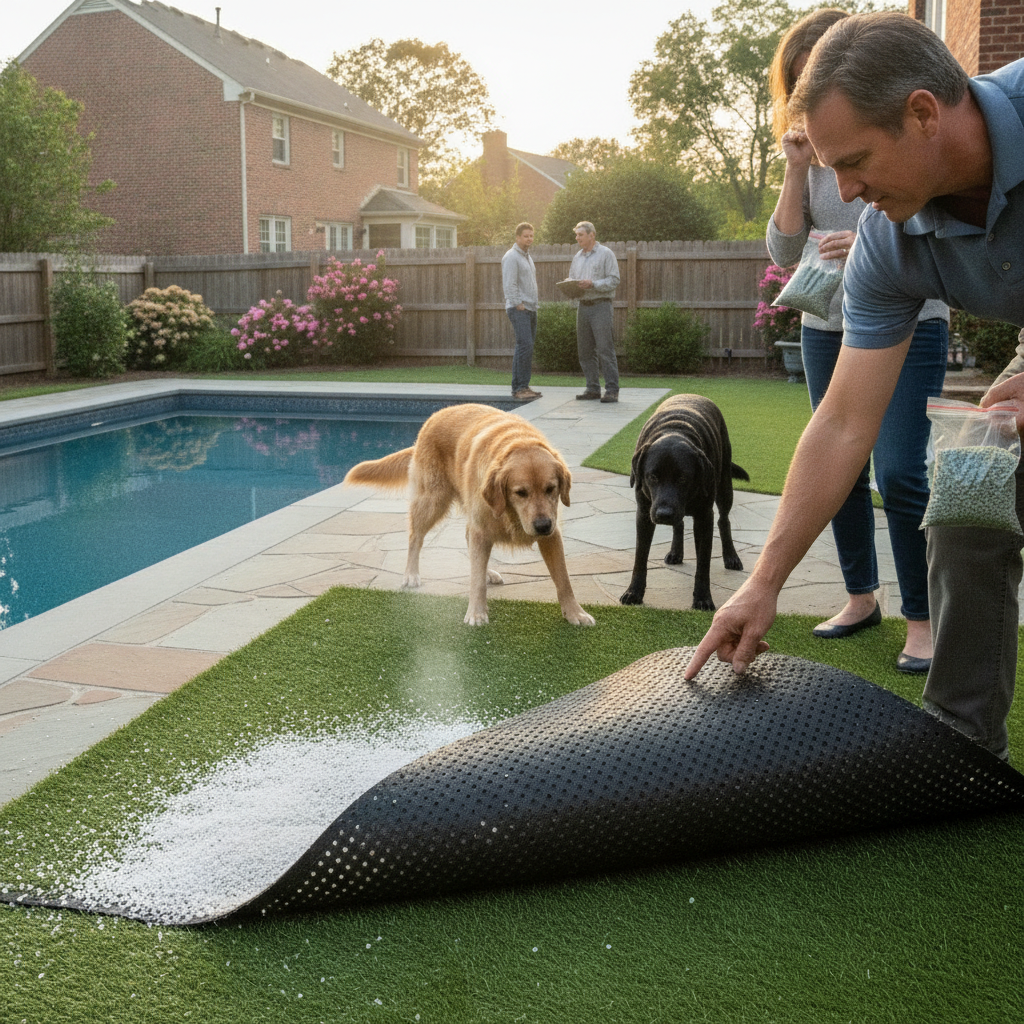
Does Artificial Turf Actually Eliminate Pet Odors? What Dog Owners in Burke, VA Need to Know
Yes — but only if the system is engineered correctly. This is where most artificial turf installations in Burke, VA and across Fairfax County go wrong. Homeowners call us after another company’s install has turned their backyard into a source of ammonia-laced odor that gets worse every time it rains or the temperature climbs in July. The turf itself isn’t the problem. The problem is what’s underneath it — and what’s not in it.
Pet urine doesn’t disappear when it hits synthetic grass. It flows through the blades, hits the backing, and either drains away or sits. If the backing doesn’t drain fast enough, if there’s no deodorizing infill layer, and if the base beneath was built with the wrong materials, you end up with ammonia compounds baking in the heat and re-activating every time moisture hits. That’s the cycle that makes turf smell. Breaking that cycle requires a system — not just a product.
Why Most Pet Turf Installations Fail at Odor Control
Walk through any turf installation guide from a general landscaper or a national franchise, and you’ll usually see a passing mention of “pet-friendly turf” without any explanation of what that actually means from an engineering standpoint. Here’s the honest breakdown of what goes wrong:
- Standard backing drainage rates aren’t fast enough. Budget turf products drain at 30–50 inches per hour. That sounds fine until you have two large dogs using a 400-square-foot area multiple times a day. Urine pools at the surface, the backing becomes saturated, and odor compounds concentrate.
- Crumb rubber infill holds urine. This is common across low-cost installations. Crumb rubber is porous and retains liquid. It locks in ammonia and off-gases it in heat. It has no deodorizing properties whatsoever.
- Compacted sand base traps liquid. If the base layer under the turf isn’t engineered for high-volume drainage — think decomposed granite compacted to a specific grade with a properly sloped subgrade — you end up with a layer of moisture retention directly under your turf.
- No antimicrobial protection means bacterial growth. Bacteria are what produce the sulfur and ammonia compounds that make pet turf smell. Without an antimicrobial treatment in the backing or infill, the problem compounds over time, not improves.
What a Properly Built Pet Turf System Actually Looks Like
At Grassify, every pet-friendly turf installation is built around a 5-layer drainage system specifically designed for high-use pet areas. This isn’t a marketing phrase — each layer has a function:
- Layer 1 — Base prep: We excavate 3–4 inches, slope the subgrade for positive drainage, and install a Class II road base compacted to 95% density. This gives urine and rainfall a clear path out, not a place to sit.
- Layer 2 — Drainage aggregate: A crushed stone layer (typically 3/4″ minus) sits above the compacted base, creating a drainage reservoir that moves liquid horizontally toward the perimeter drain before it can pool.
- Layer 3 — Weed barrier with flow-through permeability: A non-woven geotextile fabric that blocks organic material from migrating up into the turf while allowing liquid to pass through at full speed.
- Layer 4 — Turf with flow-through backing: Our pet turf products use a perforated backing rated at 400+ inches per hour of drainage — a critical spec. Standard backing can’t come close to this. The fiber itself is a flat-blade, tightly tufted pile that resists matting under heavy paw traffic.
- Layer 5 — Zeolite infill: This is the deodorizer layer. Zeolite is a naturally occurring mineral that chemically binds ammonium ions — the molecule responsible for that sharp urine smell — rather than just masking the odor. We pair it with an antimicrobial silica sand infill that inhibits bacterial growth at the fiber base.
Built correctly, this system carries a 90-day odor-free guarantee and a lifetime installation warranty on seams, edges, and base integrity.
The DMV Climate Makes Odor Control Even More Critical
Northern Virginia’s climate creates specific challenges that make a properly engineered pet turf system non-negotiable. Burke, Springfield, and the Lake Braddock corridor see average summer temperatures in the high 80s with humidity often above 70%. Heat and humidity accelerate bacterial growth. Ammonia off-gassing increases significantly above 80°F. A system that performs adequately in a dry, mild climate can become a serious odor problem in a Fairfax County summer.
Then there’s the rainfall. The DMV averages roughly 40 inches of rain per year, with heavy spring storm events capable of dropping 2–3 inches in a few hours. If your pet turf base isn’t graded and drained to handle that volume, you’re not just dealing with standing water — you’re flushing concentrated ammonia compounds back up through the turf from a saturated base. That’s not a turf problem. That’s a drainage engineering problem that shows up as a turf problem.
We see this frequently in Burke Centre and Alexandria backyards where a previous installer skipped proper base grading because the yard looked flat. Flat doesn’t mean level. Flat doesn’t mean drained.
What to Ask Any Turf Contractor Before You Sign
Before you commit to any pet turf installation in Fairfax County or the surrounding area, ask these questions directly:
- What is the drainage rate (in inches per hour) of the backing you’re using?
- What infill are you using, and does it have deodorizing or antimicrobial properties?
- How deep will you excavate, and how will you slope the subgrade?
- Do you use a drainage aggregate layer, or are you installing over compacted sand only?
- What warranty do you offer on odor control, and what does it cover?
If a contractor can’t answer those questions specifically — not just “we use pet-friendly turf” — that’s a red flag. A quality installer will welcome technical questions because it gives them a chance to show the work behind their pricing.
For more on what goes into a complete installation, the Grassify installation guide walks through each phase of the process in plain terms.
How Much Does Pet Turf Cost in Burke, VA?
For a fully engineered pet turf system — proper base prep, 5-layer drainage, zeolite infill, antimicrobial backing, and professional installation with seam and edge warranty — expect to pay in the $16–$22 per square foot range depending on yard complexity, access logistics, and square footage. A 500-square-foot backyard in a Burke townhome runs differently than a 2,000-square-foot open yard in Fairfax. Tight access, removal of existing organic material, and perimeter drain installation all factor into the final number.
What you shouldn’t do is compare that number to a $9/sq ft quote from a general landscaper who’s never built a dedicated pet drainage system. Those two quotes are not covering the same product or the same outcome. In three summers, one of them will still smell like a dog park. The other won’t.
Frequently Asked Questions
Will artificial turf smell if I only have one small dog?
Even a single dog can create odor problems on a poorly installed system over time, especially in hot, humid Northern Virginia summers. The key variables are backing drainage rate, infill type, and base prep — not just dog count. A well-built system handles one dog or five without odor issues.
Can I rinse pet turf myself to control odors?
Yes, rinsing with a hose weekly helps flush the drainage system and dilute residual compounds. It’s a good maintenance habit. But rinsing doesn’t replace zeolite infill or antimicrobial backing — it supplements them. If your turf is already smelling badly, rinsing temporarily reduces the problem without solving it.
How long does zeolite infill last before it needs to be replaced?
Zeolite gradually saturates its ion-exchange capacity over time. Depending on dog size and use frequency, you’ll typically recharge or partially replace zeolite infill every 3–5 years. This is a routine maintenance service, not a full reinstall, and it’s significantly less expensive than dealing with a failing drainage system.
Will my HOA in Burke or Fairfax allow pet turf in the backyard?
Most HOAs in Fairfax County that permit artificial turf do so for backyards with fewer restrictions than front yards. Burke Centre and similar planned communities often require an architectural review application with a product spec sheet and color sample. Grassify handles this documentation as part of every HOA-area installation. Front yards are reviewed more strictly — always check your CC&Rs before starting.
Does pet turf get too hot for dogs to use in summer?
Standard synthetic grass surfaces can reach 140–160°F on a direct-sun day in July. Our pet turf products use UV-stabilized, heat-diffusing fiber technology that reduces surface temps, and we recommend pairing shaded areas with cool zones in the turf layout. Morning and evening use is also more comfortable during peak summer heat regardless of turf type.
Ready to Stop Fighting Pet Odor in Your Backyard?
If you’re in Burke, Fairfax, Springfield, or anywhere across Fairfax County and you’re tired of a backyard that smells every time it gets warm, the solution isn’t a different cleaning product — it’s a properly built system from the ground up. Grassify specializes in pet turf installations that are engineered for this climate, built for heavy-use areas, and backed by a real odor-free guarantee.
Contact Grassify today for a free consultation. We’ll assess your yard, your drainage situation, and give you a straight answer on what it takes to build a backyard your dogs can actually use — without making the whole neighborhood aware of it.


