
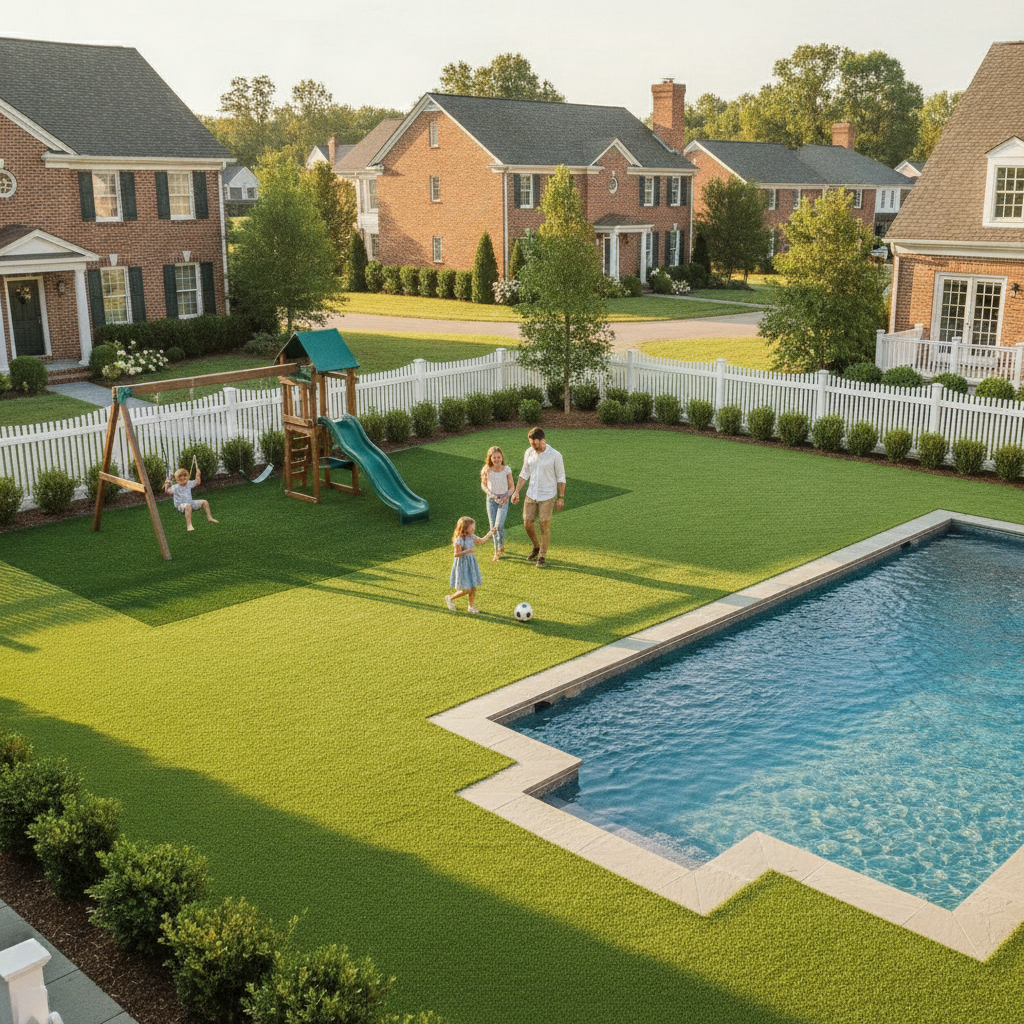
HOA Turf Approval in Fairfax County: What You Need to Know Before Installing Artificial Grass
If you live in an HOA community in Fairfax County — whether that’s in Burke Centre, Lake Braddock, West Springfield, or any of dozens of other planned neighborhoods — you cannot simply schedule an installation and move forward. You need architectural committee approval first. Skip that step, and you risk a formal violation notice, mandatory removal at your own expense, and a strained relationship with your neighbors and board. The good news: this process is very manageable when you know what the board is looking for and you show up with the right documentation. Grassify has helped homeowners across Fairfax County, Burke, Springfield, and Alexandria navigate this exact process — and we’ve built our submission package around what HOA boards actually want to see.
Why HOA Boards in Northern Virginia Are Skeptical of Artificial Grass
Most HOA architectural review boards in the DMV area aren’t opposed to artificial grass on principle — they’re worried about aesthetics and precedent. They’ve seen the bright green, plasticky, clearly fake turf that became popular in the early 2000s, and they don’t want that defining the look of the neighborhood. They’re also concerned about drainage — particularly in Fairfax County where spring rainfall is heavy and standing water complaints are a real issue in denser neighborhoods. And some boards simply don’t have a formal policy yet, which means your request will be reviewed on a case-by-case basis with no clear criteria to reference.
Understanding their specific concerns is the first step to addressing them. The boards that reject turf applications overwhelmingly do so because the applicant didn’t provide enough detail — not because artificial grass is prohibited outright.
What to Include in Your HOA Architectural Review Submission
A weak submission is one page with a product name and a photo from the manufacturer’s website. A strong submission answers every question the board might ask before they think to ask it. Here’s what a complete package looks like:
- Product specification sheet: Pile height, blade shape, color description (multi-tonal is more realistic and more likely to be approved), fiber material, UV stabilization rating, and backing type. For most residential applications in communities like Burke Centre or West Springfield, a 35mm–40mm pile height in a natural green with brown thatch layers reads most naturally from street level.
- Drainage engineering summary: HOA boards in Fairfax County take stormwater seriously. Your submission should specify the base preparation method — typically 3–4 inches of compacted Class II road base aggregate — along with the turf’s permeability rate. Quality residential turf drains at 30–50 inches per hour, which far exceeds what natural grass delivers during a heavy spring storm. Put that number in writing.
- Installation scope and boundary map: A simple site plan showing exactly where turf will be installed, its total square footage, and what borders it (existing hardscape, flower beds, mulch, edging material). Boards want to know you’re not covering the entire property in turf.
- Installer credentials: Licensed, insured, and background-checked crews. Grassify carries full liability insurance and licensing — documentation we can provide for your submission packet.
- Seam and edge detail: Explain how edges will be finished. Exposed or improperly secured edges are one of the most common aesthetic complaints with cheap installations. Bender board or concrete edging with a compacted sand finish looks clean and professional, and it’s worth describing in your application.
- Maintenance plan: Boards want to know the yard won’t look neglected in five years. A brief statement about annual infill top-off, periodic brushing, and rinse-down schedule goes a long way.
The Section Most Competitors Skip: Understanding Your Specific HOA’s Rules
Here’s something most turf companies — including several operating in the Beltway corridor — never tell you: there is no single Fairfax County ordinance that governs artificial grass in HOA communities. Every HOA has its own CC&Rs (Covenants, Conditions, and Restrictions), and those documents vary significantly from community to community. Burke Centre has different rules than Rolling Valley. Lake Braddock’s standards differ from Falls Church HOA communities.
Before you spend time preparing a submission, pull your community’s CC&Rs and look for any language around:
- Approved ground cover types (some older documents explicitly list natural sod as the only acceptable lawn material)
- Restrictions on “artificial” or “synthetic” materials in front yards
- Percentage of front yard that can be converted to non-grass surface
- Maintenance standards that artificial turf might actually exceed
If your CC&Rs are ambiguous or silent on the topic, that’s actually an opportunity — boards have discretion to approve what’s not explicitly prohibited, especially when the applicant presents a professional, well-documented case. If your CC&Rs explicitly prohibit artificial surfaces, you’re looking at either a variance request or a rule amendment, both of which take longer but have succeeded in HOA communities across Alexandria and Springfield when homeowners organized and petitioned together.
Grassify has worked through both scenarios. We’re familiar with the approval landscape across Fairfax County communities and can help you read the landscape before you commit to a timeline.
Townhome Yards: Small Spaces, Big HOA Scrutiny
If you’re in a townhome community — and there are a lot of them across Burke, Springfield, and Alexandria — your situation has an added wrinkle: the HOA often maintains the front lawn as a shared aesthetic responsibility while you’re responsible for maintenance costs. That means even a small 200–400 square foot front yard installation can trigger review from multiple stakeholders.
The physical installation challenges in townhome yards are also worth planning for upfront. Access is often tight, material delivery can’t always be staged on-site, and neighboring units may have drainage or grading considerations that affect your project. Grassify’s crews are experienced with the logistics of dense neighborhood installations — we’ve worked in alley-access lots, fence-gated side yards, and zero-lot-line properties throughout the DMV. Our residential turf installation service covers small-yard design and tight-access installs as a standard part of the process, not an afterthought.
What Happens If You Install Without Approval
This is worth being direct about: in most Fairfax County HOA communities, installing turf without prior architectural approval is treated as a violation regardless of how good it looks. The board can issue a notice of violation, impose daily fines, and require removal — and removal means your installation cost is gone with nothing to show for it. Even if your neighbors love how the yard looks, the board has an obligation to enforce the process.
The two to six week timeline for architectural review might feel frustrating, but it protects your investment. Grassify builds that timeline into every HOA project estimate upfront so you’re not caught off guard.
Frequently Asked Questions About HOA Artificial Grass Approval in Fairfax County
How long does HOA architectural review take in Fairfax County?
Most HOA architectural committees in Fairfax County meet monthly, though some larger communities review submissions on a rolling basis. Expect two to six weeks from submission to decision. Grassify can help you time your submission strategically around the board’s meeting schedule.
Can my HOA legally prohibit artificial grass in Virginia?
Virginia has no statewide law preempting HOA restrictions on artificial turf the way some Western states do. If your CC&Rs explicitly prohibit it, the HOA can enforce that restriction. However, poorly worded or outdated restrictions can sometimes be challenged — particularly if the language references cosmetic standards that modern turf clearly meets. An HOA attorney consultation may be worthwhile if you’re facing an outright prohibition.
Does Grassify help with the HOA submission, or is that my responsibility?
Grassify prepares a complete documentation package for HOA submissions as part of your project — product specs, drainage engineering summary, installation scope, and crew credentials. We’ve developed this package specifically because it matches what architectural boards in Northern Virginia communities ask for. You submit it; we give you everything you need to make the strongest possible case.
What if my HOA approves turf for the backyard but not the front?
That’s a common outcome, and it’s a perfectly workable starting point. Many Burke and Springfield homeowners start with a backyard installation — especially for pet areas or kid-play zones — and revisit the front yard application once the board has seen the finished product. A well-executed backyard install is often the most effective argument for a future front yard approval.
What pile height looks most realistic and is most likely to get HOA approval?
For HOA residential applications, a 35mm–40mm pile height with a multi-tonal blade color (mixing green shades with brown thatch fibers) is the sweet spot. It reads as natural from the street, holds its shape well in the DMV’s summer heat, and photographs cleanly for your submission. Grassify can provide physical samples in multiple colorways before you finalize your application.
Start the Conversation Before You Commit to a Date
If you’re in an HOA community anywhere from Burke Centre to Lake Braddock, West Springfield to Alexandria — or anywhere else in Fairfax County — the smartest first step is a conversation, not a contract. Grassify offers free on-site consultations where we’ll look at your yard, talk through the HOA process for your specific community, and give you a realistic picture of timeline, scope, and what the finished installation will look like.
There’s no pressure and no obligation. We’d rather spend an hour getting you oriented than have you rush into a project that stalls at the review board. Reach out to Grassify today and let’s figure out the right path forward for your yard and your community.


