
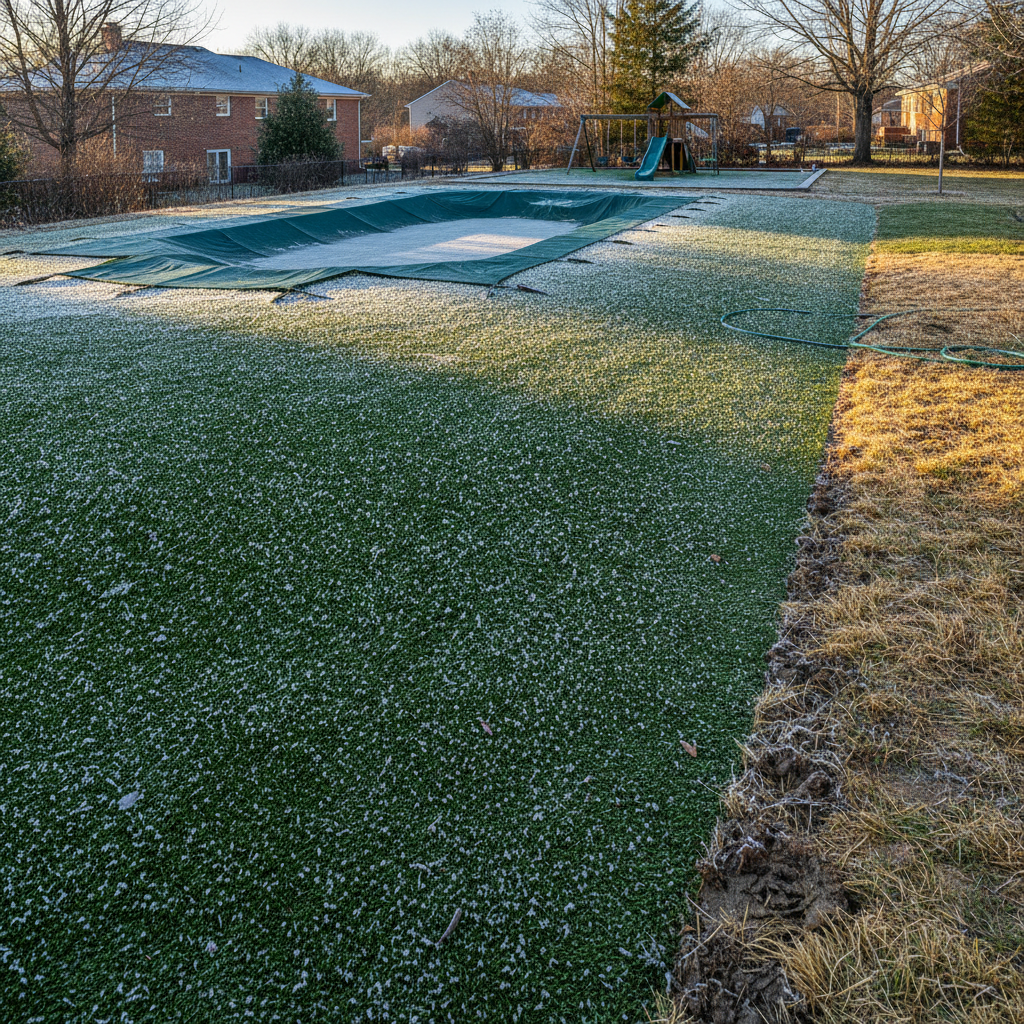
How Do You Maintain Artificial Turf Through a DMV Winter in Burke, VA?
If you have artificial turf installed in Burke, VA — or anywhere across Fairfax County, Springfield, or Alexandria — your lawn will handle a DMV winter just fine. But “just fine” assumes you know a few things: what to do when snow hits, what to avoid when temperatures are bouncing between 18°F and 52°F in the same week, and what actually holds up through a season that most out-of-state turf franchises quietly underestimate. This article covers the practical maintenance habits that protect your investment from November through March, and the base and seam quality issues that only reveal themselves when the ground starts freezing and thawing.
Why DMV Winters Are Harder on Artificial Turf Than People Expect
Northern Virginia doesn’t get the brutal, consistent cold of the Midwest or New England. What it gets is arguably messier: repeated freeze-thaw cycles through December, January, and February where temperatures rise above freezing during the day and drop back below at night. In neighborhoods like Burke Centre, Signal Hill, and Rolling Valley, you’ll see this pattern stretch for weeks at a time.
Here’s why that matters for artificial turf. The ground beneath your turf — the crushed aggregate base — is doing most of the structural work. When that base was installed correctly with proper compaction and a 3–4 inch layer of Class II crushed aggregate, it handles freeze-thaw expansion and contraction without shifting. When it wasn’t — when a general landscaper packed the base too loosely or skipped the geotextile weed barrier — you end up with seams that lift, edges that curl, and low spots that collect standing water. You won’t notice any of this in October. You’ll notice it in February when one corner of your yard is heaving and another is holding a puddle.
This is one of the most important topics that competitors in this market rarely address in any real depth. Most installer sites in the DMV have a page about maintenance, and most of those pages say something like “brush your turf regularly and rinse it off.” That’s not wrong, it’s just incomplete. Winter care in this region involves understanding how your base, your infill, and your drainage system all behave in cold and wet conditions — and what to watch for before minor issues become expensive repairs.
Snow on Artificial Turf: What You Can Do and What You Shouldn’t
Small amounts of snow — a dusting or an inch or two — don’t require any action at all. The turf will sit under it fine, and once temperatures rise, the snow melts and drains through the system just like rain would. Artificial turf doesn’t go dormant or suffer from snowpack the way natural grass does.
For heavier snowfalls, you have a few options — and one major thing to avoid.
- Plastic snow shovels are fine. Use a push broom or a lightweight plastic shovel with a flat blade. Work from the center outward and keep the blade lifted slightly so it’s moving snow across the surface, not scraping into the fiber.
- Metal snow shovels are not. Metal edges and the corner of a standard steel shovel blade can snag fibers, damage seams, and tear into the turf backing. Don’t use them.
- Ice melt products — check the label. Calcium chloride is generally safe for synthetic turf. Rock salt (sodium chloride) can be problematic in higher concentrations, particularly if it’s tracked across the turf repeatedly. If you’re treating an adjacent driveway or walkway, be conscious of what’s running off onto the turf surface during melt cycles.
- Snowblowers — proceed carefully. A rotary snowblower can work if the intake is set high enough to clear the turf without catching fiber. That said, most homeowners in Great Falls, Bethesda, or Silver Spring don’t need a snowblower for what the DMV typically delivers. A broom handles most of it.
Infill Behavior in Cold Weather: What to Expect
Most residential turf systems in Fairfax County use crumb rubber, silica sand, or a hybrid infill — and all of them can compact slightly over the winter, especially in high-traffic areas. This is normal. What you’re watching for is sections where the infill has shifted or thinned out unevenly, because that affects both the feel underfoot and, on sports surfaces, the performance of the fiber pile.
If you have a backyard putting green, pay particular attention to the edges and any areas near downspouts or drainage outlets. Sand infill in a putting green system can migrate after sustained rain followed by a hard freeze. Running a grooming rake over the surface in early spring — after the ground has settled — takes about 20 minutes and restores both performance and appearance.
For pet turf owners in Burke or Arlington with zeolite infill layers, you’ll want to rinse the surface thoroughly once temperatures are consistently above freezing in late February or March. Zeolite does its job of trapping ammonia compounds year-round, but a good thorough rinse and inspection at the start of spring keeps the odor-control system functioning at full capacity heading into the warmer months when it’s doing the heaviest work.
What the Shoulder Seasons Reveal About Your Installation Quality
February into March is when you’ll learn the most about how well your turf system was installed. As the ground thaws and the DMV’s famously heavy spring rains start up, a few things can surface.
- Seam separation. Properly heat-bonded or glued seams don’t move. If a seam is lifting, it typically means the base shifted slightly through the winter or the seam was underprepared during installation. This is a warranty claim item if you’re working with a contractor who offers a lifetime seam and edge warranty.
- Standing water. Artificial turf installed with a proper drainage system — 3/8-inch crushed aggregate base, perforated backing, and a permeable weed barrier — drains at rates far exceeding what Northern Virginia rain can throw at it. Standing water after a storm usually indicates either a drainage path was blocked by debris or the base has settled unevenly. Both are fixable.
- Fiber matting in high-traffic zones. Front entries, the area right outside a back door, and play zones in family backyards tend to show fiber compression by late winter. A quick grooming with a stiff brush or power broom in March resets the pile.
If you’re dealing with any of these issues on a recently installed system, the first call is to your installer — especially if you have a workmanship warranty in place. Understanding what your installation warranty covers before winter hits is worth the ten minutes it takes to re-read the documentation.
Routine Winter Maintenance Checklist for Fairfax County Homeowners
Here’s what a realistic winter maintenance routine looks like for a residential turf lawn in this area:
- Clear leaves and debris before the first freeze — wet leaves matted under snow can create mold or organic buildup on the turf surface and in the infill
- Check drain outlets and perimeter edges in November before temperatures drop consistently
- After any snowfall over two inches, clear with a plastic shovel or push broom — leave a thin layer rather than risk scraping the surface
- Rinse the surface on any mild day above 40°F — particularly important for pet turf systems where bacteria and ammonia compounds continue to accumulate even in cold weather
- Do a full post-winter inspection in March: walk the perimeter edges, check seams, look for low spots or uneven drainage, and groom matted fiber zones
Frequently Asked Questions
Can artificial turf freeze and crack in a DMV winter?
No. Quality synthetic turf fibers — UV-stabilized polyethylene or polypropylene — are flexible at temperatures well below freezing. The turf surface may feel stiffer when it’s genuinely cold, but it doesn’t crack, split, or become brittle under normal DMV winter conditions. The base beneath it is the more sensitive element, which is why proper compaction and aggregate depth during installation matter so much.
Should I cover my artificial turf in the winter?
Generally, no. Artificial turf is designed to be an all-weather surface. Covering it with tarps or plastic sheeting actually creates problems — trapped moisture promotes mold and mildew growth in the infill. If you have a putting green and want to protect the surface from prolonged heavy snow, a breathable landscape fabric is acceptable for short periods, but standard turf lawns don’t need covering.
Is it okay to use a pressure washer on artificial turf in the winter?
Yes, on mild days above freezing. A pressure washer on a low fan setting (not a concentrated jet) is one of the best ways to clear organic debris from the infill in the fall before winter sets in. Avoid pressure washing when surface temperatures are at or near freezing, as water forced into the infill can ice overnight and temporarily compact the system.
How do freeze-thaw cycles affect my turf warranty?
Normal freeze-thaw cycling in a climate like Northern Virginia’s is considered a standard environmental condition and is covered under a properly written lifetime installation warranty. What voiding a warranty typically looks like is mechanical damage — metal tools, snowplow contact, or heavy equipment driven across the surface. Check your warranty language for what qualifies as installer responsibility versus owner-caused damage.
Do I need to do anything special to maintain pet turf in winter in Burke or Springfield?
The maintenance fundamentals are the same, but the cadence shifts slightly. Cold temperatures slow bacterial activity, which can actually reduce odor during the winter months. That said, waste should still be removed promptly and the surface rinsed regularly on days above freezing. Come March, plan on a thorough rinse-down and a zeolite inspection — spring warmth brings bacterial activity back to full speed, and a system that went uncleaned all winter will make itself known quickly. Learn more about pet-friendly turf installation and what’s built into the drainage system to handle year-round use.
Ready to Protect Your Turf Investment Year-Round?
Artificial turf in Burke, Fairfax County, and across the DMV is a genuinely low-maintenance option compared to natural grass — but low-maintenance doesn’t mean no-maintenance, especially through the freeze-thaw shoulder seasons that define winters in this region. The homeowners who get 15–20 years out of their turf systems are the ones who did three things: had it installed with a properly engineered base, chose an installer with a real workmanship warranty, and did a simple seasonal inspection twice a year.
If you’re not sure how your current system is holding up heading into winter, or you’re thinking about installing before spring, Grassify offers free consultations for homeowners across Burke, Springfield, Alexandria, Arlington, Bethesda, and Silver Spring. We’ve been doing this in the DMV long enough to know exactly what this climate demands — and how to build a system that holds up through all of it.
Contact Grassify today to schedule your free consultation. We’ll walk your yard, assess your drainage and base situation, and give you an honest read on what your turf needs — whether that’s a new installation or a maintenance inspection on an existing system.


