
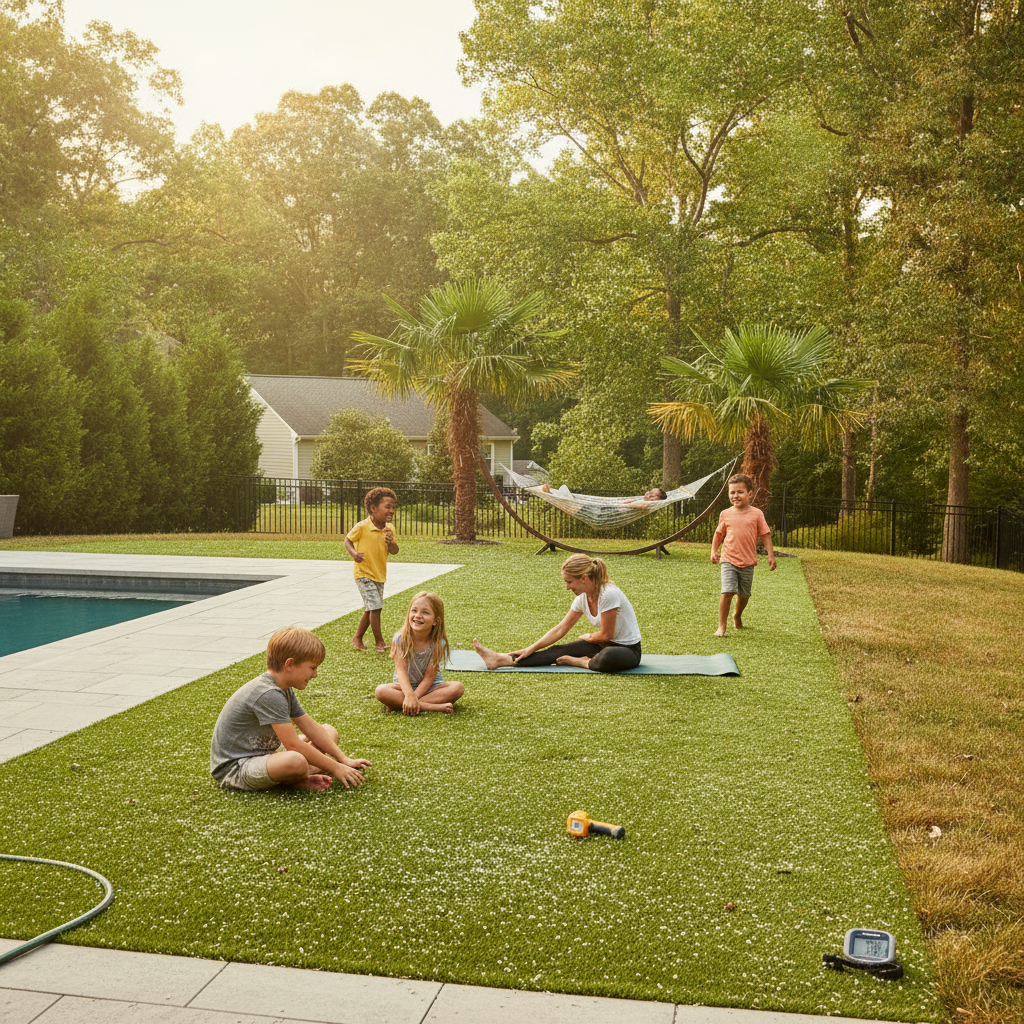
Does Artificial Turf Get Too Hot in Summer? What Alexandria, VA Homeowners Need to Know
Yes — artificial turf does get hotter than natural grass in direct sunlight, and in Alexandria, VA and across the DMV, summer surface temperatures on synthetic grass are a legitimate thing to plan for. But here’s what most competitor websites won’t tell you: heat buildup on turf is not an unsolvable problem, and it’s not a reason to avoid synthetic grass altogether. It’s an installation and product selection issue. When you choose the right fiber type, the right infill, and understand how your yard’s shade and orientation affect things, you can have a turf lawn that stays comfortable and safe through July and August — even in Northern Virginia’s humid, high-90s summers.
Why Does Synthetic Grass Get Hotter Than Natural Grass?
Natural grass cools itself through transpiration — essentially sweating. As the plant draws water up through its roots and releases moisture through its blades, it creates a natural cooling effect that can keep surface temperatures 20 to 30 degrees below air temperature on a hot day. Synthetic grass can’t do that. It’s a manufactured fiber, and in full sun it absorbs and retains radiant heat rather than shedding it.
On a 90°F day with no cloud cover and no shade, untreated synthetic grass can reach surface temperatures of 130°F to 160°F — which is hot enough to be uncomfortable for bare feet and potentially unsafe for pets with sensitive paw pads. That’s the real number you need to know, and it’s one that a lot of turf marketers gloss over.
That said, this range varies enormously based on four factors: fiber color and reflectivity, infill material, pile height and density, and shade coverage. An installer who doesn’t walk your yard and account for these variables is doing you a disservice.
What Actually Reduces Turf Surface Temperature — Technically Speaking
This is where product knowledge separates experienced local installers from box-store turf jobs and out-of-state franchise operators who show up with a one-size-fits-all product catalog.
Fiber Color and UV Stabilization
Lighter green fiber blends — particularly those that incorporate a mix of field green, lime, and olive tones — reflect more radiant heat than dark, single-tone fibers. All quality turf should also be UV-stabilized, meaning the polymers are treated to resist breakdown from prolonged sun exposure. This matters for longevity in Northern Virginia summers, where UV index climbs through June, July, and August. Non-UV-stabilized fiber fades and becomes brittle within a few seasons.
Infill Selection: The Most Underrated Factor
The infill — the granular material brushed into the base of the turf fibers — has more impact on surface temperature than almost any other variable. Crumb rubber, which was a common infill choice for decades, is one of the hottest-running infill materials available. It absorbs heat aggressively and releases it slowly, which is exactly what you don’t want in a residential backyard in Fairfax or Alexandria.
Better alternatives for residential use include:
- Silica sand — the most common residential infill, relatively neutral in heat retention, cost-effective, and excellent for maintaining blade posture
- Zeolite — a naturally occurring mineral that also functions as an odor neutralizer, making it ideal for pet areas; moderately cool-running
- Acrylic-coated sand — engineered to reflect heat rather than absorb it; one of the better options for full-sun yards
- Cork or organic infill — genuinely cooler-running than silica, increasingly popular in DMV-area residential installs, and an added environmental benefit
At Grassify, we walk every yard before recommending an infill system. A shaded townhome in Falls Church with a 200-square-foot backyard gets a different recommendation than a quarter-acre open lot in Springfield with south-facing exposure all day.
The Simple Fix Most Installers Don’t Mention: Water
One of the easiest ways to cool down synthetic grass quickly is also the most obvious — a light rinse with a garden hose. Running water over your turf for 30 to 60 seconds before your kids or pets go out can drop surface temperatures by 30 to 50 degrees within minutes. This isn’t a workaround; it’s standard practice for synthetic turf fields at schools and athletic facilities across the country. If you’re planning a backyard install in Arlington or Bethesda, just make sure your irrigation system or a simple outdoor spigot is accessible near the turf area.
Some commercial and high-end residential installs also incorporate sub-surface cooling systems or misting attachments at the perimeter, though these are overkill for most residential applications in our area.
What Competitor Sites Get Wrong About This Topic
If you’ve spent time researching local turf installers online, you’ve probably noticed that heat is either completely ignored on most competitor websites or dismissed in a single line like “just hose it down.” That’s not good enough for homeowners in the DMV who are making a $15,000 to $25,000 investment in their backyard.
What’s missing from most of those sites is any product-specific or infill-specific guidance. They’ll list “heat-resistant turf” as a feature without explaining what that actually means technically — which fiber blends run cooler, which infills to avoid, how pile height affects heat retention, or what a south-facing yard in Alexandria actually needs versus a shaded patio in a Burke Centre townhome community. That specificity is what gives homeowners the confidence to move forward.
For residential lawn installs, pile heights between 35mm and 45mm generally strike the best balance between natural appearance, foot comfort, and heat management. Very dense, tall piles (50mm+) can trap more heat at the surface layer. Your installer should be having this conversation with you before you sign anything. You can learn more about what goes into a proper residential turf install on our residential lawn turf page.
Pet Safety and Turf Heat: What Dog Owners Need to Know
Across the DMV, pet ownership is one of the top drivers for turf installations — and heat safety is a real concern for dog owners. Paw pads are sensitive, and a 140°F turf surface can cause discomfort or burns, particularly for smaller breeds. The same mitigation strategies apply: shade structures, lighter-colored fiber, cork or zeolite infill, and a quick rinse before letting pets out during peak afternoon hours.
For pet-specific installs, Grassify also uses a 5-layer drainage system engineered to push liquid through at 400+ inches per hour, which keeps the turf surface dry and reduces the heat-trapping effect of moisture-saturated infill. Our pet-friendly turf installation systems are designed specifically for the Northern Virginia pet owner — heavy use, odor control, and summer heat all factored in from the start.
Frequently Asked Questions: Turf Heat in the DMV
Is artificial turf safe for kids in summer?
In full, direct sun at peak afternoon hours, synthetic grass can reach temperatures that are uncomfortable for bare feet. Morning and evening use is comfortable year-round. During peak heat hours, a quick hose-down drops temps fast. Shade sails or pergolas over turf play areas are a popular solution in Alexandria and Arlington yards where tree cover is limited.
Does darker turf get hotter than lighter turf?
Yes. Darker fiber tones absorb more radiant heat. Multi-tone blends with olive and lime green tones run noticeably cooler than single-tone dark green products. Ask your installer to show you temperature data for specific products before committing.
What infill should I avoid if heat is a concern?
Avoid crumb rubber infill in residential applications where foot or pet contact is expected. It runs hot and has faced additional scrutiny around off-gassing. Silica sand, zeolite, acrylic-coated sand, and cork are all better alternatives for backyard installs in the Northern Virginia climate.
Will adding shade structures help?
Significantly. Even partial shade from a pergola, sail shade, or mature tree canopy can reduce surface temperatures by 40 to 70 degrees. If your yard in Fairfax, Springfield, or Bethesda has any natural shade, your installer should factor that into product and infill recommendations.
Does the base prep affect how hot the turf runs?
Indirectly, yes. A properly compacted crushed aggregate base (typically 3 to 4 inches of Class II road base) promotes drainage and prevents moisture from stagnating in the infill layer. Wet, poorly draining infill can amplify heat retention. Good drainage engineering isn’t just about rain management — it affects summer comfort too.
Ready to Talk Through Your Backyard Turf Project?
If you’re considering artificial grass for your home in Alexandria, Burke, Arlington, Fairfax, or anywhere across Northern Virginia or the broader DMV area, Grassify offers free on-site consultations with no sales pressure. We’ll assess your yard’s sun exposure, shade coverage, slope, and use case — and we’ll give you a straight recommendation on which product and infill system actually makes sense for your specific situation, not just whatever’s easiest to install.
Heat is one of the most frequently misunderstood parts of the turf conversation, and we’d rather you have the real information upfront than discover it mid-July. Request your free consultation here and we’ll get back to you within one business day.


