
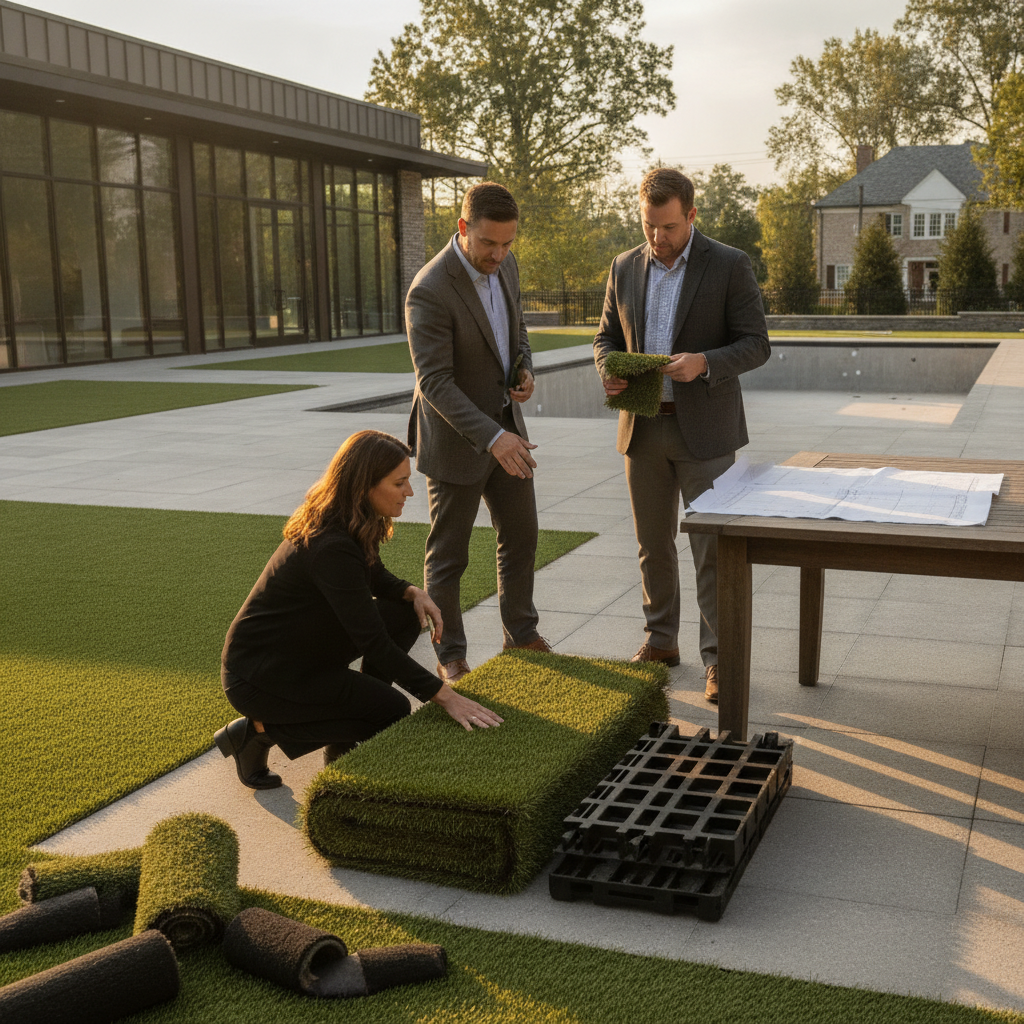
What Kind of Artificial Turf Should You Choose for a Commercial Outdoor Space in Potomac, MD?
If you manage a commercial property in Potomac, MD — a corporate campus, a multi-family community, a private school, a fitness facility with outdoor amenities, or a mixed-use development — and you’re evaluating artificial turf, the answer isn’t simply “pick a pile height and call a contractor.” Commercial outdoor turf in Montgomery County has to contend with high foot traffic, real drainage engineering requirements, freeze-thaw cycles, and in many cases, HOA or architectural review board oversight before a single shovel hits the ground. Getting the product selection wrong upfront leads to premature fiber wear, drainage failures, and costly remediation. This guide walks you through exactly what to look for — product specs, base systems, infill types, and the questions you should be asking any installer before you sign a contract.
Why Commercial Turf Selection Is Genuinely Different from Residential
A backyard lawn in Burke, VA and the common-area green space of a 200-unit apartment complex in Potomac are not the same installation challenge. The turf products that work beautifully in a residential setting — thinner pile, lighter face weight, less aggressive drainage capacity — will degrade quickly under commercial-level foot traffic and institutional use patterns.
Here’s what changes at the commercial scale:
- Face weight matters more. Residential turf typically runs 40–60 oz face weight. Commercial applications should start at 60 oz and go higher depending on traffic intensity. Heavier face weight means more fiber per square foot, slower wear, and longer visual life.
- Pile height needs to match the use case. High-traffic walkways and event lawns perform better in the 30–38mm range. Decorative common areas where foot traffic is lighter can handle up to 45–50mm. Taller pile in heavy-traffic zones mats down faster and loses its appearance within a year or two.
- Drainage capacity becomes non-negotiable. Commercial spaces see concentrated traffic patterns — people cutting the same path daily, irrigation runoff from adjacent beds, and in Potomac’s case, heavy spring rains that can dump several inches in a weekend. You need a base system engineered for those flow rates, not a basic gravel layer.
- UV stabilization must be specified in writing. Commercial properties can’t afford turf that fades or becomes brittle within three to five years. UV-stabilized polyethylene fibers with a documented warranty against color fade should be a baseline requirement in your contractor agreement.
The Base System Is Where Most Commercial Installations Succeed or Fail
This is the section that most competitor sites gloss over entirely — and it’s the part that will determine whether your turf looks and functions well in year seven or needs to be pulled and redone in year three.
For commercial outdoor turf in the Potomac and broader Montgomery County area, a properly engineered base includes:
- Native soil excavation: Typically 3–4 inches of native material removed, more in areas with heavy clay content (common throughout the DMV corridor).
- Compacted aggregate base: A 3–4 inch layer of crushed aggregate — usually Class II road base or equivalent — compacted to 95% Proctor density. This is the foundation that prevents the surface from shifting, settling unevenly, or heaving during freeze-thaw cycles in winter.
- Weed barrier: A commercial-grade, permeable landscape fabric installed over the compacted base to prevent organic breakthrough over time.
- Drainage outlet engineering: For larger commercial footprints, a perforated pipe drainage system channeled to an appropriate outlet point. This isn’t optional in areas with significant grade or impervious surface runoff nearby.
If an installer quotes you a price that seems unusually low and doesn’t itemize base preparation separately from the turf product cost, ask specifically what their base spec is. A cut-rate base is how general landscapers and out-of-state franchise installers keep their bids artificially competitive — and it’s how properties end up with rippling, pooling, or spongy turf surfaces within two to three years.
What Infill Type Is Right for Your Commercial Outdoor Space?
Infill is the material brushed into the turf fibers after installation. It stabilizes the blades, adds weight to keep the system from shifting, and — depending on the product — contributes to performance characteristics like temperature management and antimicrobial protection.
For commercial outdoor spaces, the most common infill options break down like this:
- Silica sand: The standard workhorse infill. Dense, stable, cost-effective, and appropriate for decorative lawns, walkways, and general common-area applications. Does not provide meaningful temperature reduction.
- Crumb rubber: More common in sports turf applications. Adds cushion and resilience. Not typically recommended for decorative commercial lawns due to heat absorption and the ongoing scrutiny around rubber infill in public spaces.
- Durafill / coated sand: A rounded, kiln-dried silica sand that stays cooler and flows more freely through the fiber system. A good upgrade option for high-visibility commercial spaces where surface comfort matters.
- Zeolite blends: Particularly relevant if the commercial space is adjacent to or integrated with outdoor pet relief areas. Zeolite is a naturally occurring mineral that neutralizes ammonia at the source. Properties that allow pets on common-area turf should strongly consider a zeolite component in their infill specification.
Summer surface temperatures are a real consideration in Potomac, just as they are across the DMV area. Standard turf in direct sun can reach surface temperatures significantly above ambient air temperature. If your outdoor commercial space will see heavy daytime use — school common areas, fitness facility outdoor zones, event lawns — discuss heat-mitigating infill options and fiber technology with your installer before finalizing your product selection. Grassify’s outdoor sports turf systems include fiber and infill configurations specifically selected for high-use, high-visibility applications like these.
The Gap Nobody’s Talking About: HOA and Municipal Review for Commercial Turf in Montgomery County
Almost every competitor site in this market focuses on residential HOA approval — and most cover it only at a surface level. What they largely ignore is that commercial properties in Potomac and Montgomery County MD often face a layered review process that can involve the HOA or condo association, a property management company’s architectural standards, local zoning or design review requirements, and in some cases covenants tied to the original development agreement.
Before installation begins on any commercial outdoor space, you should confirm:
- Whether the property is governed by a community association or master HOA with architectural review authority
- Whether Montgomery County or a local municipality has any material restrictions on synthetic ground cover for commercial zoning classifications
- Whether your installer carries commercial general liability insurance adequate for the project scope — typically $2M per occurrence minimum for commercial work
- Whether the product you’re selecting comes with a manufacturer’s warranty that is transferable if the property changes ownership
A good local installer will help you navigate this review process and can provide product specification sheets, drainage engineering documentation, and material data sheets that satisfy most architectural review boards on the first submission. This is one of the areas where working with a locally embedded contractor — one who has already pulled permits and navigated review boards across Fairfax County, Montgomery County, and the DC corridor — pays for itself in avoided delays.
What a Realistic Commercial Turf Budget Looks Like
Commercial artificial turf installation in the Potomac and broader Montgomery County area typically runs $14–$22 per square foot installed, depending on the product specification, base complexity, site access, and drainage engineering required. That range reflects real-world project costs — not the low-ball number that gets adjusted upward after the site assessment reveals what the base actually needs.
For context, a 5,000 square foot common-area lawn replacement project might fall in the $70,000–$110,000 range fully installed. A smaller 1,500 square foot courtyard or entry lawn could run $21,000–$33,000. Request a site-specific consultation to get an accurate estimate based on your actual conditions — acreage, base status, drainage complexity, and product selection all move the number meaningfully.
Frequently Asked Questions: Commercial Outdoor Turf in Potomac and Montgomery County, MD
How long does commercial artificial turf typically last in an outdoor setting?
A properly installed commercial turf system with appropriate face weight and base preparation should last 12–18 years in most outdoor applications. High-traffic zones like entry paths or gathering areas may show wear patterns earlier than decorative lawn areas. Product and seam warranties vary by manufacturer — ask specifically what’s covered and for how long.
Does artificial turf require ongoing maintenance for commercial properties?
Yes, though significantly less than natural grass. Commercial turf should be groomed with a power broom two to four times per year to keep fibers upright, debris cleared regularly (especially under trees), and infill topped off annually in high-use zones. There’s no mowing, no irrigation, and no seasonal fertilization program — which is where the long-term maintenance cost savings accumulate.
Is artificial turf permitted for commercial properties in Montgomery County, MD?
Generally yes, but zoning classification, community covenants, and design review requirements vary. Your installer should review the specific property conditions before installation and provide documentation suitable for any required review submissions. This is not a step to skip.
Can commercial turf handle heavy rain events like the ones common in the Potomac area?
A correctly engineered system absolutely can. Quality commercial turf backing has perforated drainage at 30–40 inches per hour or better, and a properly compacted aggregate base channels water away from the surface efficiently. The critical factor is base engineering — turf sitting on poorly prepared or clay-heavy soil will pool regardless of the product’s drainage rating.
Do I need a different product for a commercial space that also serves as a pet relief area?
Yes. If your commercial outdoor space will be used as a designated pet area — even part-time — you need a system with antimicrobial infill, a zeolite deodorizer layer, and drainage capacity rated above 400 inches per hour. Standard commercial decorative turf is not engineered for the ammonia load and organic matter that pet use creates. Grassify’s pet turf systems include a 5-layer drainage design and a 90-day odor-free guarantee specifically built for this use case.
Ready to Talk Through Your Commercial Turf Project?
Grassify works with property managers, HOA boards, school administrators, and commercial facility operators across Potomac, Bethesda, Rockville, Washington D.C., Fairfax County, and the broader DMV area. We’ve been engineering and installing commercial turf systems for over a decade, and we know what Montgomery County sites actually demand — from base prep through the final infill brush. If you’re evaluating artificial turf for a commercial outdoor space, let’s start with a site walk and a no-pressure consultation. Contact Grassify here to schedule yours.


