
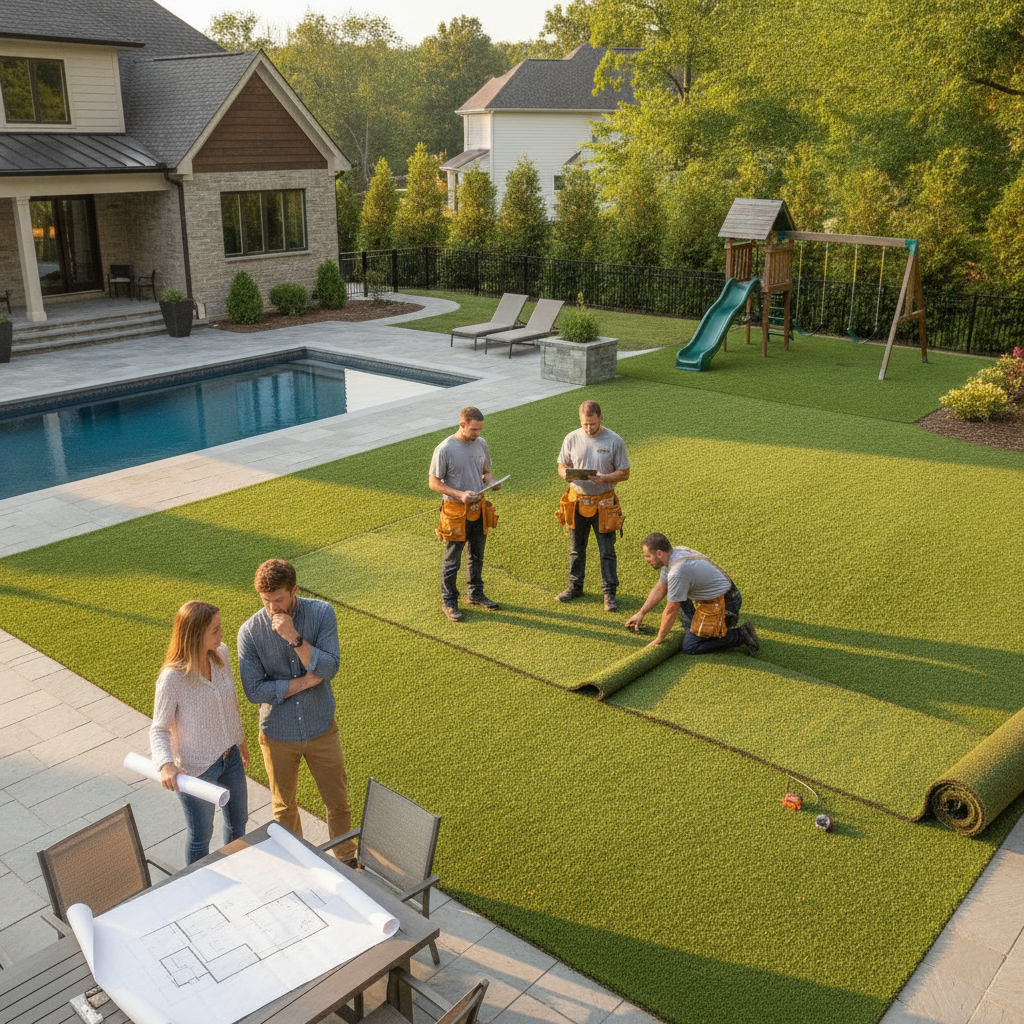
What Should You Ask a Turf Installer Before Signing a Contract in Fairfax, VA?
If you’re getting quotes for artificial turf in Fairfax, VA, you’ve probably already noticed that the proposals look nothing alike. One contractor quotes $9 per square foot, another quotes $22. One mentions a “lifetime warranty,” another hands you a brochure with no warranty language at all. And somewhere in between, a general landscaper is offering to do the whole thing with a crew that installed sod last week. Before you hand anyone a deposit, there are specific questions you need to ask — and specific answers you should expect from a contractor who actually knows what they’re doing in this region.
This guide covers the questions that most homeowners don’t think to ask, but that experienced turf installers in Fairfax County will answer without hesitation. If a contractor stumbles on any of these, that tells you something important.
1. What Does Your Base Prep Actually Include?
This is the single most important question you can ask, and it’s the one most homeowners skip. Artificial turf is only as good as what’s underneath it. In Northern Virginia, that matters more than in most parts of the country. Fairfax County gets significant spring rainfall, heavy summer humidity, and a real freeze-thaw cycle through winter. A base that isn’t engineered for those conditions will shift, heave, and develop drainage problems within a few seasons.
A qualified installer should describe a process that includes soil excavation to the correct depth (typically 3 to 4 inches for a residential lawn, more for high-traffic or pet applications), compacted crushed aggregate base, and a drainage layer that moves water away from the surface efficiently. The target for quality residential turf is a drainage rate of at least 30 inches per hour. For pet turf applications, that number needs to be dramatically higher — at least 400 inches per hour — which requires a purpose-built drainage system, not just a permeable backing.
If a contractor says they’re just laying turf over existing soil or a thin layer of sand, that’s a red flag. Ask them to walk you through the base spec in writing before you sign anything.
2. Are You Licensed, Insured, and Running Background-Checked Crews?
This seems basic, but it’s skipped constantly in the DMV market — especially with the volume of out-of-state franchise installers and general landscapers who have moved into turf work over the past few years. Virginia requires contractors to carry general liability insurance. Workers’ comp is required if they have employees. Ask to see the certificates, not just verbal confirmation.
Background-checked crews matter particularly for residential work in communities like Burke Centre, Kings Park West, or anywhere in Fairfax County where HOA neighborhoods are dense and your neighbors are close. You want to know who is working in your yard.
3. What Does Your Warranty Actually Cover — and Who Backs It?
Turf warranties are one of the most misleading things in this industry. Most product warranties from manufacturers cover the fibers for 8 to 15 years against UV degradation and fiber breakdown. That’s a product warranty. It tells you almost nothing about whether your seams will hold, your edges will stay put, or your base will remain level after a wet Northern Virginia winter.
The installation warranty — the one the contractor backs with their own name — is what you actually need to understand. A reputable local installer should offer a separate warranty on seams, edges, and base integrity. At Grassify, that’s a lifetime installation warranty. If a seam fails, an edge pulls up, or the base settles unevenly, it gets fixed. Ask every contractor you’re interviewing to put their installation warranty in writing and explain specifically what voids it.
4. How Do You Handle Drainage Design for My Specific Yard?
Fairfax and the surrounding Fairfax County suburbs don’t all drain the same way. A flat backyard in Springfield drains differently than a sloped lot in a neighborhood like Fairfax Station. A shaded yard that stays wet longer into the spring needs different base engineering than a full-sun installation on the south side of a house.
A contractor who gives you a one-size-fits-all drainage answer hasn’t actually looked at your property. Before any proposal is final, someone should walk the site, look at the grade, identify any low spots or areas where water currently pools, and tell you specifically how drainage will be handled — including where water will exit the system. This is especially true for pet turf installations, where urine volume combined with heavy rain creates real system stress that cheap drainage setups can’t handle.
5. What Turf Product Are You Recommending, and Why That One for My Application?
Not all turf is the same, and a contractor who recommends the same product for every project — regardless of whether it’s a shaded lawn, a sunny pool deck, or a dog run — isn’t approaching your project with the right level of care. Pile height, fiber shape, infill type, and backing all matter and all differ based on use case.
For a residential lawn in Fairfax, you want UV-stabilized fibers in the 35mm to 50mm pile height range with a realistic blade shape — C-shaped or S-shaped fibers hold up better under foot traffic than flat blade designs. For a pet area, zeolite infill or an antimicrobial infill system is important for odor control between cleanings. For a pool deck, you need chlorine-resistant backing and a slip-resistant texture. Ask the contractor to name the specific product they’re recommending, explain why it fits your application, and show you a sample.
You can also review the Grassify installation guide to get a better sense of what a properly scoped turf project looks like from start to finish — so you’re walking into contractor conversations informed.
6. Have You Worked in HOA Communities in This Area, and How Do You Handle Approval?
If your home is in an HOA-governed community — and a large percentage of Fairfax County homes are — you need to know whether the installer has navigated that process locally. Architectural review boards in this area vary widely in how they handle turf requests. Some Fairfax County HOAs are supportive and process approvals quickly. Others have specific requirements around turf color, pile height, perimeter edging, and the percentage of the yard that can be converted.
A contractor who’s never dealt with a local HOA is going to leave that paperwork entirely on you. A contractor with real DMV experience can tell you what to expect, which documentation typically needs to accompany the request, and whether there are any HOA-specific design constraints that should influence the installation plan.
7. What’s the Realistic Timeline From Deposit to Completed Installation?
This question filters out contractors who are overbooked, understaffed, or overpromising. In the Northern Virginia market, peak season runs from April through October. A contractor who tells you they can start a complex backyard project next week in June either has no other clients or is cutting corners somewhere. A realistic residential installation in Fairfax typically takes one to three days of active crew time, but scheduling lead times of two to four weeks are normal during peak season. Get the timeline in writing and ask what happens if weather delays the project.
Frequently Asked Questions: Hiring a Turf Installer in Fairfax, VA
How do I compare turf quotes when the prices are wildly different?
Price differences almost always come down to base prep and turf quality. A $9/sq ft quote is almost certainly cutting corners on excavation depth, aggregate quality, or using a lower-grade product. Ask every contractor to itemize: materials, base prep labor, turf product, and installation. Compare line by line, not just the total.
Is it normal for a turf contractor to require a site visit before giving a quote?
Yes, and it’s a good sign. Any contractor who gives you a final price over the phone without seeing your yard is guessing. Accurate quotes require looking at access constraints, grade, existing drainage, and the condition of the area being converted. In tight townhome yards or sloped lots common across Fairfax County, those details significantly affect cost and scope.
What’s the difference between a product warranty and an installation warranty?
The product warranty covers the turf fibers and backing against UV fade or manufacturing defects — typically 8 to 15 years depending on the brand. The installation warranty covers the workmanship: seams, edges, base prep, and drainage. Always ask for both, and always read the exclusions.
Can a general landscaper install artificial turf, or do I need a turf specialist?
Technically anyone can attempt it, but base engineering and drainage design are where general landscapers consistently fall short. Proper compaction ratios, aggregate selection, and edge retention require experience that comes from doing turf exclusively — not as an add-on service. The failures we see most often in Alexandria, Springfield, and across Fairfax County come from installations done by crews who were primarily trained on natural grass or hardscaping.
Does the type of infill affect odor control for pet owners?
Significantly. Standard crumb rubber or silica sand infill has no odor-control properties. For dog owners, zeolite infill — a naturally occurring mineral that binds ammonia ions — is the baseline recommendation. Combined with an antimicrobial infill layer and a drainage system rated for high-volume liquid throughput, it makes a real difference in how the turf performs between maintenance sessions. Infill type should always come up in a pet turf conversation before you sign.
Ready to Get Answers From an Installer Who Actually Knows Fairfax?
Grassify is based in Burke, VA and has been installing turf across Fairfax, Springfield, Alexandria, and the broader Fairfax County area for years. Every project gets a licensed crew, a site visit before any quote is finalized, and a lifetime installation warranty that covers seams, edges, and base integrity — in writing. If you’re collecting proposals and want one from a contractor who can actually answer all of the questions above, reach out for a free consultation at grassify.us/contact-us.


