
How Long Does Artificial Turf Actually Last in Fredericksburg, VA? A Realistic Lifespan Guide for Homeowners and Property Managers
If you’re considering artificial turf for a home in Fredericksburg or the Stafford area, the lifespan question is one of the first things you should pin down — and unfortunately, it’s one of the least honestly answered questions in this industry. The short answer: a properly installed synthetic lawn in this region should last 15 to 20 years with minimal maintenance. A poorly installed one can start showing serious problems — matting, seam separation, drainage failure, fiber breakdown — within five to seven years. The difference isn’t the brand name on the product. It’s everything that happens before and during installation.
Why Turf Lifespan Varies So Much — Especially in Northern Virginia
Most turf manufacturers publish warranty terms of 8 to 15 years on the product itself. That covers the fiber and backing under normal conditions. What it doesn’t cover is what the local climate does to an improperly built base — and in the Northern Virginia corridor from Burke and Fairfax County south through Fredericksburg and Stafford, that’s where most premature failures actually originate.
The DMV region has a climate that’s genuinely hard on turf systems. Summers are hot and humid, often pushing surface temperatures on exposed turf above 130°F without heat-resistant fiber technology. Winters bring freeze-thaw cycles that can buckle a base that wasn’t properly compacted or graded. Spring is notoriously wet — the kind of heavy, sustained rainfall that turns a poorly drained sub-base into a sponge, leading to standing water, mold risk, and infill displacement over time.
Fredericksburg and Stafford sit in a transitional zone where clay-heavy soils are common. Clay doesn’t drain — it holds water. If your installer doesn’t account for the native soil profile and engineer drainage accordingly, you can have a beautiful-looking lawn that’s silently failing underneath. By year four or five, you start noticing soft spots, uneven surfaces, and seams that are lifting at the edges.
The Three Factors That Actually Determine How Long Your Turf Lasts
1. Base Preparation — The Foundation Everything Else Rests On
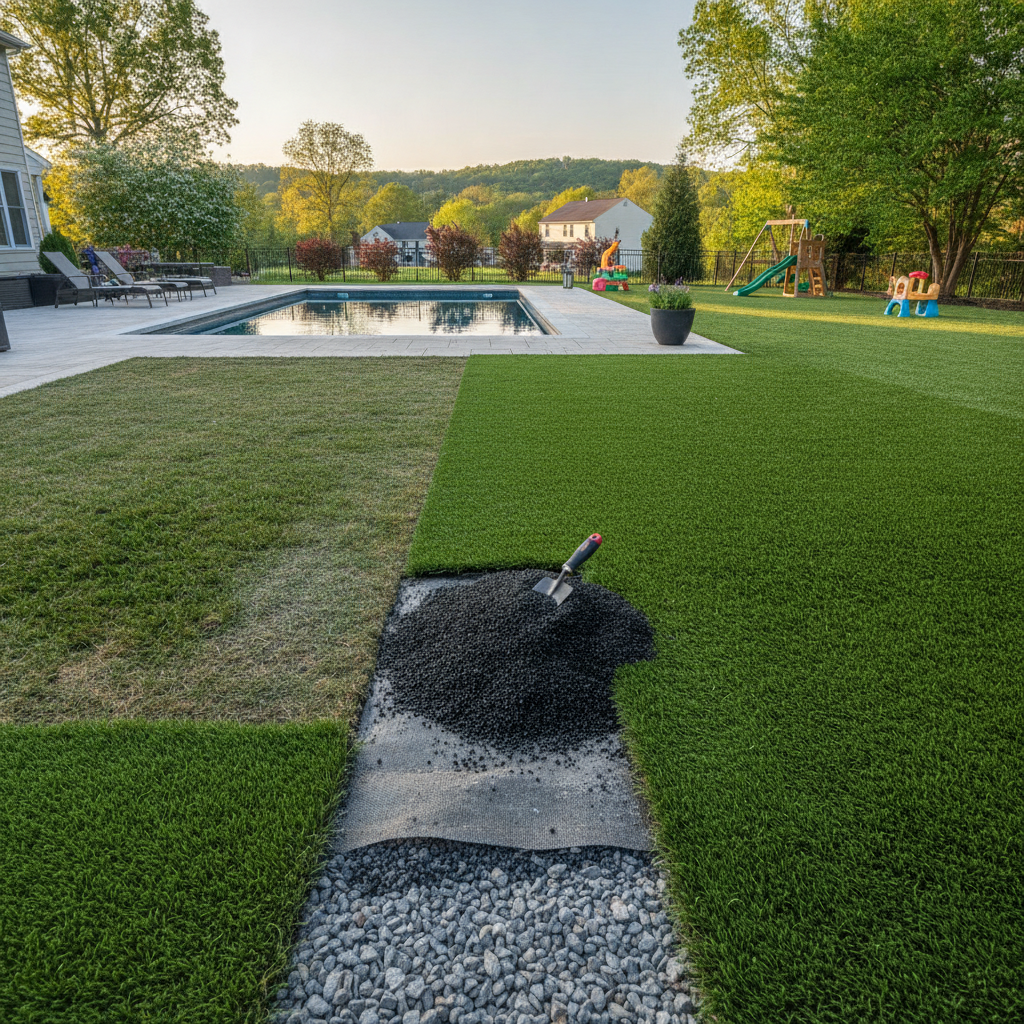
A properly built base for residential turf in this region typically involves excavating 3 to 4 inches of native soil, installing a weed barrier, laying a compacted aggregate base of crushed decomposed granite or Class II road base, and ensuring a minimum 1% grade for water runoff. On clay-heavy soils — common throughout Stafford County — a French drain or additional perforated pipe drainage system is often necessary.
Skip any of these steps and you shorten the lifespan of your installation significantly. A base that shifts, settles unevenly, or retains moisture will stress the turf above it constantly, accelerating seam failure and backing degradation. This is one of the areas where budget installers and general landscapers routinely cut corners, and it’s also the area that’s hardest to evaluate once the turf is down.
2. Fiber Quality and UV Stabilization
Not all synthetic grass fibers are built the same. Higher-quality polyethylene fibers with UV stabilization additives — the kind used in commercial-grade products — resist color fade and brittleness far longer than entry-level imports. In a region that sees 180+ days of direct sun exposure per year, UV degradation is a real and measurable factor.
Look for turf products that specify UV stabilization in the fiber manufacturing process, not just a topical coating. Fibers that are UV-stabilized throughout the strand hold their color and flexibility through a decade or more of direct summer exposure. Products without this specification can start fading and stiffening noticeably within three to five years in the Virginia sun.
At Grassify, our Lush Life residential turf line uses UV-stabilized polyethylene fibers with pile heights ranging from 30mm to 50mm, engineered specifically for lawns that need to look natural through both the humid DMV summers and the occasional hard freeze.
3. Infill Type and Long-Term Stability
Infill is the granular material brushed into the turf fibers to keep them upright, provide cushioning underfoot, and add stability to the system. It’s also the component most people know the least about — and one that directly affects lifespan.
Crumb rubber infill, once the standard, is now known to compact over time and can cause turf fibers to mat in high-traffic areas. Silica sand performs better in terms of longevity but can also compact. For residential lawns, a blended system using silica sand with an organic or coated infill layer gives you the best balance of stability, drainage, and long-term fiber support.
For pet owners in Fredericksburg or Stafford, infill choice becomes even more critical. Zeolite-based deodorizer layers and antimicrobial infill systems dramatically extend the functional lifespan of pet-area turf by preventing odor buildup and bacterial growth that can degrade the backing over time. Our pet turf systems use a 5-layer drainage design with 400+ in/hr drainage rates and a 90-day odor-free guarantee — the infill is chosen specifically to maintain structural integrity under heavy pet use.
What a Legitimate Warranty Should Actually Cover
This is a section you won’t find on most competitor websites, and it’s worth understanding before you sign anything.
There are two separate warranties on any turf installation: the product warranty from the manufacturer and the installation warranty from the contractor. Most manufacturers cover fiber fade and backing integrity for 8 to 15 years. What they don’t cover is how the base was built, whether seams were properly bonded, or whether the edging will hold over freeze-thaw cycles.
An honest installer should offer a separate, written installation warranty covering seams, edges, and base integrity — not just point you to the manufacturer’s product guarantee. At Grassify, we back our installations with a lifetime warranty on seams, edges, and base work. If a seam separates or an edge lifts, that’s on us, not on you to argue with a manufacturer’s claims department.
When you’re evaluating installers in the Fredericksburg or Stafford area, ask this directly: “What does your installation warranty cover, and how long does it last?” If the answer is vague or they only reference the manufacturer’s product warranty, that’s a significant red flag.
Signs That Turf Is Approaching End of Life — and When to Call
Even a well-installed system will eventually reach the end of its useful life. Here’s what that actually looks like, so you know what’s normal wear versus what’s an installation problem masquerading as aging:
- Fiber matting in high-traffic areas: Normal after 10–15 years in heavily used zones; premature if it appears within the first five years and should be covered by warranty
- Seam visibility or lifting: Almost always an installation issue regardless of age — seams bonded correctly with the right adhesive and backer tape should hold indefinitely
- Color fade or sheen: Light fading after 12–15 years is normal on UV-stabilized products; significant fading within five years suggests a lower-grade fiber
- Drainage slowdown: If water starts pooling where it didn’t before, the infill has likely compacted or the base has shifted — this requires inspection, not just watering more
- Backing separation: If the backing is delaminating from the fiber layer, the product warranty should cover it — document it and contact your installer
Frequently Asked Questions
Does artificial turf last longer in shaded yards versus full-sun yards?
Partially shaded yards typically see less UV-related fiber degradation, which can extend cosmetic lifespan. However, heavily shaded areas with poor air circulation can retain moisture, which stresses the backing and infill differently. Neither condition is universally better — proper base drainage matters more than sun exposure in most cases.
Do I need to do anything to maintain turf and extend its lifespan?
Yes, but it’s minimal compared to natural grass. Occasional cross-brushing with a stiff broom keeps fibers upright in high-traffic areas. Rinsing pet areas weekly prevents bacterial buildup. Removing leaves and debris prevents organic matter from working into the infill layer. A professional infill top-up every five to seven years can meaningfully extend the functional life of the system.
Will the freeze-thaw winters in Fredericksburg damage my turf?
A properly built base handles freeze-thaw cycles without issue. The base aggregate is compacted and graded specifically to manage moisture movement during freeze events. Where problems occur is when the base was installed too shallow, not properly compacted, or when drainage was inadequate — those bases shift when soil freezes and thaws repeatedly, which stresses everything above them.
How do I know if a turf installer is cutting corners on base prep before installation starts?
Ask for a written scope of work that specifies excavation depth, aggregate type, compaction method, and drainage provisions. A reputable installer will provide this without hesitation. If they quote you a price without ever discussing what goes under the turf, that’s your signal to ask more questions — or look elsewhere.
Is there a difference in lifespan between residential lawn turf and pet turf systems?
Pet turf installations face more chemical stress from urine and cleaning products, which is why the backing material and drainage design matter more in those applications. A properly specified pet turf system with antimicrobial infill and a multilayer drainage base should last just as long as a standard residential lawn — but a lower-grade system installed without odor-control engineering will degrade faster in pet zones.
Ready to Talk About a Long-Term Turf Investment?
Whether you’re planning a residential lawn in Fredericksburg, a pet-friendly backyard in Stafford, or a commercial property anywhere in the Northern Virginia corridor, the lifespan conversation starts with an honest assessment of your site — soil type, drainage conditions, sun exposure, and intended use. That’s exactly what a Grassify site consultation covers before we ever quote a project.
We’ve been installing turf across the DMV area for over 12 years. We know what clay soil does to an undersized base, what a Virginia summer does to an unprotected fiber, and what a hard winter does to a seam that wasn’t bonded correctly. Our installations are backed by a lifetime warranty on the work itself — not just a manufacturer’s product guarantee.
Contact Grassify today to schedule your free consultation. We’ll walk your site, talk through realistic options for your budget and goals, and give you a straight answer on what to expect — no sales pressure, no vague promises about a product that can’t back them up.


