
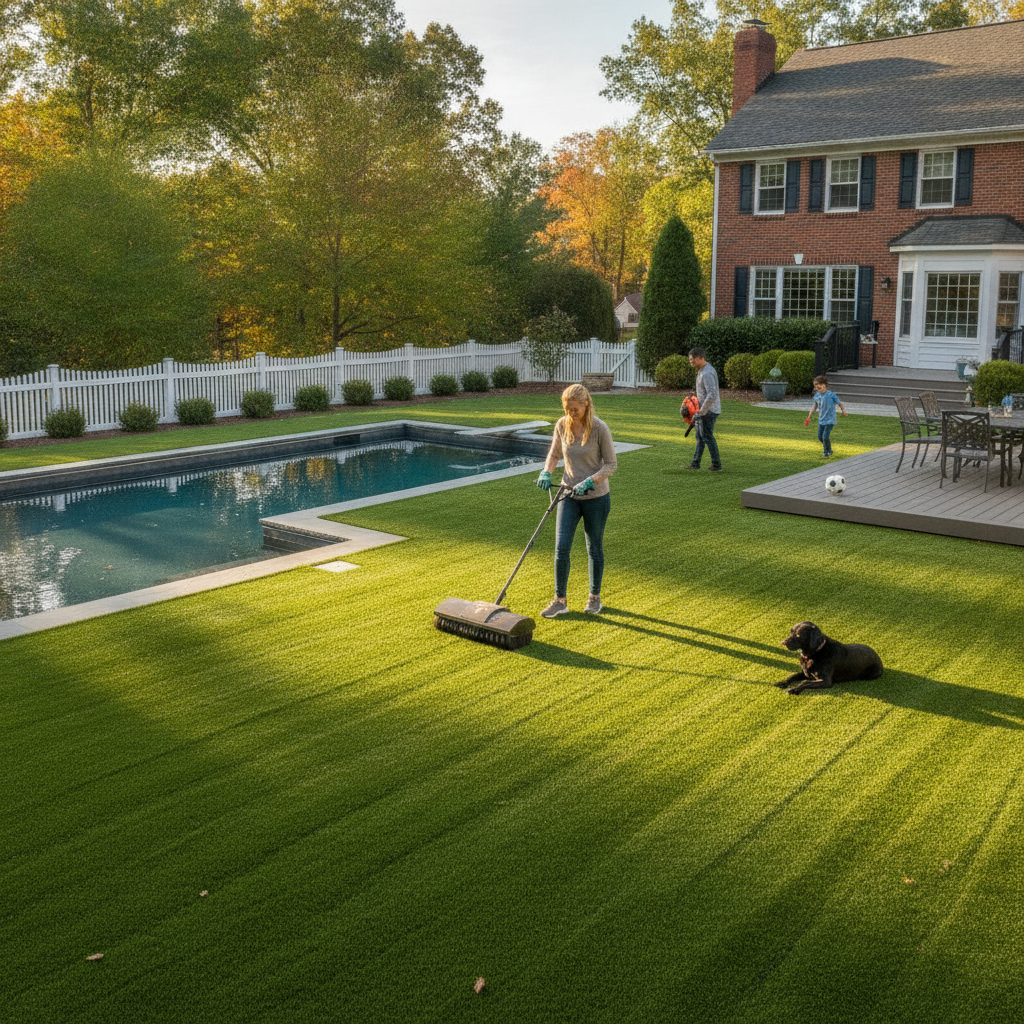
How Do You Maintain Artificial Turf Year-Round in Fairfax, VA? A Practical Upkeep Guide for Homeowners
Artificial turf in Fairfax, VA requires far less work than natural grass — no mowing, no fertilizing, no irrigation schedules — but it does have a maintenance routine, and understanding that routine is what separates turf that looks great for 20 years from turf that mats down, holds odors, or drains poorly by year five. If you’ve recently installed synthetic grass or you’re considering it, here’s a straightforward, season-by-season breakdown of what upkeep actually looks like in Northern Virginia’s specific climate.
Why Fairfax County’s Climate Makes Maintenance Habits Matter More Than You’d Think
The DMV area isn’t an easy environment for outdoor surfaces. Fairfax County gets heavy spring rains — often sustained downpours that can overwhelm a poorly installed base — followed by hot, humid summers where surface temperatures climb and organic material like pollen, leaves, and pet waste breaks down faster than it would in a drier climate. Then you get freeze-thaw cycles through January and February that stress seams, edges, and infill compaction.
None of this means your turf is fragile. It means that skipping routine care during the wrong season compounds into bigger problems. A professional installation with a properly engineered base and quality infill is the foundation — but what you do after that installation determines how long it performs at its best.
What a Realistic Weekly and Monthly Routine Looks Like
Most homeowners in areas like Burke Centre, Fairfax Station, and West Springfield find that a consistent light-maintenance habit takes less than 15 minutes a week. Here’s what that actually involves:
- Rinse high-traffic areas weekly. A standard garden hose is all you need. If you have dogs, rinse the areas they use most at least twice a week. This flushes ammonia compounds through the drainage layer before they have a chance to bind to infill particles.
- Remove debris promptly. Leaves, twigs, and seed pods should be blown or brushed off the surface regularly — especially in fall. Decomposing organic material sitting on turf in a humid Fairfax summer creates the conditions for mold and surface odors.
- Brush the pile once or twice a month. Use a stiff-bristled push broom or a power broom (available at most equipment rental shops) and work against the grain of the fibers. This keeps the pile upright, prevents matting in heavy-use zones like doorways and play areas, and redistributes infill that shifts over time.
- Inspect seams and edges quarterly. Check that seam tape hasn’t separated and that edge borders are still secured. In areas with freeze-thaw exposure, ground movement can occasionally shift edges — especially if the original base prep wasn’t deep enough.
Spring: Your Most Important Maintenance Window
After a Northern Virginia winter, spring is when you want to do your most thorough turf inspection. Check the entire surface for any areas where the base may have shifted, look for seam separation at joints, and do a full power-brush of the lawn to lift fibers that have been compressed under foot traffic or under a winter’s worth of rain and freeze cycles.
Spring is also pollen season in Fairfax County — and pollen accumulates in turf infill faster than most homeowners expect. A thorough rinse in April or May will clear pollen from the surface and drainage layer before it has time to compact into the base. If you have a pet-friendly turf system with a zeolite deodorizer layer, spring is also the right time to assess whether the zeolite needs recharging — typically a diluted salt-water rinse will reactivate it.
Summer: Heat, Humidity, and High-Traffic Management
Summers in Fairfax are warm and humid, and synthetic turf surface temperatures can rise significantly on black-infill systems without cooling features. If your turf uses a heat-resistant infill like ThermalCool or a coated sand product, you’re in better shape — but even then, rinsing the surface with a garden hose on peak-heat afternoons brings surface temperatures down quickly and gives pets and kids a more comfortable surface within minutes.
Summer is also when pet waste management becomes most critical. Solid waste should be removed immediately and the area rinsed. Liquid waste on a properly installed 5-layer drainage system (rated at 400+ inches per hour) will pass through cleanly, but the ammonia that remains on infill particles is what causes persistent odor. Consistent rinsing and an enzyme-based turf cleaner applied monthly during summer months keeps odors from building up.
For homeowners in Alexandria or Arlington with smaller yards and less air circulation between structures, odor management is especially important — enclosed spaces trap heat and amplify any organic compounds in the surface.
Fall: Clear Debris Before It Becomes a Drainage Problem
Leaf fall in Fairfax County can be heavy, especially in neighborhoods with mature tree canopies like Kings Park or areas near Burke Lake. Leaves sitting on turf for extended periods don’t just look messy — they can clog the micro-perforations in your turf backing and slow drainage performance over time.
A leaf blower set on low is the fastest tool for clearing turf. Avoid metal rakes, which can snag and pull turf fibers. Once leaves are cleared, do a final power-brush before temperatures drop to set the pile in good shape heading into winter.
Winter: What Freeze-Thaw Cycles Actually Do to Your Turf
Well-installed artificial turf handles Northern Virginia winters without issue — but there are a few things worth knowing. First, snow and light frost are fine to leave in place; they won’t damage turf fibers or infill. Avoid using metal shovels directly on the turf surface. A plastic shovel or a soft-bristle push broom works fine for clearing snow accumulation.
Do not use rock salt or calcium chloride on your turf to melt ice. These compounds can degrade certain infill types and damage the turf backing over repeated applications. If you need to speed up melting, diluted sand over the icy patch gives traction without chemical damage.
The bigger winter concern is what happens at the base level. If your sub-base wasn’t compacted to the right depth and density — typically 4 inches of decomposed granite compacted to 95% density — freeze-thaw cycles can cause slight ground heaving that stresses seams and edge borders. This is one reason choosing an experienced local installer matters more than it might seem. Crews who have worked in Fairfax County know how deep to go and how to prep for our specific winter conditions.
If you’re comparing installer options, reviewing the full installation guide is a good way to understand what proper base prep actually involves before you sign any contract.
What Competitors’ Maintenance Guides Miss
Most turf company websites in the DMV area cover maintenance in a single paragraph — or not at all. What’s almost never addressed is the interaction between infill type and regional climate. Crumb rubber infill, still used by some installers in the area, holds heat and odor more aggressively in humid summer conditions and can compact unevenly through winter cycles. Silica sand infill is more stable and easier to maintain, but requires more frequent top-dressing as it settles. Zeolite infill layers, used in pet systems, have a specific recharging protocol that most homeowners don’t know about unless their installer tells them.
These aren’t details you’ll find in a generic FAQ. But they directly affect how much work your turf requires and whether it performs well in year eight the same way it did in year one.
Frequently Asked Questions: Turf Maintenance in Fairfax, VA
How often should I brush my artificial turf?
Once or twice a month is sufficient for most residential lawns. High-traffic areas — near back doors, pet runs, and play zones — benefit from brushing every two weeks. Always brush against the grain of the pile fibers.
Can I use a pressure washer on my turf?
Yes, but use a low-pressure setting and a wide-fan nozzle. High-pressure, narrow-stream washing can displace infill unevenly and, over time, damage fiber roots at the backing. A standard garden hose handles 90% of what homeowners need.
Do I need to add infill over time?
Usually yes — not every year, but infill does settle and migrate with use and weather. Most installations benefit from a light top-dress of infill every three to five years. Your installer should be able to tell you what infill type your system uses so you can match it correctly.
Will leaves and organic debris stain my turf permanently?
Not if you clear them regularly. Extended contact with decomposing organic material in humid conditions can leave surface residue, but a diluted enzyme cleaner and a thorough rinse will clear it. The key is not letting debris sit through a wet week in October.
My turf has a bad smell near where my dog uses it — what should I do?
If your pet turf system was installed with a zeolite deodorizer layer and odor is still present, the zeolite may need recharging. A diluted salt-water rinse (roughly one pound of non-iodized salt per gallon of water) applied to the affected area and allowed to drain can reactivate the zeolite. If odor persists after that, contact your installer — it may indicate that the drainage layer is partially clogged and needs professional flushing.
Ready to Get Your Turf on a Proper Maintenance Schedule — or Start Fresh with a Quality Installation?
Whether you’ve had artificial turf for three years and want to make sure you’re maintaining it correctly, or you’re evaluating a new installation for your Fairfax home, backyard, or commercial property, Grassify is happy to walk you through exactly what’s involved. We’ve been working with homeowners across Fairfax County, Springfield, Alexandria, Burke, and the broader Northern Virginia area for over a decade, and we know this climate and these yards well.
Contact Grassify today for a free consultation — we’ll assess your existing turf or your yard and give you a straightforward recommendation with no pressure and no generic sales pitch.


