
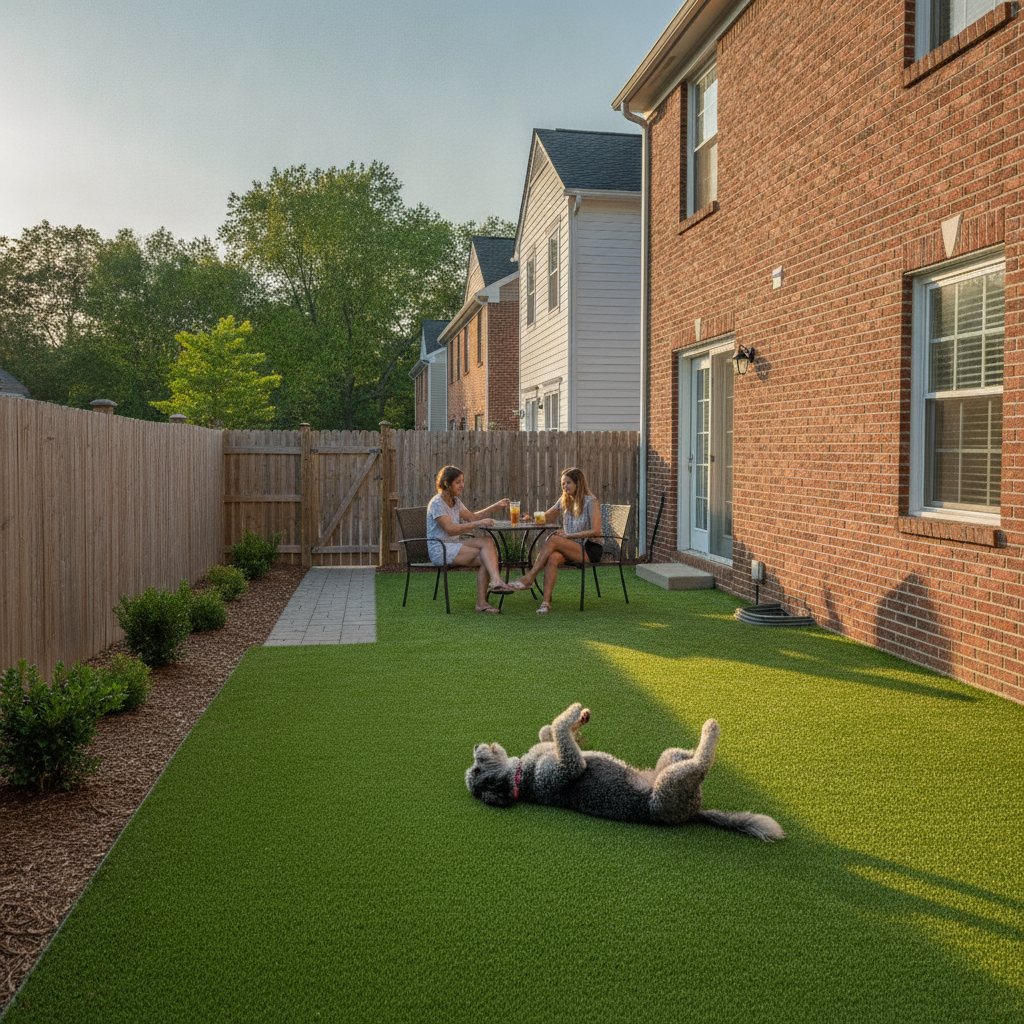
Is Artificial Turf Worth It for a Townhome with a Small Backyard in Alexandria, VA?
Yes — and for most Alexandria townhome owners, it’s one of the smartest investments they make in their property. A small backyard doesn’t mean artificial turf is overkill. In fact, it’s often where turf makes the most dramatic difference. When you’re working with 200 to 600 square feet of outdoor space, every square foot matters. Mud, bare patches, and struggling grass don’t just look bad — they make a small yard feel even smaller and harder to use. Replacing that with dense, green, low-maintenance synthetic grass transforms the space into something actually functional, year-round.
That said, townhome turf installation in the Northern Virginia area has some specific wrinkles worth understanding before you commit. HOA approval, tight installation access, drainage that can actually handle our wet springs, and choosing the right turf product for a compact space — none of that gets covered well by most of the installers working in this market. Here’s what you actually need to know.
Why Townhome Yards Are Uniquely Suited for Artificial Turf
Most townhome backyards in Alexandria, Arlington, and Fairfax County share a few common characteristics: they’re small, often fenced, sometimes shaded by the structure itself, and see heavy foot traffic relative to their size. Natural grass has a hard time thriving under those conditions. You’re fighting shade, compacted soil, and a yard that might get more use per square foot than a full quarter-acre suburban lot.
Artificial turf removes all of those variables. It doesn’t care about shade. It doesn’t compact under a dog’s daily patrol route or a kid’s play area. It stays green regardless of whether you watered it this week. For townhome residents who want a usable, attractive outdoor space without devoting hours to maintenance, it’s a genuinely practical solution — not just a luxury upgrade.
The cost equation also works well at small scale. A 300-square-foot backyard installation might run between $3,600 and $7,500 depending on the turf product, base work required, and access complexity. Spread that over a 15-year product lifespan and compare it to annual lawn care costs, reseeding, and irrigation — the numbers tend to favor turf, especially in HOA communities where curb appeal matters and you’re already paying fees for common area maintenance.
The Access Problem No One Talks About
Here’s where a lot of general landscapers and out-of-state turf franchises get into trouble with townhome installations: getting materials into the yard in the first place. Many Alexandria and Arlington townhomes have fenced backyards with a single gate — sometimes only 36 inches wide. There’s no side yard. No driveway access. No way to bring in a skid steer or large wheelbarrow without pulling fence sections.
An experienced installer plans for this from the first site visit. That means hand-hauling crushed aggregate base material through the house or over a fence, using narrower compaction equipment, and sequencing the work around access constraints that don’t exist on a standard suburban lot. If you get a quote from someone who didn’t walk your yard and ask about gate access, that’s a red flag. Tight-access installation takes longer and requires a crew that knows how to problem-solve in the field — not just roll out turf on an open lawn.
HOA Approval: What Alexandria Townhome Owners Need to Know First
If your townhome is governed by a homeowners association — and most in Alexandria, Burke, and the broader Fairfax County corridor are — you need architectural approval before any turf goes down. This is non-negotiable, and skipping it can result in costly removal requirements.
Most HOA architectural review committees want to see product specifications (fiber type, pile height, color), a site plan showing where turf will be installed, and sometimes a sample of the turf itself. The good news is that most well-manufactured residential turf products pass HOA review without issue when presented properly. What sinks applications is vague documentation or products that look too artificial in color or texture.
We’ve helped dozens of homeowners in HOA-governed communities navigate this process. The key is submitting a complete, professional package the first time rather than going back and forth with the review board. If you’re working with a residential turf installer who has local HOA experience, they should be able to help you prepare that submission — not leave it entirely in your hands.
Drainage in a Confined Space: Why This Matters More Than You Think
Northern Virginia gets serious spring rainfall — often several inches in a short stretch. In a small, enclosed townhome backyard, poor drainage doesn’t just mean soggy turf for a day. It means standing water, mildew risk, and potential damage to the turf base if water has nowhere to go.
Proper base prep for a small yard is the same engineering problem as a larger installation — it just has less margin for error. A quality installation uses 4 to 6 inches of compacted crushed aggregate with appropriate slope to direct water away from structures, combined with a perforated backing on the turf itself. Turf products with quality drainage backing can move water at 30 to 40 inches per hour or more — well ahead of even a hard DMV rainstorm. Don’t let any installer tell you drainage is a non-issue on a small yard. It’s the same problem; it just has less room to absorb mistakes.
For townhome owners with dogs, drainage takes on additional importance. A confined space where a dog spends time daily needs a turf system specifically designed for pet waste — not just standard residential turf. That means a multi-layer drainage system, zeolite deodorizer infill, and antimicrobial infill to prevent odor buildup in an enclosed area. Learn more about what separates a purpose-built pet turf installation from standard residential grass.
Choosing the Right Turf Product for a Small Townhome Yard
Not every turf product is appropriate for a compact residential space. Very long pile heights — 50mm and above — can look out of place in a small backyard and tend to mat down faster in high-traffic zones. For most townhome yards, a 35mm to 42mm pile height with moderate density strikes the right balance: it looks lush and realistic without overwhelming a small space or requiring constant grooming to stay upright.
Fiber shape also matters. S-shaped or W-shaped blade fibers tend to spring back better under foot traffic than flat-blade varieties — important in a yard where the same square footage absorbs all of your outdoor activity. UV-stabilized polyethylene fibers hold their color through the brutal Northern Virginia summers without fading or breaking down over time.
For townhome applications specifically, we often recommend products with a thatch layer built in — it adds a natural, layered look that photographs well and reads as more realistic at close range, which matters when neighbors and HOA board members are looking over your fence.
What the Installation Timeline Actually Looks Like
For a standard 200–500 square foot townhome backyard, installation typically takes one to two days once the HOA approval is in hand and materials are sourced. Day one covers demolition of existing grass or material, base excavation, aggregate installation, and compaction. Day two is turf layout, seaming, infill application, and edge securing. You’ll be using the space within 24 to 48 hours of completion.
Seaming quality is especially critical in small yards. Because you’re working in a tight space, seam placement and technique directly affects how the finished product looks at close range. Poorly executed seams on a large open lawn are easy to hide. In a small backyard, they’re impossible to miss. Ask your installer specifically about their seam techniques and request photos of previous small-yard installations before signing anything.
Frequently Asked Questions: Townhome Turf in Alexandria and Northern Virginia
Do I need a permit to install artificial turf in my Alexandria townhome backyard?
In most cases, no building permit is required for residential turf installation in Alexandria or Fairfax County. However, if your property is in an HOA community — which most Alexandria townhomes are — you’ll need architectural approval from your HOA before work begins. Your installer should be familiar with this process.
Will artificial turf make my small backyard look smaller?
It tends to do the opposite. Uniform green turf visually opens up a confined space more than patchy or uneven natural grass. Choosing a product with the right pile height and a natural-looking thatch layer makes a small yard feel intentional and well-designed rather than cramped.
Can artificial turf handle a dog in a small enclosed yard?
Yes, but only if you use a turf system specifically designed for pets — not standard residential turf. In a confined space with a dog, drainage rate and odor-control infill are critical. A basic residential product will develop odor problems quickly in an enclosed yard with regular pet use.
How do I handle the gate access issue during installation?
A good installer assesses access constraints during the initial site visit and adjusts their crew and equipment accordingly. This may mean hand-carrying materials, temporarily removing fence sections, or staging equipment differently. Ask specifically about this during your consultation — an experienced local installer won’t be surprised by the question.
What’s the cost range for a small townhome backyard turf installation in Northern Virginia?
Most small townhome backyard installations in the Alexandria, Burke, and Arlington area fall in the $12 to $25 per square foot range installed, depending on turf product, base work required, and access complexity. A 300-square-foot yard might run $3,600 to $7,500 total. Get an in-person quote — any number you find online without a site visit is an estimate, not a real price.
Ready to Transform Your Townhome Backyard?
If you’re a townhome owner in Alexandria, Arlington, Burke, or anywhere across Fairfax County who’s ready to stop fighting a losing battle with a small, struggling yard — we’d love to take a look at your space. Grassify has been installing artificial turf across the DMV for over a decade, and we know the specific challenges that come with townhome yards: tight access, HOA paperwork, drainage in confined spaces, and getting seams right when there’s nowhere to hide them.
We’ll walk your yard, give you honest recommendations, and put together a detailed proposal — no pressure, no upselling products you don’t need. Contact us to schedule your free consultation and let’s figure out what your backyard can actually become.


