
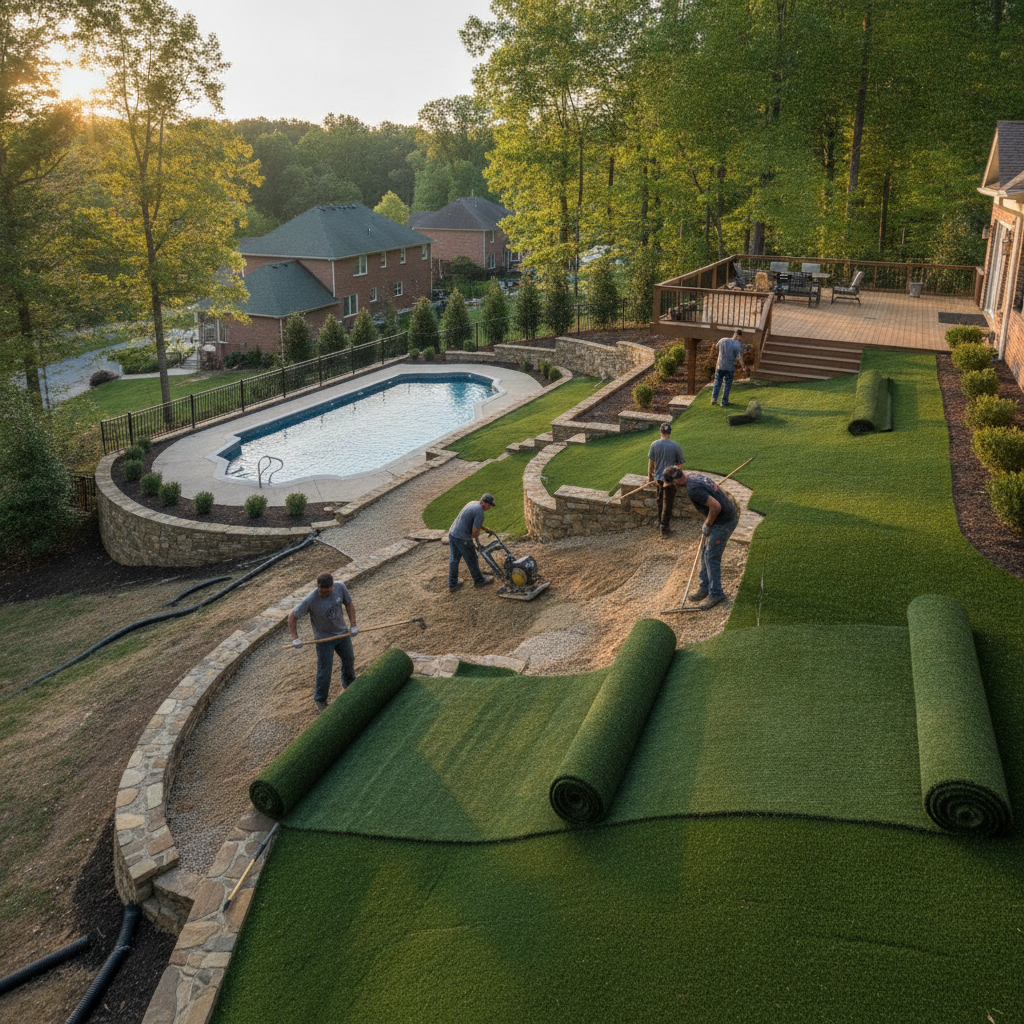
Can You Install Artificial Turf on a Slope or Hillside in Burke, VA?
Yes — and in Burke, VA, sloped yards are one of the most common requests we get. A huge portion of homes in Burke, Springfield, and across Fairfax County were built on rolling terrain with side yards, back embankments, and tiered lots that are an absolute nightmare to mow, seed, or keep alive through the summer. The good news: artificial turf handles grades well when it’s installed correctly. The catch is that “correctly” on a slope means something very different from a flat lawn install. Base engineering, drainage direction, anchoring method, and turf weight all have to be calibrated for the grade. Get any of those wrong, and you’ll have turf that buckles, slides, or turns into a waterfall channel during the first heavy spring rain.
This guide walks you through exactly what slope installation involves, where the technical complexity lives, and what questions to ask before you hire anyone to do the work.
Why Slopes Are Harder Than Flat Yards — and Why That Matters in Northern Virginia
On a flat surface, gravity is your friend. Water drains straight down through the turf backing, through the crushed aggregate base, and into the soil below. On a grade, gravity is still your friend — but now it’s also trying to pull your base material downhill, carry water laterally instead of vertically, and stress every seam and anchor point along the slope.
Northern Virginia makes this worse. The DMV area gets some of the heaviest spring rain events on the East Coast. A strong May storm can dump two to three inches in a few hours, and if your sloped turf isn’t engineered for lateral water flow, you’re looking at erosion underneath the backing, pooling at the toe of the slope, and infill migration that leaves bare, matted sections at the bottom. We’ve evaluated yards across Fairfax County where homeowners had turf installed by general landscapers who did beautiful flat-surface work but had no real protocol for grade management. The problems usually show up after the first full wet season.
What Slope Percentage Changes About Base Prep
The first thing a qualified installer should do before quoting a slope installation is measure the grade. Slopes are typically expressed as a percentage — rise divided by run. Here’s a rough framework for how grade affects installation approach:
- Under 10% grade: Minimal deviation from standard base prep. A 4-inch compacted aggregate base (typically Class II road base or decomposed granite) handles drainage and stability well. Standard perimeter nailing and stapling anchors the turf.
- 10–25% grade: This is where you need to think carefully. The base depth may increase to 5–6 inches to provide enough mass resistance. Drainage channels or French drain integration at the toe of the slope become important to redirect water that runs laterally down the grade. Turf is typically secured with additional anchor nails spaced more closely — often every 4–6 inches along horizontal seams rather than the standard 6–8 inches.
- Over 25% grade: Steep embankments need binder materials or geotextile stabilization layers incorporated into the base to prevent the aggregate itself from migrating. Some very steep slopes benefit from a concrete or compacted decomposed granite toe board at the bottom edge to give the turf a firm anchor. The turf is often laid in horizontal runs across the slope rather than vertical runs, which keeps seams perpendicular to the direction of water flow.
If an installer quotes your sloped yard and doesn’t ask about the grade percentage — or says their process is the same as any other yard — that’s a red flag worth taking seriously.
Drainage Engineering on a Grade: What Actually Needs to Happen
One thing that doesn’t get talked about enough in the turf industry is the difference between permeability and drainage engineering. Nearly all quality synthetic turf is permeable — water passes through the backing at rates of 30 to over 400 inches per hour depending on the product. That handles vertical drainage. But on a slope, you also have to manage the water that’s moving horizontally across the surface before it even hits the turf.
For sloped installations in areas like Burke Centre, Rolling Valley, or Signal Hill — neighborhoods with mature lots and significant grade changes — Grassify typically incorporates one or more of the following drainage solutions depending on what the yard needs:
- Perforated pipe at the toe of the slope to collect lateral subsurface flow and route it away from the foundation or neighboring property
- Graded swales built into the base prep that direct surface water toward a designated outflow point rather than letting it sheet across the turf
- Permeable base aggregate with a drainage fabric layer that allows water to move downward but resists base migration
The goal is to manage where water goes — not just hope it passes through. This is especially important for pet turf on grades. If you have dogs using a sloped yard, urine and wash water need a directed path out of the system. Grassify’s pet turf systems include a 5-layer drainage design with zeolite deodorizer and antimicrobial infill that achieves 400+ inches per hour drainage — but that only performs as intended when the base is sloped and drains correctly beneath it.
The Gap Most Turf Installers Don’t Fill: Seaming on a Grade
Here’s the section that almost no turf company in the DMV area addresses publicly, and it’s where a lot of sloped installations fail over time: seam management on a grade.
When turf rolls are seamed on a flat surface, gravity isn’t working against the bond. On a slope, the weight of the turf — especially once infill is added — creates a continuous downward pull on every horizontal seam. Over one or two freeze-thaw cycles (which Fairfax County gets every winter from roughly November through February), that pull can cause seams to gap, especially if they were adhered with standard seaming tape rather than a combination of tape and mechanical fasteners.
On any slope over 15%, Grassify uses a dual-method seaming approach: seaming tape bonded with outdoor-grade polyurethane adhesive, plus mechanical nail anchoring every 3–4 inches along the seam length. The seams are also oriented horizontally across the slope wherever possible, so the weight of the turf is distributed along the seam rather than pulling directly against it. This is backed by a lifetime warranty on all seams and edges — and it’s one of the reasons we’re specific about technique rather than just describing installation as a general process.
What About Erosion Control? Turf vs. Alternatives on a Slope
One underappreciated advantage of synthetic turf on a hillside is erosion resistance. Natural grass on a steep grade in Northern Virginia is a maintenance problem year-round: it’s nearly impossible to mow safely, it goes bare in shaded sections under tree canopy, and the root system often isn’t deep enough to prevent soil loss during the heavy rain events the region sees every spring.
Artificial turf, when installed with a proper geotextile layer and compacted base, acts as a protective cap over the soil. Water infiltrates through the turf rather than sheeting across bare ground, which dramatically reduces the erosion potential compared to a patchy natural grass slope. For homeowners in Great Falls or along the Fairfax Station corridor with steep, wooded rear lots, this is often a primary driver for choosing turf — not just aesthetics, but actual land stabilization.
If you’re considering residential turf for a lawn or embankment, make sure your installer understands the erosion control dimension and not just the aesthetic one. A properly installed turf surface can anchor the slope for 15–20 years with minimal maintenance, replacing a situation that required annual reseeding and constant intervention.
Cost Context for Sloped Installations
Slope installations typically run on the higher end of the residential cost range — generally $18 to $25 per square foot for moderate to steep grades, compared to $12 to $18 per square foot for straightforward flat-surface installs. The additional cost reflects longer labor hours for base grading, more aggregate material to build out the drainage bed, enhanced anchoring hardware, and the slower pace of precision work on an angled surface. Anyone quoting you flat-rate pricing on a steep hillside without accounting for these variables is either underestimating the job or planning to cut corners on the base.
Frequently Asked Questions: Sloped Turf Installation in Burke and Fairfax County
How steep is too steep for artificial turf?
There’s no absolute cutoff, but slopes over 35–40% become difficult to install safely and may require structural solutions like retaining walls or tiered terracing before turf is even a conversation. Between 25–35%, turf is viable but requires significant base engineering. Most residential yards in Burke and Springfield that we work on fall in the 10–25% range, which is very manageable with the right approach.
Will my HOA in Fairfax County have issues with turf on a visible slope?
It depends on the HOA’s governing documents. Many HOA communities in Fairfax County have aesthetic guidelines that address ground cover materials, and some specifically call out slopes or embankments visible from the street. You’ll typically need to submit a material sample, an installation diagram, and sometimes a rendering showing how the finished turf will look. Grassify can provide all of that documentation as part of the project process.
Can I install turf on a slope myself?
For a gentle grade under 10%, a skilled DIYer with experience in landscape base prep can manage it — though base compaction equipment is non-negotiable. For anything over 10%, the drainage engineering and anchoring complexity make professional installation strongly advisable. The failure points on slope installs are almost always in the base and seaming, not the turf itself.
How does infill behave on a slope over time?
Infill migration is a real issue on steeper grades. Sand and crumb rubber infill can gradually work their way downhill, leaving the upper section of the turf sparse and the lower section compacted. Grassify uses a stabilized infill application on grades — typically a combination of coated sand and zeolite that binds slightly once settled — and the anchor nail pattern is designed to reduce infill movement between anchor points.
Does sloped artificial turf need more maintenance than flat turf?
Marginally, yes. You’ll want to brush the turf back uphill a couple of times per year to counteract fiber lay direction caused by gravity and foot traffic. Debris — leaves, mulch from adjacent beds — tends to collect at the toe of the slope, so that area needs attention after wind events. Otherwise, maintenance is similar to any other turf installation: occasional rinsing, seasonal inspection of edges and seams.
Ready to Talk Through Your Slope Project?
If you’ve got a hillside, embankment, or tiered yard in Burke, Springfield, Alexandria, or anywhere across Fairfax County that’s been a problem area for years, Grassify is the right call. We’ve been engineering sloped turf installations across the DMV for over a decade, and we’ll give you an honest assessment of what your specific grade needs — base depth, drainage routing, anchoring method, and realistic cost — before we ask you to sign anything. Request your free on-site consultation here and we’ll come out, measure the grade, and walk you through exactly what the install involves.


