
How Does Artificial Turf Handle Heavy Rain and Drainage in Burke, VA? What Homeowners Need to Know
Artificial turf drains exceptionally well — but only when it’s been installed correctly. That distinction matters a great deal in Burke, VA, where the spring rainy season regularly delivers two to four inches of rain in a single week and summer thunderstorms can dump an inch of water in under an hour. If your synthetic grass system isn’t engineered with the right backing, base material, and slope, you’re not solving your drainage problem — you’re hiding it under a layer of green plastic until it gets worse.
This is one of the most important topics we see glossed over by both national turf franchises and general landscapers trying to break into the turf market. Here’s the full picture on what proper turf drainage actually requires in Northern Virginia, and how to tell the difference between a system that’s built to last and one that’s going to fail after the first heavy storm.
Why Drainage Is a Bigger Deal in Northern Virginia Than Most Installers Admit
The DMV area sits in a humid subtropical climate with one of the highest annual rainfall averages on the East Coast — typically around 41 inches per year in Fairfax County. Burke itself gets hammered in spring with consistent multi-day rain events, and many yards in neighborhoods like Burke Centre and Rolling Valley have clay-heavy soil that doesn’t absorb water naturally. Natural grass in those yards is already fighting a losing battle. Synthetic grass installed over that same clay base, without proper drainage engineering, will turn into a swamp.
The freeze-thaw cycle makes it worse. During winter, moisture trapped in a poorly prepared base will expand and contract repeatedly, breaking apart the compacted aggregate layer and causing the turf surface to shift, buckle, or develop soft spots. By the time spring arrives, homeowners are dealing with seam separations, edge lifting, and a surface that no longer drains evenly. These are not product failures — they’re installation failures rooted in inadequate drainage prep.
What a Properly Engineered Turf Drainage System Actually Looks Like
There are three components that have to work together for artificial turf to drain properly in a heavy-rain climate like ours: the turf backing itself, the base material layer, and the site grading.
1. Perforated Backing — and Why the Hole Count Matters
Every quality artificial turf product should have a perforated backing — small holes punched through the turf’s polyurethane or latex backing layer that allow water to pass through rather than pooling on the surface. But not all perforated backings perform equally. A turf product with a drainage rate of 30 inches per hour might sound impressive until you compare it to products designed for high-rainfall climates, which can hit 300 to 1,000+ inches per hour depending on how the backing is engineered.
For standard residential lawns in Burke or Springfield, a drainage rate in the 30 to 100 in/hr range is typically sufficient. For pet turf applications, you need significantly higher — Grassify’s pet-friendly turf systems are built around a 5-layer drainage design that achieves drainage rates exceeding 400 inches per hour, because pet urine combined with heavy rain creates a compounding problem that a basic perforated backing simply can’t keep up with.
2. The Aggregate Base — Where Most Budget Installs Cut Corners
The turf backing does nothing if the base material underneath it is saturated and can’t accept water flow. A properly installed turf base in Northern Virginia typically requires 3 to 4 inches of compacted crushed aggregate — usually decomposed granite or Class II road base — graded to promote water movement toward a defined drainage edge or collection point.
This is the step where general landscapers and low-bid installers tend to cut corners. Some use sand or native soil as a base, which compacts differently, retains moisture, and shifts under freeze-thaw stress. Others skip proper compaction equipment altogether, leaving a base that looks fine at installation but develops low spots within one or two seasons. On top of a clay subgrade like many Burke and Fairfax County yards have, this creates a perched water table — water collects just below the turf surface with nowhere to go.
A quality installer will also add a weed barrier fabric between the subgrade and the aggregate, and in some cases a drainage channel or perforated pipe at the low end of the installation to direct water away from the yard entirely. This isn’t optional in the DMV — it’s standard practice for a system that will hold up over a 15 to 20 year lifespan.
3. Site Grading — The Step That Determines Everything Downstream
Even perfect backing and a solid base won’t save you from standing water if the yard isn’t graded correctly. Water needs somewhere to go. Most residential turf installations in Alexandria, Burke, and Springfield require a slope of at least 1% (roughly one inch of drop per eight feet of run) toward a natural drainage point — a garden bed edge, a storm drain, a swale, or a permeable border.
If your yard has a bowl shape, low spots, or drains toward your foundation, that needs to be corrected during base prep — not worked around. Trying to compensate with a higher-drainage turf product won’t fix a grading problem. Water still has to physically flow somewhere.
What Happens When Drainage Is Done Wrong
We’ve seen it across Fairfax County more times than we can count: a homeowner gets a low quote from a general contractor or a national franchise that subs out the installation, and within a season or two they’re dealing with:
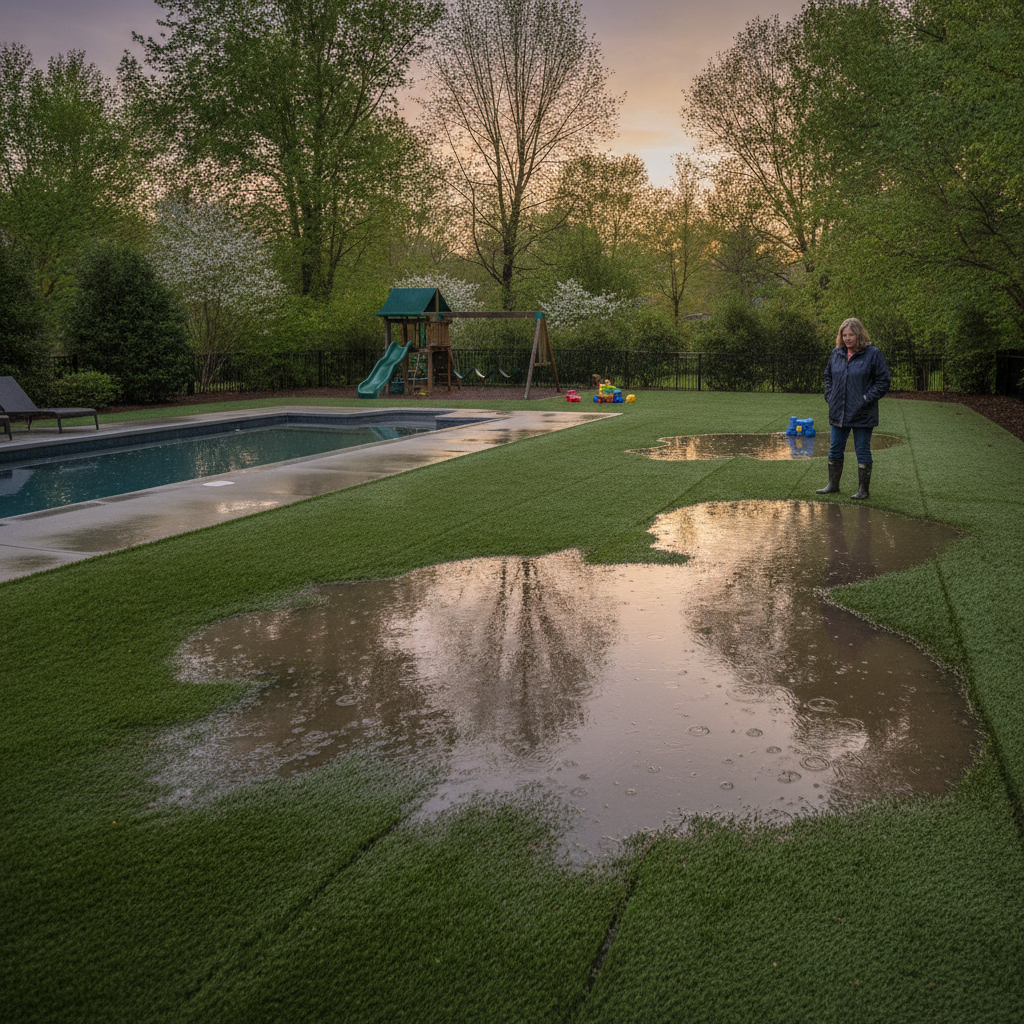
- Puddles that sit on the turf surface for hours after rain
- Soft or spongy spots where the base has shifted or saturated
- Edges and seams lifting as the base material moves under freeze-thaw pressure
- Odor problems in pet turf areas where urine isn’t draining fully through the system
- Mold or algae growth in low-drainage zones that stay perpetually damp
None of these problems are cheap to fix after the fact. Remediation typically requires pulling up the turf, regrading and recompacting the base, and re-installing — which can cost nearly as much as the original job. This is exactly why Grassify backs every installation with a lifetime warranty on seams, edges, and base preparation. If the drainage fails because of how we built it, we come back and fix it. That warranty is only possible because we don’t cut corners on base prep in the first place.
If you’re considering a residential lawn installation and want to understand the full scope of what goes into a properly built system, our installation guide walks through each step in detail.
What to Ask Any Turf Installer About Their Drainage Plan
Before you sign a contract with any turf company serving Northern Virginia, ask these questions directly:
- What drainage rate does your turf backing achieve, and how is that tested? A credible installer can cite a specific number and explain the testing method.
- What base material do you use, and how deep will it be? Anything less than 3 inches of compacted crushed aggregate is a red flag for Northern Virginia’s soil conditions.
- How will you handle my yard’s existing drainage pattern? They should assess your grading before giving you a quote, not after.
- Do you use compaction equipment on-site? Hand tamping a base is not adequate for a long-term installation.
- What does your warranty cover, and does it include base failure? Many installers warranty the product but not the installation work.
If an installer can’t answer these questions clearly — or gives you vague answers about “industry-standard drainage” without specifics — that’s a sign they’re not engineering the system, they’re just laying grass.
Frequently Asked Questions: Turf Drainage in Burke and Northern Virginia
Does artificial turf cause flooding or redirect water toward my foundation?
Not when it’s installed correctly. A properly graded and drained turf system actually moves water away from your foundation more predictably than natural grass, which can develop bare patches, ruts, and erosion channels over time. The key is making sure the base is graded away from your house — something your installer should confirm during site assessment.
Can turf handle the spring rainy season in Fairfax County?
Yes — if the drainage rate and base prep are appropriate for the volume. A residential turf system with a 30 to 100 in/hr drainage rate handles normal rainfall easily. The issue in Fairfax County is less about rainfall intensity and more about what happens to that water once it passes through the turf — which is a base prep and grading question, not a turf product question.
Will my artificial turf in Burke hold up through freeze-thaw winters?
It will if the base is compacted correctly and the drainage system prevents moisture from sitting trapped below the surface. Crushed aggregate bases that drain freely are far more resistant to freeze-thaw heaving than native soil or sand bases. This is why base material selection matters so much in Northern Virginia.
My yard has clay soil. Is that a problem for turf drainage?
Clay soil is one of the most common soil types across Fairfax County and Prince William County, and it does require attention during base prep. The solution is to excavate the native clay to sufficient depth, install a drainage fabric, and replace it with a compacted permeable aggregate that won’t retain water. Skipping this step is what causes the drainage failures you see in poorly installed systems.
How do I know if my current artificial turf has a drainage problem?
After a moderate rainstorm (half an inch or more), walk your turf surface. If water is still pooling on the surface more than 30 minutes after the rain stops, your drainage system isn’t performing correctly. Soft or spongy areas are also a sign that the base is retaining moisture. Both issues are worth addressing sooner rather than later — water damage to a base compounds over time.
Get a Drainage Assessment Before You Install
If you’re planning a turf installation in Burke, VA — or anywhere across Northern Virginia — drainage engineering isn’t a line item to negotiate away. It’s the foundation of a system that will perform the way you expect it to, through heavy spring rain, humid summers, and cold winters, for 15 to 20 years.
Grassify does a full site drainage assessment before every installation. We look at your soil type, existing grading, drainage patterns, and proximity to structures before we ever recommend a product or build a quote. That’s the difference between a yard that performs and a yard that fails.
Request your free consultation today and let’s build a system that’s engineered for what Northern Virginia weather actually delivers — not what the brochure assumes.


