
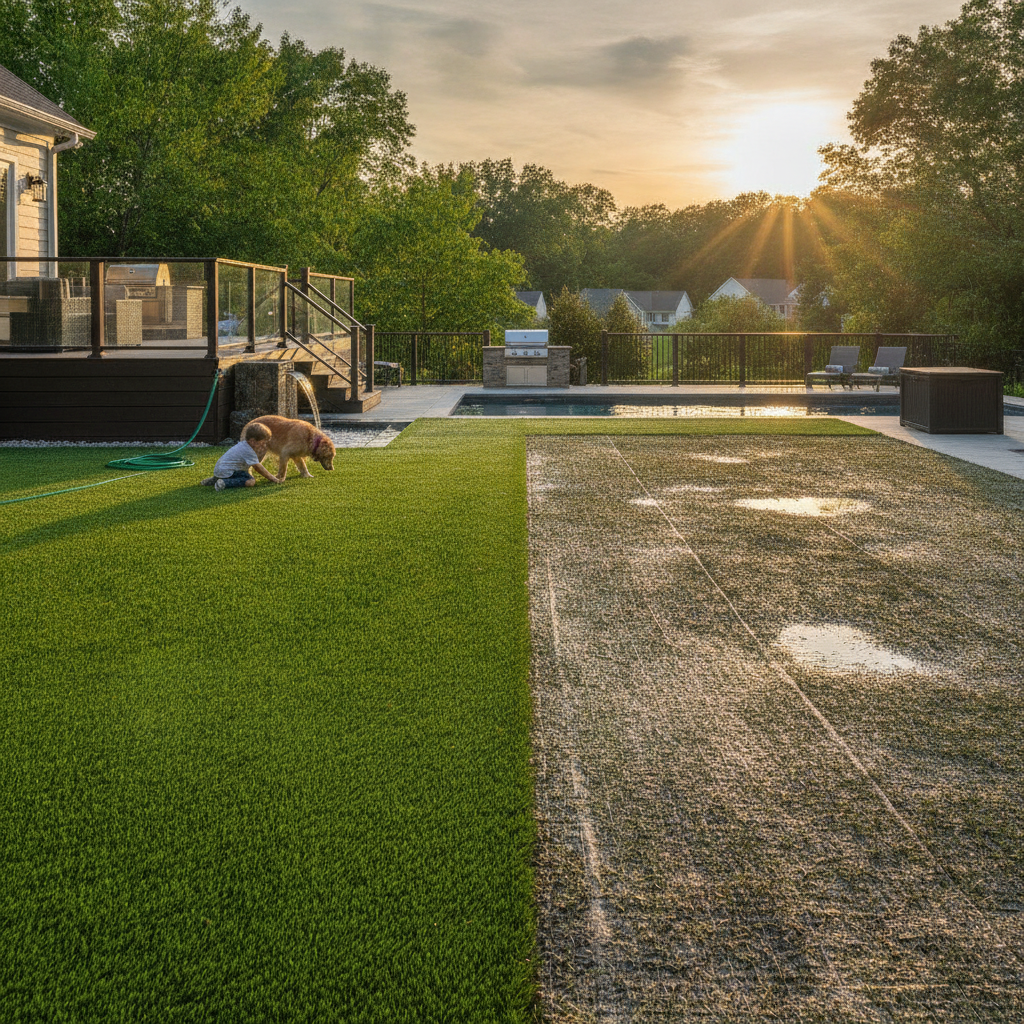
What’s the Real Difference Between Artificial Turf Brands in Burke, VA? How to Compare Products Before You Buy
If you’ve started researching artificial turf in Burke, VA, you’ve probably already noticed that every installer has a branded product with a sleek name, and most of them sound roughly the same in a brochure. The real differences — the ones that will matter when your yard is baking under a July sun or getting hammered by a March downpour — are buried in the technical specs. Fiber denier, backing construction, drainage flow rate, UV stabilization rating, infill compatibility: these are the numbers that separate a lawn that looks great for fifteen years from one that flattens, fades, or starts smelling like a dog run after the third summer.
This isn’t a ranking of every turf brand on the market. It’s a practical guide to reading product specs the way an installer reads them — and knowing what questions to ask before you sign anything.
Why Product Selection Matters More Than Most Installers Admit
One of the most consistent gaps across local competitor websites is the near-complete absence of product-level guidance. Most turf company sites in the DMV area either push a single brand without explanation or offer a vague dropdown menu of “luxury,” “standard,” and “commercial” tiers. That doesn’t help you understand why one product costs $6 more per square foot than another — or whether that difference is worth it for your specific yard, application, and household.
The truth is, product selection isn’t one-size-fits-all. A 50mm, high-pile residential lawn product is the wrong choice for a pool deck. A low-pile, sand-filled putting green surface is a bad fit for a yard with two large dogs. And a budget-tier product with a single-layer backing might perform adequately in Arizona but will struggle with the freeze-thaw cycles and heavy spring rainfall that are standard in Fairfax County.
The Four Specs That Actually Determine Turf Quality
1. Fiber Type and Denier
Artificial turf fibers are almost universally made from polyethylene (PE), polypropylene (PP), or a blend of both. For residential lawns in Northern Virginia, you want PE fibers — they’re softer underfoot, more UV-resistant, and they hold their shape better over time. PP fibers are stiffer and cheaper; you’ll find them in budget rolls and some commercial applications where foot traffic matters more than aesthetics.
Denier refers to the thickness of individual fiber strands. Higher denier (typically 8,000–13,000 for quality residential products) means a denser, more durable blade that resists matting. Lower denier fibers feel softer initially but flatten faster under regular use. If you have kids, dogs, or just a yard that gets regular foot traffic, don’t go below 8,000 denier on the face fiber.
2. Pile Height and Face Weight
Pile height — the length of the fiber blade — typically ranges from 30mm to 50mm for residential lawns. A 35mm–40mm pile is the sweet spot for most Burke and Springfield backyards: realistic appearance, manageable heat retention, and easier to keep debris-free. Going above 45mm looks lush but requires more grooming to prevent matting, especially in shaded corners or high-traffic paths.
Face weight (measured in ounces per square yard) tells you how much fiber material is actually in the product. A face weight below 50 oz/yd² is generally a red flag for residential applications. Quality residential turf runs 60–80 oz/yd², while premium pet and high-traffic products often hit 80–100 oz/yd². Don’t let a salesperson substitute pile height for face weight — a tall, sparse blade looks fine in the showroom and fails fast in the yard.
3. Backing Construction and Drainage Rate
This is the spec that separates installers who understand Northern Virginia’s climate from those who don’t. The DMV gets an average of 40+ inches of rain per year, with heavy spring events that can dump two inches in an hour. If your turf backing can’t move water fast enough, you end up with pooling, soggy infill, and — in pet areas — bacterial buildup that no amount of rinsing will fix.
There are two common backing types: standard polyurethane-coated woven backing and perforated or flow-through backing. Standard backing relies on small drainage holes punched at intervals; flow-through backing uses an open-weave structure that drains uniformly across the entire surface. For residential lawns in Fairfax County, flow-through backing with a drainage rate of at least 30 inches per hour is the minimum you should accept. For pet turf applications, that number should be significantly higher — systems engineered for dog yards should hit 400+ inches per hour with a proper 5-layer drainage base beneath them.
4. UV Stabilization and Warranty Terms
Every quality turf product includes UV stabilizers in the fiber extrusion process. The question is how long those stabilizers are rated to last under direct sun exposure. Budget products often carry 5–8 year UV warranties. Premium products are rated for 15+ years. In a yard with full southern exposure — common in Burke Centre and Rolling Valley neighborhoods — the difference between a properly UV-stabilized fiber and a cheap alternative will be visible within three years as color fade and fiber brittleness.
Read the warranty language carefully. A “15-year product warranty” that only covers manufacturing defects and excludes UV fade, seam separation, or backing delamination is not a 15-year warranty in any meaningful sense. Ask specifically: what does the warranty cover, what voids it, and who handles the claim — the manufacturer or the installer?
Matching the Product to the Application
Even within a single yard, the right product varies by zone. Here’s how to think about it:
- Residential lawns (front or back): 35mm–45mm pile, face weight 60–80 oz/yd², PE fiber, flow-through backing, natural green color variation with thatch layer for depth
- Pool decks and patios: Lower pile (25mm–35mm), heat-resistant fiber coating, chlorine-resistant backing, slip-resistant texture — pile height matters less than heat performance and drainage here
- Pet areas: Antimicrobial infill compatibility, flow-through backing rated for high drainage, zeolite deodorizer layers as part of the infill system, and short-to-medium pile that’s easy to rinse and dry
- Putting greens: Nylon fiber (not PE), very low pile height (10mm–20mm), sand infill for true ball roll — this is a completely different product category from lawn turf
If an installer is quoting you a single product for all of these applications, that’s a sign they’re prioritizing simplicity over performance. A yard in Alexandria with a pool surround, a dog run, and a small putting corner actually needs three different products installed across the same project.
What Grassify Uses and Why
At Grassify, we carry purpose-built product lines for each application. Our Lush Life product is engineered specifically for residential lawns and pet areas — UV-stabilized PE fiber, flow-through backing, and infill compatibility with both silica sand and antimicrobial zeolite systems. We don’t upsell a single premium SKU for every job; we match the product to the site conditions, the use case, and the HOA requirements that apply in communities across Burke, Fairfax, Springfield, and Arlington.
Every installation comes with a lifetime warranty on seams, edges, and base prep — not a manufacturer warranty that disappears when the brand gets acquired. When something fails, you call us, not a 1-800 number.
Frequently Asked Questions
Is expensive turf always better than budget turf?
Not automatically, but there’s a meaningful quality floor. Below roughly $12–$14 per square foot installed in Northern Virginia, you’re almost always looking at compromises in backing quality, UV stabilization, or fiber denier that will show up within five years. Above that threshold, you’re paying for specific performance characteristics — make sure those characteristics match your actual application.
Can I buy turf from a big-box store and have it installed separately?
Technically yes, but most licensed installers in the DMV area won’t warranty labor on materials they didn’t supply. If the product fails, you’re in a gray zone — the retailer points to installation, the installer points to materials. It’s cleaner and often cheaper long-term to have your installer supply the product under a single warranty.
Does pile height affect how hot the turf gets in summer?
Yes. Taller, denser piles retain more heat. In Alexandria and Arlington yards with full southern exposure, a 50mm high-pile product can reach surface temperatures that are uncomfortable for barefoot use on hot afternoons. Heat-resistant fiber coatings and lighter color blends help, but so does right-sizing your pile height for the exposure conditions of your specific yard.
How do I know if a turf product is HOA-compliant before I order it?
HOA architectural guidelines in Fairfax County communities typically regulate pile height, color (natural-looking vs. bright greens are often specified), and sometimes fiber type. Before selecting any product, pull your HOA’s current architectural standards document and confirm that the specific product you’re considering — not just “artificial turf” generically — meets those specs. Grassify handles HOA documentation and product approval submissions as part of every residential project.
What’s the warranty difference between a manufacturer warranty and an installer warranty?
A manufacturer warranty covers product defects — things like fiber shedding, backing delamination, or color fade beyond rated limits. An installer warranty covers the workmanship: seam integrity, edge stability, base prep performance, and drainage function. You need both, and they should be clearly spelled out in separate terms. If an installer can only offer you the manufacturer’s warranty and nothing else, you have no protection against installation failures.
Ready to Choose the Right Turf for Your Yard?
Comparing turf products on a spec sheet is a starting point, but the right choice depends on your specific yard, your household, your HOA requirements, and the soil and drainage conditions on your property. If you’re in Burke, VA or anywhere across Fairfax County, reach out to Grassify for a free on-site consultation. We’ll assess your space, walk you through the product options that actually make sense for your application, and give you a clear, itemized quote — no pressure, no upsell, no vague brochure language.


