
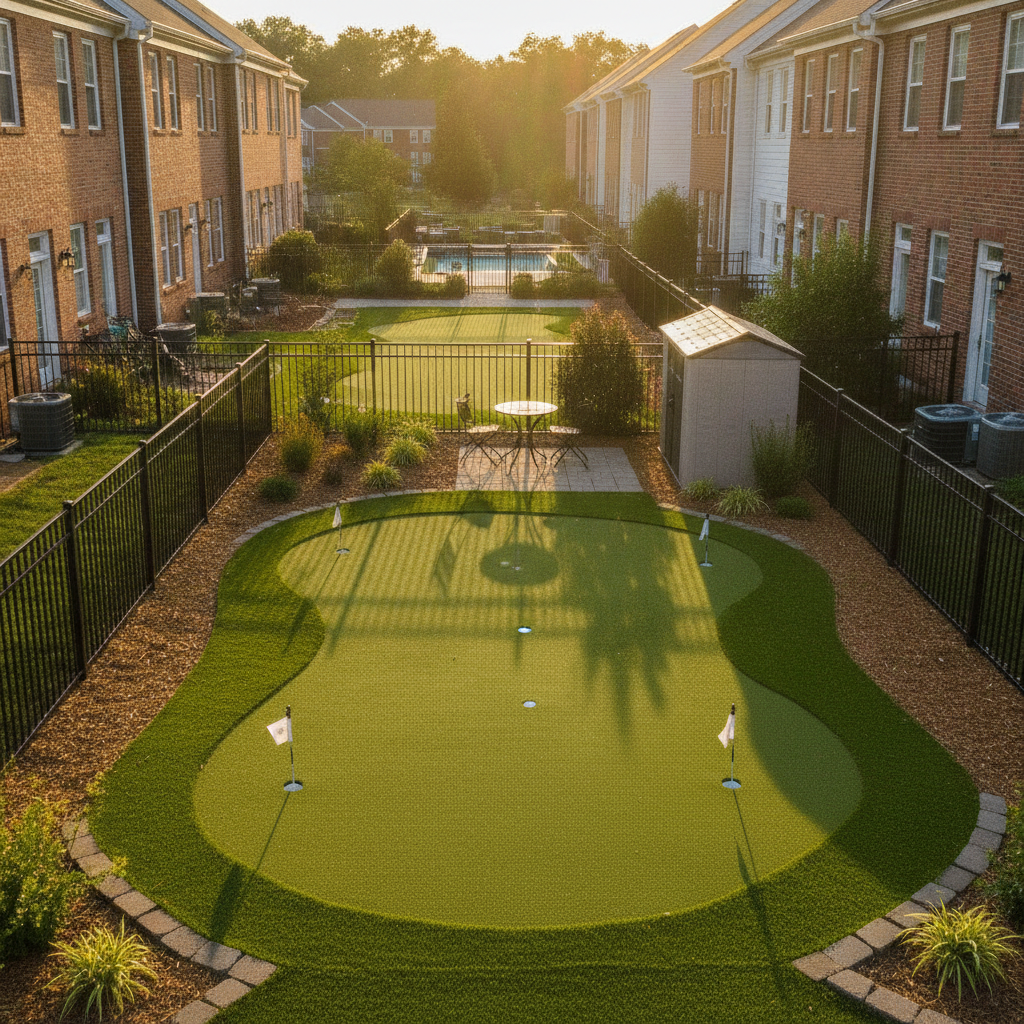
Can You Install a Backyard Putting Green in a Townhome or Small Yard in Springfield, VA?
Yes — and you might be surprised how little space you actually need. Plenty of golf enthusiasts in Springfield, West Springfield, and neighboring parts of Fairfax County have built fully functional putting greens in backyards that measure 200 to 400 square feet or less. The key isn’t square footage. It’s smart design, the right turf product, and an installer who has actually worked in tight residential spaces before — because a lot of them haven’t.
Most of the putting green content you’ll find online is written for people with a half-acre lot in the suburbs. It assumes you have open access, room for multiple holes, elevation changes, and space to grade the base without worrying about fences, gates, or neighboring units. That’s not the reality for most homeowners in Springfield, Burke, or the townhome-dense corridors just off the Beltway. This article is written specifically for those of you working with what you’ve got — a modest backyard, possibly a narrow side yard, maybe a concrete patio you want to repurpose.
What Putting Green Size Actually Works in a Small Yard?
The good news: a workable putting green doesn’t need to be large. A 150–250 square foot green is enough for a single hole with a meaningful roll and a short chip zone. If you’ve got 300–450 square feet to work with, you can fit two to three holes with gentle contour changes that actually improve your short game practice. Anything larger than that and you’re moving into territory more typical of larger residential lots in Great Falls or Fairfax Station — though that’s a nice problem to have.
The more important question isn’t size — it’s shape and grade. A rectangular or L-shaped green can often be fitted into a narrow townhome backyard in ways that a square layout can’t. And subtle elevation changes of just 1–3 inches, built into the crushed aggregate base, create realistic ball breaks that make practice genuinely useful rather than just decorative.
The Turf Product Makes a Real Difference
Not all synthetic grass rolls the same, and that matters enormously for putting practice. Standard residential turf — even high-quality landscape turf — is designed for visual appeal and foot traffic comfort. Putting green turf is engineered for ball speed, consistency, and true roll. Those are different technical requirements, and they call for a different fiber construction and infill approach.
At Grassify, we use Pro Putt for backyard putting greens. It’s a low-pile, dense-weave surface designed specifically for golf applications — tight enough to give you predictable ball roll, durable enough to handle daily chip shots, and stable under a fine silica sand infill that locks fibers upright without creating bounce inconsistency. Unlike standard landscape turf with a 30–50mm pile, putting green turf runs at 12–15mm, and that low profile is what makes the surface play true.
If you’ve seen putting greens that look great in photos but play like you’re putting on carpet, the problem is almost always the wrong turf product — usually a landscape turf installed by someone who doesn’t specialize in golf applications.
Base Prep in a Small Yard: Why This Step Can’t Be Rushed
The base is what separates a putting green that lasts 15 years from one that starts buckling and shifting after two wet winters. In Northern Virginia, that matters even more than it does in drier climates. Springfield and the surrounding Fairfax County area gets significant spring rainfall — often 3–5 inches in a single week during March and April — and the freeze-thaw cycles through January and February put real stress on anything built on an improperly compacted sub-base.
For a putting green installation, we typically excavate 4–6 inches, depending on the existing soil composition, then install a compacted crushed aggregate base (typically decomposed granite or Class II road base) that provides both stability and drainage. The drainage layer is critical — water that pools under a putting green surface will deform the base over time, creating soft spots and dead zones in the green that ruin ball roll and eventually damage the turf backing.
In townhome backyards specifically, base prep in tight spaces requires hand-tool work and sometimes wheelbarrow staging when equipment access through the gate isn’t possible. That’s normal for experienced crews. If an installer quotes you a job without asking about your gate width or access path, that’s a flag worth noting.
HOA Approval for Putting Greens in Fairfax County Communities
If your townhome or single-family home is part of an HOA-governed community — which covers a large portion of Springfield and West Springfield — you’ll want to check your architectural guidelines before scheduling installation. Most HOAs in Fairfax County that allow synthetic turf will also allow a backyard putting green, but some have specific rules about the appearance of synthetic surfaces visible from common areas or neighboring units.
The typical HOA approval process involves submitting a site plan, a product spec sheet showing the turf’s appearance and color, and sometimes photos of comparable installations. This is something Grassify walks clients through regularly. We can provide the documentation packages HOA architectural review committees typically request, and we’ve worked with HOAs across Fairfax County and the broader DMV area often enough to know what usually gets approved without pushback — and what tends to generate questions.
If you’re unsure whether your HOA allows synthetic turf, the safest move is to check your CC&Rs and submit a written inquiry to your architectural review committee before committing to a design. We’re happy to help you think through what to submit. Learn more about our full range of backyard putting green installation services and what that process looks like from start to finish.
What the Installation Timeline Actually Looks Like
For a small-yard putting green in a townhome or modest residential setting, expect the full installation to take one to two days once materials are staged. That includes excavation, base compaction, drainage prep, turf cutting and seaming, sand infill, and hole cup installation. More complex designs with multiple holes, fringe turf borders, or elevation changes may run into a second or third day.
From the time you sign a contract, lead time to installation typically runs two to four weeks depending on season. Spring and early summer are the busiest windows in this market — if you’re thinking about a putting green for summer use, reaching out in March or April puts you in a better position than waiting until June.
Cost for a backyard putting green in the Springfield and Fairfax County area generally runs in the $15–$25 per square foot range, depending on complexity, number of holes, fringe turf inclusion, and site access conditions. A 250-square-foot green might run $4,000–$6,000 fully installed. That’s a rough range — your actual quote will depend on what your specific yard looks like.
Why General Landscapers Usually Aren’t the Right Fit for This
Backyard putting greens are one of those jobs that look simpler than they are. The base engineering, the turf selection, the infill calibration, and the contouring all require specific experience that most general landscapers and even some synthetic grass installers don’t have. The DMV area has seen an influx of out-of-state franchise turf companies and general landscaping crews offering synthetic grass services — and the quality variance is significant.
A crew that primarily installs landscape turf will often use the wrong product for a putting green, skip the proper aggregate base in favor of a thinner setup, or apply infill quantities that create an inconsistent playing surface. None of these failures are obvious at installation. They show up six months later when you notice the ball breaking differently across different parts of the green, or two years later when a soft spot develops after a hard winter.
Grassify is based in Burke and has worked across Fairfax County — including Springfield and Alexandria — long enough to know what the soil conditions, drainage requirements, and HOA dynamics in this area actually demand. Our installation warranty covers seams, edges, and base integrity for the life of the product, not just the first year.
Frequently Asked Questions
How small is too small for a backyard putting green in Springfield?
There’s no firm minimum, but below 100 square feet you’re really looking at more of a chipping mat than a functional green. A 150–200 square foot footprint gives you enough room for a single hole and a short approach zone that’s actually worth practicing on.
Can a putting green be installed over an existing concrete patio?
Yes, in many cases. If the concrete is structurally sound, level, and has adequate drainage, we can install putting green turf directly over it using an appropriate adhesive and shock pad system. This is actually a common setup for Alexandria and Arlington townhome residents who have a concrete patio they want to convert.
Will my HOA automatically reject a putting green application?
Not usually. Most HOAs in Fairfax County that allow synthetic turf will also approve a backyard putting green, especially if it’s not visible from the street or common areas. Approval is more likely when you submit a complete application with product documentation showing the turf’s natural appearance and color.
Does a putting green drain properly in heavy rain?
A properly built putting green with a crushed aggregate base drains very efficiently — typically at rates well above what Northern Virginia’s heaviest rainfall events produce. The key is that the base has to be engineered for drainage, not just compacted flat. That’s a base-prep question, not a turf question.
Can I add fringe turf around a putting green in a small yard?
Yes, and we’d recommend it. A fringe turf border (usually a slightly taller pile height than the putting surface itself) gives your green a finished, realistic look and also defines the chip zone clearly. In a small yard, it can also serve as the primary ground cover, so you’re getting both a putting green and a clean, low-maintenance lawn surface in a single installation.
Ready to Design Your Backyard Putting Green?
If you’re in Springfield, Burke, Fairfax, or anywhere across Fairfax County and you’ve been wondering whether your backyard is big enough for a putting green — it probably is. The harder question is finding an installer who knows how to build one that actually plays well in a tight space, holds up through Northern Virginia winters, and gets through your HOA without a headache.
Grassify handles all of it. Reach out to schedule a free consultation and we’ll come take a look at your yard, talk through your design options, and put together a quote that’s specific to your space — no guesswork, no pressure.


