
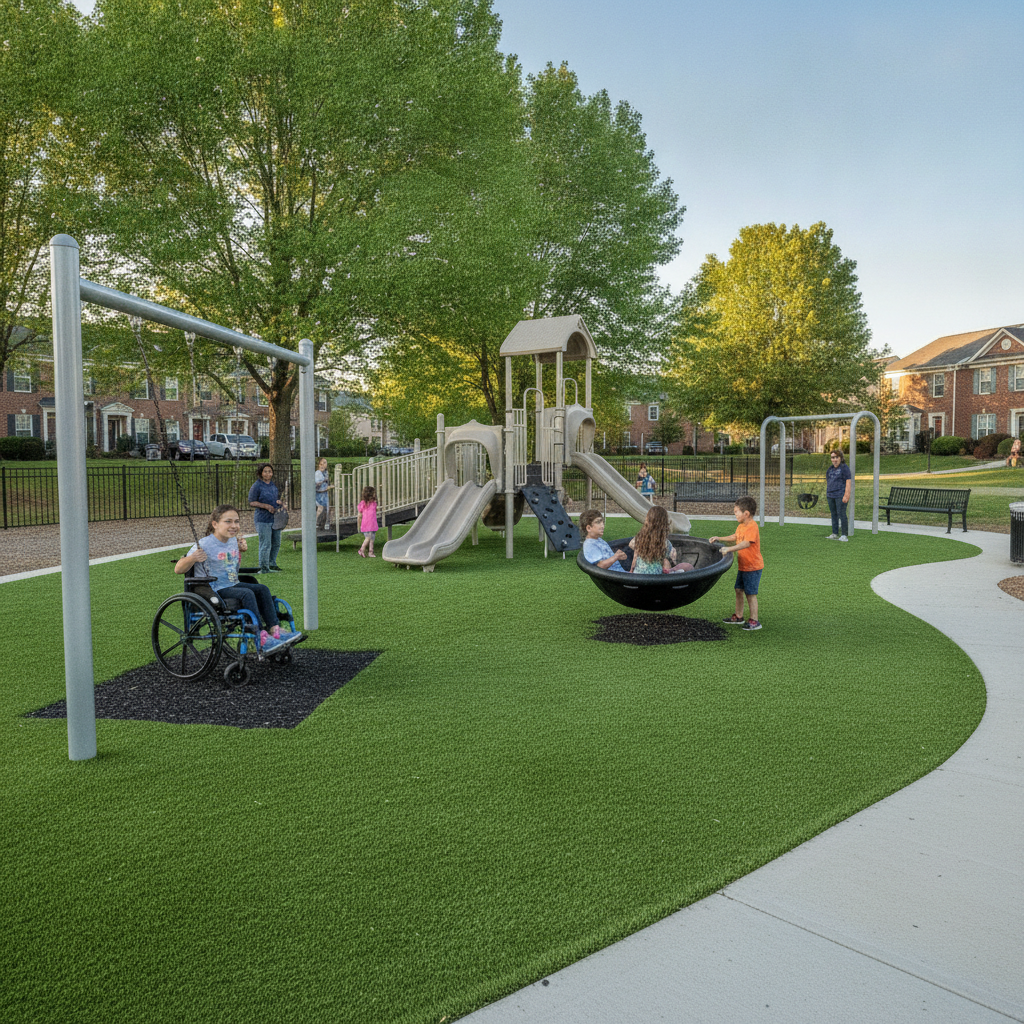
Can Artificial Turf Help a School or Daycare Meet ADA Accessibility Requirements in Fairfax County?
Yes — but only if the product is specified and installed correctly. Not all artificial turf qualifies as an ADA-accessible surface, and in Fairfax County, where schools and licensed daycares are subject to both Virginia Department of Education regulations and federal accessibility standards, getting this wrong isn’t just a compliance headache. It’s a liability. This guide walks you through exactly what makes artificial turf ADA-compliant, what certifications to require from your installer, and why this is one of the most underserved topics in the local turf industry.
Why ADA Compliance on Playgrounds Is More Complicated Than Most Facilities Realize
The Americans with Disabilities Act requires that accessible routes connect all elements of a playground — not just the entrance gate, but the play equipment itself. That means your ground surface has to meet specific firmness and stability standards so that children using wheelchairs, walkers, or adaptive mobility equipment can actually navigate it. The U.S. Access Board’s guidelines use a testing standard called the ASTM F1951, which measures surface firmness and stability under a simulated wheelchair maneuver. Not every synthetic grass product passes this test.
Loose infill materials like rubber mulch or wood fiber — which are still common at older Fairfax County elementary schools — typically fail the firmness test and require ramps or paved accessible routes to maintain compliance. The right artificial turf system, paired with the right backing and infill, can actually provide a surface that meets ASTM F1951 directly, without adding expensive hardscape transitions.
What CPSC and IPEMA Certification Actually Means — and Why Both Matter
When you’re evaluating artificial turf for a school or daycare playground, two certifications should be non-negotiable: CPSC compliance and IPEMA certification.
The Consumer Product Safety Commission (CPSC) sets safety guidelines for playground equipment and surfacing, including critical fall height (CFH) ratings. Every play structure has a maximum fall height, and your ground surface needs to absorb enough impact energy to protect a child who falls from the highest accessible point. This is measured by a Gmax rating — the lower the Gmax, the better the shock absorption. CPSC guidelines recommend a Gmax of 200 or less at the maximum CFH.
IPEMA (International Play Equipment Manufacturers Association) independently tests and certifies that surfacing products meet ASTM F1292 for impact attenuation and ASTM F1951 for accessibility. When a turf product carries IPEMA certification, you have third-party documentation that it passed both tests — which is exactly what you need when your school is audited or inspected.
At Grassify, the playground turf systems we install are CPSC and IPEMA certified, and we can provide those test reports during your planning process. This is something a lot of general landscapers and national franchise installers can’t produce on request — and if an installer can’t hand you third-party certification documents, that’s a red flag.
The Gap No One Is Talking About: Surface Accessibility vs. Route Accessibility
Here’s something that almost none of the local turf competitor websites address at all: ADA compliance on a playground isn’t just about what’s under the swings. It’s about the entire accessible route from the parking lot or building entrance to every piece of play equipment that’s designated as accessible.
That means your turf installation needs to be planned in coordination with the existing site layout. If you’re replacing wood mulch or pea gravel across the entire play area, the new turf surface also needs to provide a continuous, stable path from the perimeter of the playground to the accessible equipment entries. Transitions between the turf field and adjacent concrete or asphalt pathways need to be flush — no lips, no gaps, no abrupt changes in grade that would stop a wheelchair.
In Fairfax County specifically, we’ve done installs at school sites in Springfield and Alexandria where the original playground design had accessible equipment but non-compliant surfaces leading up to it. Replacing the surface with properly installed turf — with a compacted decomposed granite base engineered to the correct slope and transition — brought the whole area into compliance without any concrete work.
What the Right Base Prep Looks Like for a Compliant School Turf Installation
The surface you can see is only part of the equation. ADA firmness and stability — as well as the shock-absorption rating required by CPSC — both depend heavily on what’s underneath the turf fibers.
A compliant playground turf system typically includes:
- Excavation to the correct depth — usually 4 to 6 inches depending on the CFH requirement of the equipment above it
- A compacted crushed aggregate base — typically Class II road base or decomposed granite, graded to drain at a minimum 1% slope away from structures
- A shock-absorbing pad layer — foam or rubber underlayment rated to meet the required Gmax at your equipment’s critical fall height
- IPEMA-certified turf with appropriate infill — typically crumb rubber or a blended infill for playgrounds, or sand infill for lower-impact areas
In Northern Virginia, freeze-thaw cycles through winter create real stress on base layers. A base that isn’t properly compacted or doesn’t have adequate drainage will heave, shift, and create surface irregularities that compromise both your Gmax rating and the accessible route you worked to build. This is a specific regional factor that out-of-state franchise installers often don’t engineer for correctly — and it shows up two winters after installation.
Daycares and Licensed Facilities Have Additional Requirements
If you’re operating a licensed daycare or preschool in Fairfax County or Loudoun County, your playground may also be subject to inspection by the Virginia Department of Social Services (DSS) and compliance with Virginia’s child care facility regulations, which reference CPSC handbook guidelines directly. DSS inspectors do verify that outdoor play surfaces are maintained and appropriate for the age groups being served — and a surface that was compliant at installation can fall out of compliance if infill compacts, the Gmax rating degrades, or drainage failures create uneven areas.
This is one reason we recommend a documented installation with test reports kept on file at your facility, along with a periodic maintenance plan. We build that documentation into every commercial playground project we complete.
What to Ask Any Turf Installer Before Signing a Contract for a School or Daycare
If you’re getting bids from multiple installers in the Beltway corridor, here are the questions that separate qualified commercial turf contractors from landscapers who’ve done a few backyard installs:
- Can you provide IPEMA certification documentation for the specific product you’re proposing?
- What Gmax rating does the system achieve at our equipment’s critical fall height?
- Does your base design include a shock-absorbing pad layer, and what thickness?
- How do you handle transitions to adjacent hardscape for ADA accessible routing?
- What does your warranty cover, and does it include the shock-absorption layer?
A contractor who can’t answer the first two questions with documentation shouldn’t be installing surfaces at a school or daycare — period.
If you want to see what a licensed, background-checked installation looks like from the ground up, learn more about how Grassify operates before your first site visit.
Frequently Asked Questions
Does all artificial turf qualify as an ADA-accessible playground surface?
No. Only turf systems that have been tested and certified under ASTM F1951 qualify as firm and stable accessible surfaces. The product, infill type, and base preparation all affect whether the installed surface passes. Always ask for the certification documentation before purchase.
How often does a turf playground surface need to be tested for Gmax compliance?
CPSC recommends annual testing of playground surfaces to verify that shock-absorption performance hasn’t degraded. Infill can compact over time, especially in high-traffic areas under swings or at equipment exits. Periodic grooming and infill top-up are part of a compliant maintenance program.
Can a Fairfax County school or daycare use artificial turf for both the playground and adjacent lawn areas?
Yes. Many facilities use a playground-grade, IPEMA-certified turf in the fall zone under equipment, and a standard landscape-grade turf in adjacent open play areas, field perimeters, or entry areas. The two zones require different products and different base specifications, which is why a proper site assessment matters before you design the layout.
What’s the typical cost range for a school playground turf installation?
Commercial playground turf installations generally run $15–$25 per square foot depending on the size of the area, the critical fall height requirement, whether a shock-absorbing pad is needed, and the complexity of transitions and drainage. Larger projects often see better per-square-foot pricing. We provide detailed written proposals after a site visit — not ballpark numbers over the phone.
Do schools in Arlington or Alexandria need to follow the same compliance standards as Fairfax County?
Yes. ADA requirements are federal and apply uniformly. Virginia DSS child care regulations also apply statewide to licensed facilities. The local variables are site-specific — grade, drainage, existing infrastructure — not the compliance standards themselves.
Get a Free Site Assessment for Your School or Daycare Playground
If you manage a school, daycare, recreation center, or public play area in Fairfax County, Burke, Springfield, Alexandria, Arlington, or anywhere across Northern Virginia, Grassify can walk your site, assess your current surface, and provide a written proposal that includes the IPEMA product documentation, base specification, and Gmax compliance plan. We work with facilities managers, principals, and property directors — and we know how to navigate the approval and inspection process at the local level.
Contact Grassify to schedule your free consultation. Bring your equipment specs and critical fall heights if you have them — we’ll handle the rest.


