
How Do You Keep Artificial Turf from Smelling Bad in a Dog Run in Burke, VA? What Pet Owners Need to Know
If your artificial turf dog run has started to smell, the short answer is this: the turf itself isn’t the problem — the drainage system underneath it (or the lack of one) almost certainly is. Burke, VA pet owners deal with this more than they should, mostly because the turf was installed without the engineered base and odor-control infill layers that a high-use pet area actually requires. The good news is that a properly built system won’t just mask the smell — it will eliminate it at the source. Here’s what that actually looks like, and why getting the build right from the start matters far more than any cleaning product you’ll find at the hardware store.
Why Artificial Turf Dog Runs Develop Odor — and Why Most Fixes Don’t Work
Urine odor in artificial turf accumulates in one place: the infill layer. When urine drains through the turf fibers and sits in sand, crumb rubber, or compacted decomposed granite without a dedicated odor-neutralizing agent, bacteria colonize the infill and begin breaking down ammonia compounds. That breakdown process is what you’re actually smelling. In hot, humid Northern Virginia summers — and Burke gets plenty of both — bacterial activity accelerates, and a dog run that was tolerable in April can become genuinely unpleasant by July.
The mistake most general landscapers and low-bid turf installers make is treating pet turf the same as lawn turf. They lay standard infill, maybe a basic gravel sub-base, and call it a day. When the smell sets in, they recommend enzyme sprays or hose-downs. Those help temporarily, but they don’t solve the structural problem: liquid is pooling somewhere in the base instead of moving through it, and the infill has no capacity to neutralize ammonia on contact.
What a Proper Pet Turf Drainage System Actually Looks Like
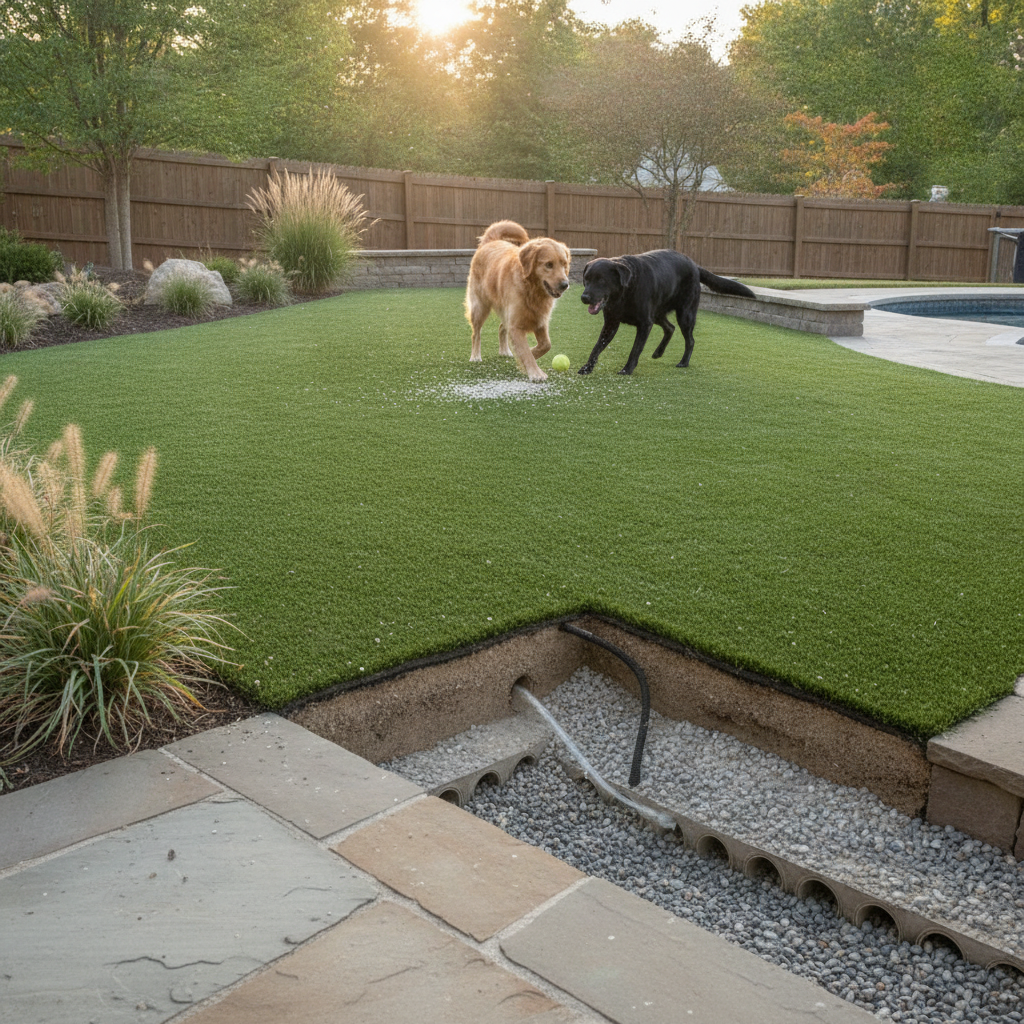
A genuinely odor-resistant dog run isn’t just about the turf product — it’s about what’s built underneath it. At Grassify, our pet-friendly turf installation in Burke and across Fairfax County uses a 5-layer drainage system engineered specifically for high-use pet areas. Here’s what that system includes from the ground up:
- Compacted base layer: Crushed aggregate (typically 3/4″ minus crushed stone) compacted to 95% density. This is what prevents settling and gives urine somewhere to move. A flat, poorly graded base is usually the first point of failure in smelly dog runs.
- Drainage grid or perforated channel: Depending on yard size and grade, a perforated drainage channel or modular drainage grid routes liquid away from the pet zone rather than allowing it to pool beneath the turf.
- Weed barrier: A commercial-grade, permeable fabric layer that keeps the base from migrating upward into the infill while still allowing fluid to pass through freely.
- Turf with perforated backing: Pet turf backing is punched with drainage holes at a density that allows 400+ inches per hour of drainage — far above what even the heaviest Burke rainstorm would demand. This is not standard turf backing. It’s a specific construction that many general installers skip because it costs more at the product level.
- Zeolite deodorizer infill layer: This is the layer most installers leave out entirely. Zeolite is a naturally occurring mineral with a high cation exchange capacity — in plain terms, it binds ammonia ions on contact rather than letting them off-gas. It’s blended into the infill layer above the turf backing, and it’s what makes the difference between a dog run that smells fine after two years and one that smells after two months.
In neighborhoods like Burke Centre and Rolling Valley, where yards tend to be smaller and dog runs are often tucked into tight side yards or enclosed patio areas with limited airflow, that zeolite layer is especially important. Limited ventilation means ammonia compounds don’t dissipate — they concentrate. You need chemistry working for you at the ground level, not just airflow.
Antimicrobial Infill: What It Does and When You Need It
Beyond zeolite, antimicrobial infill is worth discussing for any high-density pet area — meaning multiple dogs, larger breeds, or a dog run that sees consistent daily use. Antimicrobial infill incorporates silver-ion technology into the infill particles themselves, which inhibits bacterial growth across the entire infill surface area. It doesn’t replace zeolite; the two work on different mechanisms. Zeolite binds ammonia. Antimicrobial infill suppresses the bacteria that produce the secondary odor compounds.
For a single medium-sized dog in West Springfield or Alexandria, zeolite infill and a properly drained base may be all you need. For a household with two or more large dogs, or for a commercial dog daycare or kennel, combining zeolite with antimicrobial infill is the configuration we’d recommend — and it’s one of the few areas where spending slightly more upfront pays for itself quickly in maintenance time and smell-related complaints.
The Gap Most Competitors Don’t Cover: Maintenance Protocol That Actually Works
Here’s something you won’t find spelled out clearly on most local competitor websites: even the best pet turf system requires a simple, consistent maintenance routine to stay truly odor-free. The drainage and infill do the heavy lifting, but routine maintenance is what keeps the system performing at full capacity over the long term.
What that actually looks like in practice:
- Weekly rinse: A garden hose rinse across the dog run, directing water toward the drainage outlet if one exists, flushes residual urine solids through the backing and into the base. This takes about five minutes and makes a measurable difference in long-term odor accumulation.
- Solid waste removal: Pick up daily. Solid waste left on artificial turf longer than 24 hours will begin to leach into the infill, and no drainage system eliminates that. This is the single biggest maintenance failure we see.
- Quarterly enzyme treatment: A diluted enzyme spray applied across the field and allowed to sit for 15–20 minutes before rinsing out will break down any organic buildup that has made it past the zeolite layer. This is not a substitute for proper drainage — it’s a supplement to it.
- Annual infill top-up: Zeolite infill has a finite ammonia-binding capacity. After 12–18 months of heavy use, a professional top-up of fresh zeolite restores that capacity. This is inexpensive relative to replacing the turf system or living with odor.
We back our pet turf installations with a 90-day odor-free guarantee and a lifetime warranty on seams, edges, and base construction — because when the system is built correctly, we’re confident in how it performs. If you’re comparing bids, ask every installer directly whether their quote includes zeolite infill, perforated backing, and what their drainage rate specification is. Vague answers or a spec sheet that doesn’t mention drainage rate at all are red flags.
Freeze-Thaw Cycles and Why Base Prep Matters Even More in Pet Zones
One factor specific to the DMV area that doesn’t get discussed enough: freeze-thaw winter cycles in Fairfax County can heave and shift a poorly compacted sub-base. In a standard lawn turf installation, base movement creates cosmetic issues — bumps, seam separation. In a dog run with a drainage-dependent odor-control system, base heaving can disrupt the slope and channeling that makes the drainage work. Liquid starts pooling instead of flowing. The zeolite layer gets overwhelmed. By spring, you have a smell problem.
This is why we compact pet turf bases to a higher density specification than standard lawn installs, and why we’re careful about slope grading from the start. It’s not glamorous detail work, but it’s the difference between a dog run that performs well through three winters and one that starts smelling by the second spring.
Frequently Asked Questions: Artificial Turf Odor Control for Dog Runs in Burke, VA
How long before artificial turf in a dog run starts to smell?
It depends entirely on the installation. A properly built system with perforated backing, a graded aggregate base, and zeolite infill should stay odor-free for 12–24 months with normal maintenance before a zeolite top-up is needed. A system built with standard sand infill and no drainage engineering can start developing odor within 60–90 days of regular use.
Can I fix a smelly dog run without replacing the turf?
Sometimes. If the turf itself is in good condition and the primary issue is infill saturation rather than base failure, professional deep-cleaning and zeolite infill replacement can restore acceptable performance. If the base is poorly graded or compacted and liquid is pooling beneath the turf, that’s a structural problem that usually requires pulling the turf up and rebuilding the base.
Does the type of artificial turf fiber affect how much a dog run smells?
Fiber type has less impact than most people expect — it’s primarily an infill and drainage issue. That said, a tighter, shorter pile height (around 30–35mm for pet areas versus 40–50mm for ornamental lawns) does make rinsing and maintenance easier and leaves fewer fiber gaps where organic material can accumulate.
Is zeolite infill safe for dogs?
Yes. Zeolite is a naturally occurring mineral with a long history of use in agricultural and horticultural applications. It’s non-toxic, non-irritating, and widely used in pet-specific turf installations across the country. Dogs can walk, dig, and rest on zeolite-infilled turf without any health concerns.
Do HOAs in Fairfax County allow artificial turf dog runs?
Many do, but it varies by community. In HOA-governed neighborhoods across Burke and Springfield, artificial turf installations typically require an architectural review committee (ARC) submission before work begins. Dog run turf that’s fully enclosed within a fenced side yard often receives less scrutiny than front-yard installations, but you should confirm your specific HOA’s requirements before scheduling installation. We help homeowners navigate that process routinely.
If you’re ready to stop fighting odor and start enjoying your backyard again, contact Grassify for a free consultation. We’ll assess your space, explain exactly what the right system looks like for your yard and your dogs, and give you a straight quote with no surprises. Serving Burke, Fairfax County, Springfield, Alexandria, and the broader DMV area.


