
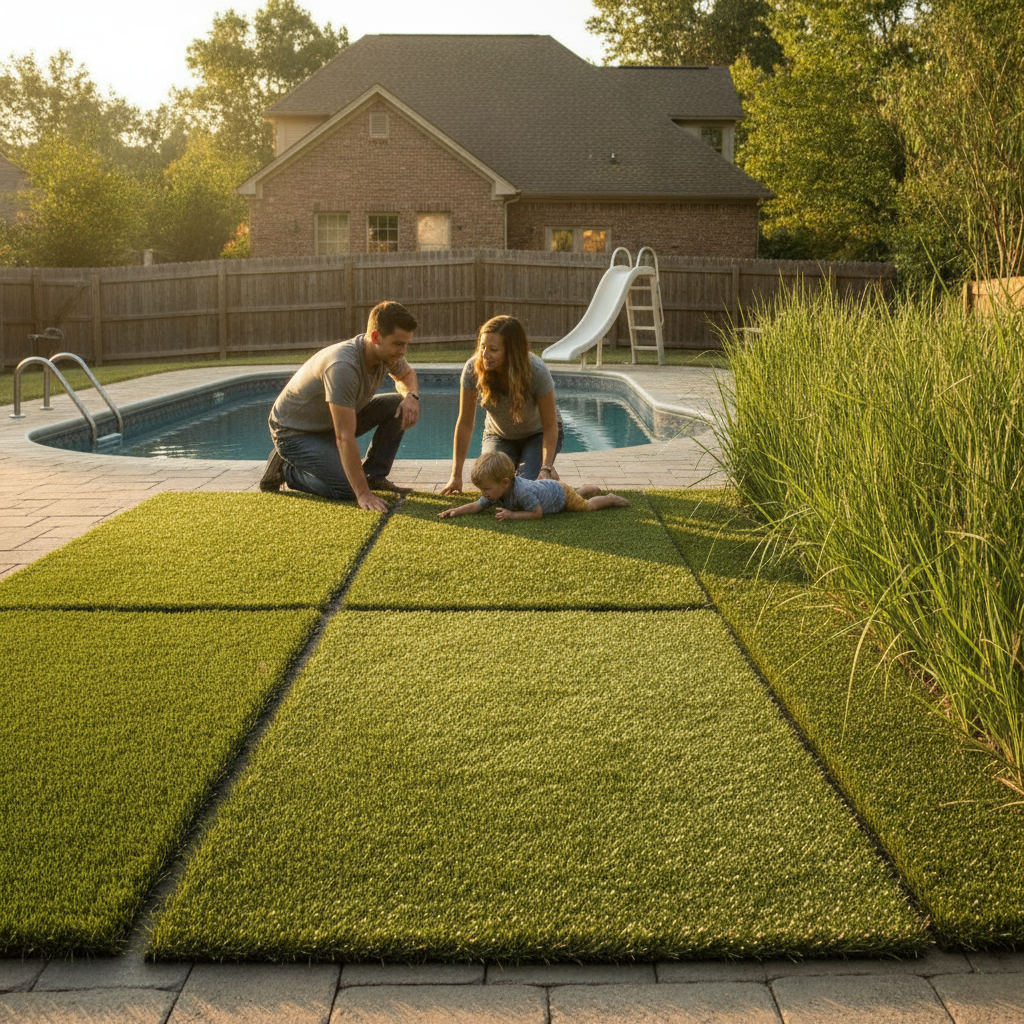
How Do You Choose the Right Artificial Turf Pile Height for Your Yard in Burke, VA?
If you’ve started researching artificial turf in Burke, VA, you’ve probably run into spec sheets listing pile heights like 30mm, 40mm, and 50mm — and wondered whether any of it actually matters. It does, more than most homeowners realize. Pile height is the measurement from the top of the turf backing to the tip of the blade, and choosing the wrong height for your application is one of the most common mistakes we see when people either DIY their installation or hire a crew that doesn’t ask enough questions upfront. Too short and your lawn looks sparse and plastic. Too tall and your pet turf traps waste, loses drainage efficiency, and mats down within a year. Getting pile height right is the difference between a yard that looks great for a decade and one that disappoints by year three.
Why Pile Height Isn’t Just About Looks
It’s tempting to pick the tallest, plushest turf on the shelf and call it done. But pile height interacts with several other variables: fiber density (measured in stitches per square meter), infill depth, drainage rate, and how the turf will actually be used. A 50mm blade that looks lush in a showroom sample can flatten under foot traffic within months if the stitch count isn’t high enough to support that length — a problem that hits especially hard in high-use areas like back doors, play zones, and dog runs.
Fiber geometry matters too. Taller blades require a stronger C-shape or W-shape cross-section to stand upright under load. Blades with a flat or ribbon cross-section at 50mm will lie over quickly, creating that telltale fake-grass mat look that nobody wants. When you’re comparing products, ask specifically about the blade shape, not just the pile height.
The Three Practical Pile Height Ranges — and What They’re Actually For
Short Pile (20mm–32mm): Precision and Performance
Short pile turf is the right call when performance matters more than cushion. Putting greens run at 12mm–20mm because ball roll consistency depends on a tight, firm surface. For areas around pool decks and patios in neighborhoods like Burke Centre or Rolling Valley, a shorter 25mm–30mm product typically works best — it stays flat underfoot, doesn’t trap water between blades after splash, and provides better slip resistance than a tall, fluffy product that can bunch up under bare wet feet.
Short pile is also the right call for HOA-restricted communities where the turf needs to pass an aesthetic review. In Fairfax County, a number of HOAs specify that synthetic turf must closely mimic the appearance of a well-maintained natural lawn — meaning something in the 30mm–35mm range with a fine blade profile will sail through architectural review faster than a shaggy 50mm product. If you’re navigating HOA approval in Springfield or Alexandria, this distinction matters before you buy a single roll.
Medium Pile (33mm–42mm): The Everyday Residential Sweet Spot
For most residential lawns in Fairfax County — front yards, side yards, standard-use backyards — medium pile is where the best balance lives. A 37mm–40mm product with a high stitch count (typically 16,500–20,000 stitches per square meter) gives you the visual fullness of a healthy lawn without the maintenance problems that come with longer blades.
This is the range where Lush Life sits, and it’s what we install most often for residential lawns across Burke, Fairfax, and the surrounding neighborhoods. Medium pile holds infill well — usually a mix of silica sand and coated crumb rubber or a TPE alternative — which means better resilience underfoot and better UV-stabilized blade recovery after heavy summer foot traffic.
One thing to keep in mind for the DMV area specifically: the freeze-thaw cycles we get from November through March put stress on infill settlement. Medium pile turf with a properly compacted crushed stone base holds infill more consistently through that cycle than a taller product where blades flex more aggressively in freezing temperatures.
Tall Pile (43mm–60mm): Use It Carefully
Tall pile turf — 45mm, 50mm, even 60mm — is commonly marketed as the most luxurious option, and it can be, in the right application. But it comes with trade-offs that most installers don’t fully explain upfront.
For pet areas and dog runs, tall pile is actually a poor choice. Longer blades slow the passage of liquid through to the drainage layer beneath, which undercuts the drainage efficiency you’re paying for. If you’re building a dedicated pet area, a 30mm–38mm pet-specific product with a perforated backing — engineered to drain at 400+ inches per hour — outperforms a 50mm product every time, regardless of how plush the taller option looks in a sample.
Where tall pile does shine is in decorative settings with low foot traffic: a shaded side yard that’s mostly visual, a landscaping strip along a fence line, or a decorative rooftop application. In those scenarios, a dense 50mm product with a quality W-shaped blade can genuinely look indistinguishable from real grass. Just make sure you’re not putting it somewhere dogs, kids, or heavy patio furniture will flatten it within the first season.
What Competitors Don’t Tell You About Pile Height and Drainage
One gap we consistently notice in the local market is that most turf installers — including several operating in the Beltway corridor — talk about pile height purely as an aesthetic choice. They’ll show you samples, let you feel the texture, and ask how tall you want it. What they won’t walk you through is how pile height affects your drainage system design, which is critical in a region that gets 40+ inches of rainfall per year and heavy spring downpours that can dump two inches in an hour.
Here’s the engineering reality: taller pile turf requires a deeper infill layer to support the blades, which means less open space near the top of the turf system for water to move through quickly. In a region like Northern Virginia where spring rains are intense and the ground is often already saturated, that drainage lag can matter. A properly designed base — typically 3–4 inches of compacted crushed aggregate graded to a 1–2% slope — compensates for this, but only if your installer accounts for pile height in the drainage plan. If they’re quoting you a flat drainage spec regardless of the product you’ve chosen, that’s a flag worth raising.
You can read more about how Grassify approaches base preparation in our installation guide, which covers the full sequence from excavation through infill and finishing.
Matching Pile Height to Your Application: A Quick Reference
- Putting greens: 12mm–20mm, tight weave, sand-only infill for true ball roll
- Pool decks and patios: 25mm–32mm, short pile with slip-resistant texture and chlorine-resistant backing
- Pet areas and dog runs: 30mm–38mm, perforated backing, zeolite or antimicrobial infill
- HOA-regulated front yards: 32mm–38mm, fine blade profile, natural color blends
- General residential backyards: 37mm–42mm, medium pile, balanced stitch count
- Decorative low-traffic areas: 45mm–50mm, W-blade construction, dense fiber for visual impact
Questions to Ask Your Installer Before You Commit
Not every turf contractor in Fairfax County is going to walk you through this level of detail unprompted. Here are a few questions worth asking before you sign anything:
- What is the stitch count and blade shape on the product you’re recommending at this pile height?
- How does your drainage design account for the pile height and infill depth we’re using?
- Is the pile height you’re recommending appropriate for the amount of foot traffic and pet use in this space?
- Does the product you’re recommending carry a UV-stability warranty, and for how long?
If a contractor can’t answer these questions clearly, they’re likely spec’ing based on what they have in inventory rather than what’s right for your yard.
For pet-specific applications, you can explore how Grassify’s pet turf systems integrate pile height selection with the 5-layer drainage design that keeps dog areas odor-free through DMV summers.
Frequently Asked Questions
Is taller pile height always better for residential lawns in Burke, VA?
No. Taller pile looks impressive in samples but can mat down quickly under foot traffic and slow drainage performance. For most residential backyards in Burke and Fairfax County, a 37mm–42mm medium pile with a high stitch count outperforms 50mm products in long-term durability and appearance.
Does pile height affect how hot the turf gets in summer?
Indirectly, yes. Taller, denser blades can retain more heat near the surface than shorter, more open pile structures. If surface temperature is a concern — which it legitimately is during July and August in Northern Virginia — ask about heat-resistant fiber technology and whether the product has been tested for surface temperature performance.
Will my HOA in Fairfax County have requirements about turf pile height?
Some do, though they typically frame it in terms of appearance rather than a specific millimeter spec. The practical guidance is to bring a product sample with your HOA application and confirm it passes their visual review before installation begins. Shorter, finer-blade products generally receive faster approval in HOA communities across the DMV area.
Can I use the same pile height for my lawn and my dog run?
You can, but it’s not ideal. Your lawn area will generally do well with a 38mm–42mm product, while your pet area performs better at 30mm–36mm for drainage efficiency. When Grassify designs a yard that combines both uses, we often recommend a seamed transition between two purpose-specific products rather than a single compromise product across the whole space.
How do I know if a contractor is recommending the right pile height or just selling me inventory?
Ask them to justify the recommendation based on your specific use case — foot traffic volume, pets, drainage needs, HOA rules. If the answer is vague or they can’t connect the pile height to your drainage design, get a second opinion. A good installer should be able to explain exactly why a given pile height makes sense for your yard before a single measurement is taken.
Ready to Get the Right Turf for Your Yard?
Pile height is one piece of a larger puzzle — and it’s the kind of detail that separates an installation you’ll love for fifteen years from one that frustrates you by year four. At Grassify, we’ve been spec’ing and installing turf across Burke, Fairfax, Springfield, and the broader DMV area long enough to know that the right product starts with the right questions, not the prettiest sample.
If you’re ready to talk through your yard, your use case, and which pile height actually makes sense for your space, reach out to us for a free consultation. We’ll come out, measure your space, walk through the drainage and base requirements, and give you a straight recommendation — no upselling, no pressure, just honest turf advice from a crew that installs it every week right here in Fairfax County.


