
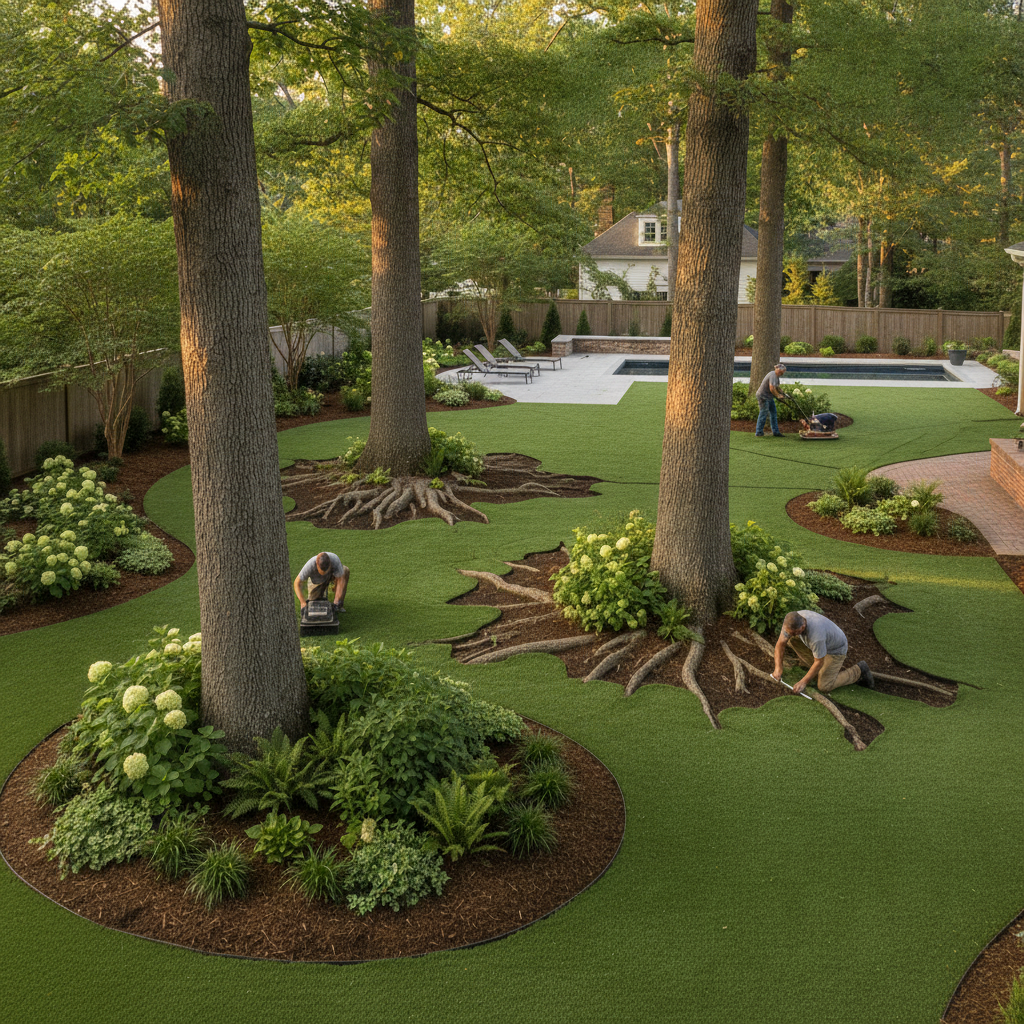
How Do You Install Artificial Turf Around Tree Roots and Landscaping Beds in Bethesda, MD?
Yes, you can install artificial turf around mature trees, raised landscaping beds, and mixed plantings — but only if the base prep and root management are done correctly from the start. In Bethesda and across Montgomery County, where mature oak, maple, and cherry trees are common features of residential yards, this is one of the questions we get most often that very few turf guides actually answer in any real depth. Done right, turf and trees can coexist beautifully. Done wrong, you end up with buckled seams, dead tree canopy, or both.
This guide walks you through what the installation actually involves, what questions to ask any installer before they touch your yard, and why this particular challenge demands a more careful approach than a standard open-lawn turf job.
Why Tree Roots and Turf Are a Complicated Combination
Here’s the core tension: artificial turf requires a compacted, stable aggregate base — typically 3 to 4 inches of crushed decomposed granite or Class II road base — to drain properly and hold its shape through freeze-thaw cycles. Tree roots, on the other hand, are living systems that grow, shift, and expand over years. They don’t stop because you’ve installed something on top of them.
If you compact base material directly over a shallow root zone without the right preparation, you risk two things simultaneously. First, root pressure will eventually push up through the base and deform the turf surface — sometimes within a single growing season in warm, wet years like we see frequently along the Beltway corridor. Second, compacting the soil too aggressively around a tree’s root flare can cut off the oxygen exchange the roots need, slowly stressing or killing a tree that took decades to grow.
Neither outcome is acceptable, and neither is cheap to fix.
The Right Approach: Root Barriers and Floating Base Systems
The professional solution has two key components: a root barrier and a modified base installation method near the tree.
Root barriers are solid HDPE or polypropylene panels installed vertically around the tree’s drip line perimeter, driven 12 to 18 inches into the ground. They redirect lateral root growth downward rather than outward, which keeps aggressive surface roots from migrating under your new turf base over time. This is standard practice in commercial landscaping and should be standard practice in any quality turf installation around trees — but it’s a step that many general landscapers and budget installers routinely skip.
Closer to the root flare itself, a reputable installer will typically use a floating or semi-rigid base system rather than fully compacted aggregate. This might mean a thinner base layer (1.5 to 2 inches instead of 3 to 4 inches), a rubberized or foam underlayment pad that distributes load without compacting soil, or a combination of both. The tradeoff is that the area closest to the trunk typically gets a generous mulch ring rather than turf — protecting the root collar and giving you a clean, finished edge where turf and planting meet.
Landscaping Beds: Clean Edges, Solid Borders, Long-Term Separation
If your yard in Bethesda or nearby Chevy Chase or Potomac includes raised garden beds, planting borders, or mixed shrub beds alongside the turf area, the transition zones are where most installations succeed or fail visually — and structurally.
A clean, durable edge between turf and a planting bed requires a few things done well:
- Bender board or aluminum edging that’s staked at grade to create a hard separation between base aggregate and native soil. Plastic landscape edging from a big-box store is not adequate — it flexes, it heaves in freeze-thaw cycles, and it lets base material migrate into your beds over time.
- A weed barrier that’s properly lapped at the transition zone so that soil from the bed side doesn’t undermine your base, and so roots from bed plantings don’t push laterally under the turf over time.
- Proper grade management so that rain runoff from a raised bed doesn’t channel onto the turf surface or pool at the seam. The DMV gets significant rainfall in spring, and Bethesda properties with clay-heavy soil can struggle with runoff in ways that flat midwest yards simply don’t.
If your beds include irrigation — drip lines, pop-up heads, or soaker systems — those need to be mapped and protected before excavation begins. A good installer will mark irrigation infrastructure on day one. A careless one will cut through it.
What the Finished Install Should Look Like (and What It Shouldn’t)
Around a mature tree, the finished product should have a clean, intentional mulch ring of at least 18 to 24 inches around the root flare — not turf butted right up against the bark. The turf perimeter should be cut cleanly, secured with nails or staples into a compacted border zone, and finished with an edging material that prevents the seam from lifting or separating. You should not see the turf edge pulling away from the mulch ring, rippling across the root zone, or showing any vertical movement when you walk across it.
Around landscaping beds, the turf edge should sit flush with the top of your edging border, with no gaps and no visible base material. The turf pile should be brushed upright at the perimeter so the cut edge isn’t obvious. Residential lawn turf installed by an experienced crew should look like it was always there — not like a carpet laid next to a garden.
Can’t You Just Work Around the Roots Yourself?
DIY turf installation is common for simple, open spaces. But around tree roots and established plantings, it’s genuinely high-risk. If you nick a large lateral root during excavation, you may not see any tree stress for one or two growing seasons — and then the decline accelerates quickly. If you compact base material too aggressively in the root zone, the damage is done before you roll out a single piece of turf. The cost of losing a 30-year-old tree is almost always more than the cost of having the turf installed properly the first time.
This is a job where 12+ years of site-specific installation experience — reading how roots are running, knowing when to stop excavating and when a floating base is the right call — makes a real difference in the outcome.
Frequently Asked Questions
Will artificial turf hurt my trees in Bethesda?
It doesn’t have to — but installation matters. A properly installed root barrier and a mulch collar around the root flare protect the tree’s oxygen exchange. Improperly compacted base material over the root zone is the real risk, which is why this isn’t a job for a general landscaper unfamiliar with turf base engineering.
How close to a tree trunk can artificial turf go?
As a general rule, leave at least 18 to 24 inches of mulched buffer around the root flare, increasing with tree size. For large, established trees — the kind common in older Bethesda, Chevy Chase, and Potomac neighborhoods — you may want a 36-inch or larger ring. Your installer should assess this on-site, not give you a blanket number from a brochure.
What happens if a tree root eventually pushes up through the turf?
Without a root barrier, this is a real possibility over 5 to 10 years. The fix typically involves removing the affected section, cutting back the root (carefully and correctly), and reinstalling base and turf — which is disruptive and costly. The right root barrier system at installation is significantly cheaper than a mid-life repair.
Can you install turf around raised garden beds without harming the plants?
Yes, as long as the irrigation for your beds is protected during base excavation and the edging transition is installed cleanly. A proper aluminum or steel bender board border keeps base aggregate from migrating into bed soil and maintains clean drainage on both sides of the transition.
Does Grassify serve Bethesda and Montgomery County?
Yes. We work across the full DMV service area including Bethesda, Potomac, Chevy Chase, and Montgomery County, as well as Northern Virginia and Washington, D.C. If you have a yard with trees, mixed beds, or any complex landscaping, we’re happy to walk the site and give you an honest assessment before you commit to anything.
Talk to a Local Installer Who’s Seen This Before
Tree roots, planting beds, and mixed landscapes add real complexity to a turf project — but they don’t make it impossible. The key is working with an installer who takes the time to assess what’s actually in the ground before excavation starts, uses proper root barriers and edge systems, and builds the base with the long-term health of your yard (and your trees) in mind.
If you’re in Bethesda, Potomac, Chevy Chase, or anywhere across the DMV and you’re wondering whether your yard can support artificial turf alongside its existing landscaping, reach out to Grassify for a free on-site consultation. We’ll look at the full picture — roots, drainage, grade, bed transitions — and tell you exactly what the job involves before you sign anything.


