
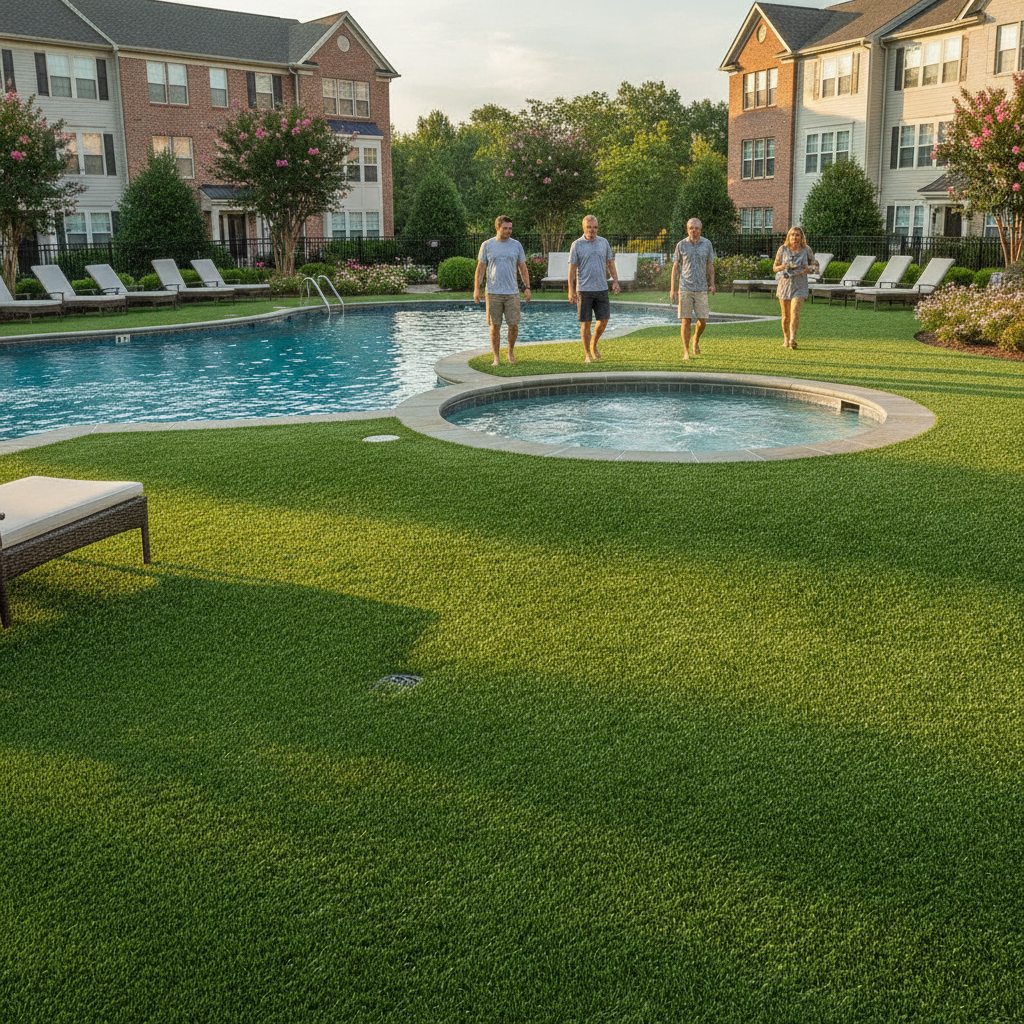
How Do You Install Artificial Turf Around a Pool or Hot Tub at an HOA Community in Great Falls, VA?
If your HOA community in Great Falls, VA is considering artificial turf around a shared pool or hot tub, the short answer is: yes, it can be done — and done beautifully — but it requires the right product, the right drainage system, and a clear path through your association’s approval process. This isn’t a standard lawn installation. Pool deck turf operates in a completely different environment than a backyard grass replacement, and in a governed community, you’re also accountable to your HOA’s architectural guidelines before a shovel hits the ground.
Here’s what HOA boards, property managers, and homeowners in Great Falls and surrounding Fairfax County communities need to understand before moving forward with a pool or hot tub turf project.
Why Pool Deck Turf Is Different from Backyard Lawn Turf
The biggest mistake HOA boards make when evaluating pool deck turf is treating it like a lawn replacement. It’s not. The product specifications, base preparation, and drainage engineering are fundamentally different when you’re dealing with constant water exposure, chemical splash zones, and heavy barefoot foot traffic on a hot summer day.
Here’s what makes pool and hot tub turf installations unique:
- Chlorine and chemical resistance: Standard turf backing can degrade when exposed to pool chemicals over time. Pool deck turf needs a chlorine-resistant backing that holds up through years of splash, runoff, and occasional direct contact with treated water.
- Slip resistance: Wet turf around a pool must have a texture that reduces slip risk. Pile height, fiber density, and infill all factor into traction — a lower pile height (typically 25mm–35mm) performs better in wet conditions than the taller landscaping blades used in lawn installations.
- Heat management: Fairfax County summers are brutal. Dark green turf surfaces in direct sun can reach temperatures 20–50°F above ambient air temperature. For a community pool where members walk barefoot, that’s a real comfort and safety issue. Heat-reflective turf technology — designed with lighter fiber colors and specialized coatings — significantly reduces surface temperature without sacrificing appearance.
- Drainage rate: Pool decks need to shed water fast. Look for a turf backing with a drainage rate of at least 30 inches per hour — and ideally closer to 50+ inches per hour in high-splash zones. The base system beneath also needs to be engineered to move water efficiently toward existing deck drains.
The HOA Approval Process in Great Falls: What to Expect
Great Falls is home to several established HOA-governed communities — and Fairfax County HOAs, in general, tend to run detailed architectural review processes. If your project involves a shared amenity like a community pool, you’re navigating both the HOA’s Architectural Review Committee (ARC) and possibly input from the broader board before a single material gets approved.
Here’s the typical approval flow for a pool deck turf project in an HOA community:
- Submit product samples and specifications: Your ARC will almost certainly want to see the actual turf product, not just a photo. Fiber color, pile height, texture, and backing specs should all be included in your submission packet. Some committees in Fairfax County also request drainage rate documentation and a base prep plan.
- Provide a site plan or layout diagram: Show where the turf will be installed relative to the pool coping, drains, furniture staging areas, and any adjacent hardscape. This helps committees assess visual impact and practical logistics.
- Address safety documentation: For a shared amenity, some HOA boards will ask for slip-resistance test data or manufacturer safety ratings. Having this ready upfront speeds approval significantly.
- Timeline for review: Most Fairfax County HOA ARCs review submissions within 30–45 days. Build this into your project schedule — don’t schedule installation before approval is in hand.
Working with a turf installer who has experience navigating HOA submissions in Northern Virginia is not optional for community projects — it’s essential. Grassify has handled HOA documentation packages across Fairfax County, McLean, Reston, and beyond, and we know what local committees typically ask for before they sign off.
What the Right Product Actually Looks Like for a Community Pool Deck
Not every turf product on the market is appropriate for a community pool deck. Here’s what to look for when evaluating options for a shared outdoor water amenity:
- Pile height: 25mm–35mm is the sweet spot for pool decks. Taller piles trap more moisture and can feel unstable underfoot when wet.
- Fiber type: Flat or C-shaped monofilament fibers with a slightly matte finish tend to perform best in wet environments — they’re more forgiving underfoot and show less heat-related sheen than slit-film fibers.
- Backing system: A polyurethane or dual-layer backing with drainage perforations every few inches is the standard for pool applications. This lets water pass through immediately rather than pooling on the surface.
- Infill: Silica sand infill is the most common choice for pool decks — it’s stable, easy to maintain, and doesn’t absorb chlorinated water the way some organic infills do. Avoid rubber crumb infill in pool zones; it can degrade in chemical environments and scatter into the pool.
Grassify’s Plush Pad turf is purpose-built for poolside and patio applications — designed with chlorine-resistant backing, a comfortable underfoot texture, and a pile height that balances aesthetics with wet-surface traction. It’s what we recommend for the majority of community pool deck projects in Great Falls and across the Beltway corridor.
Base Prep and Drainage: The Part Most Installers Get Wrong
This is where a lot of general landscapers and lower-cost installers fall short — and where community pools in particular demand a higher standard.
A proper pool deck turf installation on a community property typically involves:
- Assessment of existing concrete or paver substrate — turf can often be installed directly over a sound concrete deck without removal
- Ensuring existing deck drains are functional and properly sloped before turf goes down — water must have somewhere to go, or it will pond under the surface and create mold and odor problems within a season
- Installing a drainage mat or shock pad between the concrete and the turf backing where cushioning is needed or where drainage improvement is required
- Securing perimeter edges with aluminum bender board or edge trim that can withstand freeze-thaw cycles without heaving — this matters in Northern Virginia winters more than most people expect
- Seaming placement that avoids high-traffic pathways; well-placed seams in a pool deck installation are essentially invisible and structurally sound under heavy use
If your community is in the early stages of evaluating this project, Grassify offers a site walkthrough and consultation at no charge. We’ll assess the existing deck condition, identify drainage considerations, and give your board a realistic scope and budget estimate before you move into the HOA approval phase.
Hot Tub Surrounds: A Smaller Footprint, Same Technical Requirements
Private homeowners in Great Falls with standalone hot tubs — whether on a patio, deck, or in a backyard setting — often ask about turf as a surround material. The technical requirements are largely the same as a pool deck: chlorine-resistant backing, slip-resistant texture, good drainage, and heat-tolerant fibers.
One additional consideration for hot tub surrounds: steam. Hot tubs produce more condensation than pools, and in cooler months that steam settles on nearby surfaces. Your turf should be able to handle both hot summer sun and cool-season moisture without delaminating or developing odor issues. A quality UV-stabilized, chlorine-resistant product with a perforated backing handles this well — but a cheap imported roll from an overseas wholesaler typically does not.
Learn more about how we approach residential pool deck and patio turf installations for both private homes and community properties across Northern Virginia.
What This Typically Costs for a Community Installation
Community pool deck turf projects vary significantly based on square footage, substrate condition, drainage complexity, and product selection. For planning purposes, commercial and community pool deck installations generally run in the $15–$22 per square foot range installed, depending on scope. That includes product, base prep, drainage assessment, and professional installation with a lifetime seam and edge warranty.
For HOA boards budgeting a capital improvement project, we can provide a detailed written proposal with itemized costs after an on-site walkthrough — which is the only accurate way to scope a community installation. Avoid any installer who quotes you per square foot without seeing the site first.
Frequently Asked Questions: Pool and Hot Tub Turf for HOA Communities in Great Falls, VA
Does artificial turf around a community pool require a special permit in Fairfax County?
In most cases, turf installation on an existing pool deck does not require a building permit in Fairfax County — it’s typically treated as a surface improvement rather than new construction. However, your HOA’s ARC approval is a separate and required step for any community amenity modification. Always confirm with your association’s governing documents before starting.
Can turf be installed directly over an existing concrete pool deck?
Yes — and this is often the preferred approach for community pools. If the concrete is structurally sound and properly sloped toward existing drains, turf can be installed directly on top using adhesive and perimeter fastening. This avoids demolition costs and shortens the installation timeline significantly.
How do you clean community pool deck turf?
Routine maintenance is straightforward: rinse with water as needed, use a stiff brush to remove debris, and apply a diluted turf cleaner a few times per season. The perforated backing allows pool water, rain, and rinse water to drain through quickly, so the surface dries fast after use. Chlorinated splash water does not damage quality pool turf products and generally helps suppress mildew and organic growth.
What happens to pool deck turf in a Northern Virginia winter?
Properly installed pool deck turf handles freeze-thaw cycles well because the backing is secured to a stable substrate — typically concrete — that doesn’t shift with frost. The fibers themselves are UV-stabilized and cold-weather stable. The main risk in Northern Virginia winters is at the perimeter edges, which is why quality aluminum or stainless edge banding (not plastic) is critical in this climate. Grassify backs all edge and seam work with a lifetime installation warranty.
How long does pool deck turf last in a high-traffic community setting?
With proper installation and routine maintenance, commercial-grade pool deck turf typically lasts 12–18 years in a community setting. UV stabilization and chlorine resistance are the two biggest factors in product lifespan around a pool — both of which should be specified in writing by your installer before you sign a contract.
Ready to Bring Your Community Pool Deck Project to Life?
Whether you’re managing an HOA community in Great Falls, overseeing a shared amenity project in McLean or Reston, or a homeowner in Fairfax County replacing a worn concrete surround around a private pool, Grassify can walk you through the full process — from HOA documentation support to product selection to installation day.
We’re a licensed, insured, locally operated team based in Burke, VA, and we’ve been doing this across the DMV for over a decade. We know what Fairfax County HOA boards want to see, what products hold up in Virginia summers and winters, and how to get a pool deck installation done cleanly and efficiently — even on community properties with tight scheduling windows.
Contact Grassify today to schedule your free on-site consultation. We’ll assess your space, answer your HOA questions, and put together a written proposal your board can actually work with.


