
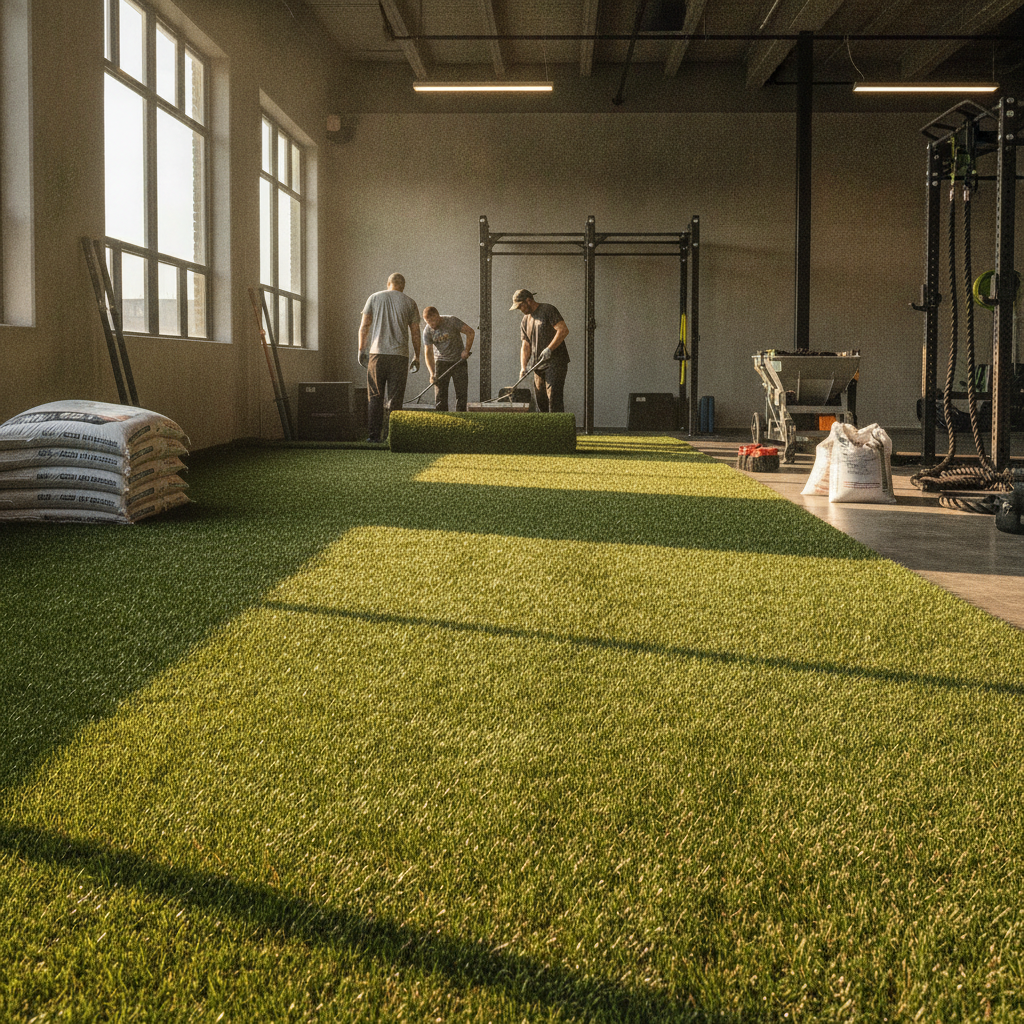
How Do You Install Artificial Turf Inside a Gym or Fitness Studio in Alexandria, VA? What Gym Owners and Trainers Need to Know
If you’re a gym owner or personal trainer in Alexandria, VA thinking about installing artificial turf in your facility, the short answer is: yes, it’s one of the best surface upgrades you can make — but it has to be done right. Commercial gym turf is not the same product as residential lawn turf, and the installation process is not the same either. The wrong pile height, the wrong infill, or a poorly prepped concrete subfloor can turn a high-performing training surface into a liability. This guide walks you through exactly what you need to know before you commit to a project.
Why Gym Owners in Alexandria and Northern Virginia Are Adding Turf
Functional fitness facilities, CrossFit boxes, private training studios, and sport performance gyms across Northern Virginia have been replacing rubber flooring and hardwood sections with turf for good reason. A proper turf surface handles sled pushes, battle ropes, farmer carries, agility drills, and bear crawls without the floor drag issues you get with rubber or the slipping risks you get with hardwood. It also looks sharp, photographs well for social media, and is genuinely easier to clean between client sessions than most flooring alternatives.
In Alexandria specifically — where boutique fitness studios and performance gyms are competing hard for members — a turf zone is increasingly a visual and functional differentiator. The same is true across Arlington, Springfield, and Fairfax, where gym density is high and facility aesthetics matter as much as equipment selection.
What Makes Indoor Gym Turf Different from Residential Turf
This is the part that most generic turf companies get wrong, and it’s where the gap in competitor content really shows. Most residential turf guides focus on pile height for aesthetic appearance and drainage systems for rain. Indoor gym turf solves an entirely different set of problems. Here’s what actually matters for a commercial fitness application:
Pile Height: Shorter Is Better for Performance
For gym use, you generally want a pile height between 1.5 inches (roughly 38mm) and 2 inches (50mm). Shorter fibers give you a firmer, more consistent surface for sled tracks and agility drills. Taller piles — which look great in a backyard — create too much fiber movement underfoot during lateral cuts and can interfere with sled glide. Some high-performance installations use turf as short as 1 inch for sled-only lanes. The right pile height depends on what training activities your facility prioritizes.
Infill Selection for Indoor Use
Outdoor residential turf typically uses silica sand, crumb rubber, or zeolite blends. Indoor gym turf needs an infill system that performs without off-gassing concerns in an enclosed space. For most fitness studios, we recommend a light sand infill or a low-infill system using denser fiber construction — not crumb rubber, which can release particulates in a ventilated indoor environment and create odor issues over time. If you’re running a high-sweat environment with athletes working close to the ground, this matters more than most installers will tell you upfront.
Backing and Subfloor Compatibility
Almost every gym installation in Alexandria and the surrounding area is going over a concrete subfloor. Turf going over concrete needs a backing system that doesn’t trap moisture underneath — even indoors, concrete can wick humidity, and a sealed or semi-sealed backing will develop mildew over time. A perforated or open-flow backing, combined with proper edge finishing, keeps the turf breathable and stable. Some installations also add a thin foam or rubber underpad for impact absorption, which is worth considering if athletes are doing groundwork, rolls, or high-repetition ground-contact movements on your turf zone.
You can explore more about our dedicated gym turf solutions at Grassify’s gym turf page.
What the Installation Process Actually Looks Like
For an indoor gym installation, the process is different from a residential backyard job in a few specific ways. Here’s a realistic sequence:
- Subfloor assessment: We inspect the concrete for level variance, cracks, moisture intrusion, and surface contamination (oil, rubber residue, adhesive from old flooring). Any variance over 3/16 inch across a 10-foot span needs to be addressed before turf goes down.
- Layout and seam planning: Most gyms need custom cuts around columns, equipment anchor points, and wall edges. Seam placement matters — seams that fall under a sled track or high-traffic lane will fail faster if they’re not placed and welded correctly.
- Turf securing method: On concrete, we typically use a combination of turf adhesive and perimeter securing channels rather than nails or staples. For removable installations — for gyms that rent space or need flexibility — we can design a system that allows turf to be rolled and relocated without damaging the subfloor.
- Infill application and brushing: Once turf is secured and trimmed, infill is applied evenly and the fibers are power-brushed upright. This step is what separates a professional finish from an amateur one — skipping or rushing the brushing phase leaves fibers matted and the surface uneven.
- Edge and transition finishing: Transitions to rubber, hardwood, or tile sections need clean, secure metal or aluminum profiles. This is both a safety issue and a durability issue — a raised edge is a trip hazard and a point where turf backing can peel if it’s not properly capped.
Cost and Timeline Expectations for Gym Turf in Alexandria
For commercial indoor installations, expect to budget in the range of $12–$20 per square foot depending on turf grade, infill system, subfloor prep requirements, and the complexity of cuts and seaming. A 500-square-foot sled track and functional fitness zone in a boutique studio will run differently than a full-floor turf installation in a 3,000-square-foot performance facility. Timeline for most gym installations is one to two days for the turf work itself, with subfloor prep adding time if concrete leveling or crack repair is needed.
We provide free consultations and on-site measurements, so you’ll have a firm quote before any work begins — no surprises mid-project. Grassify serves Alexandria, Arlington, Burke, Fairfax, Springfield, Washington, D.C., and surrounding areas throughout the DMV.
Why General Landscapers and National Franchise Turf Companies Often Miss the Mark on Gym Projects
This is worth saying plainly: a company that primarily installs residential lawn turf or sports fields is not automatically qualified to execute a commercial indoor gym installation. The subfloor requirements, backing specifications, infill chemistry, and seam engineering are different enough that experience on one doesn’t transfer automatically to the other. We’ve quoted corrections on gym turf jobs where a general landscaper laid an outdoor product with a sealed backing directly on a concrete slab, used crumb rubber infill in an enclosed space, and left transitions unfinished. Those aren’t minor issues — they affect athlete safety and the usable life of the surface.
When you’re vetting a turf installer for your gym, ask specifically how many indoor commercial installations they’ve completed, what backing specification they recommend for concrete subfloors, and what infill system they use in enclosed spaces. If they give you a generic answer that doesn’t distinguish between indoor and outdoor applications, keep looking.
For a closer look at what a proper indoor sports turf installation involves, visit our indoor sports turf page.
Frequently Asked Questions About Gym Turf Installation in Alexandria, VA
Can I install gym turf over an existing rubber floor?
In some cases, yes — if the rubber is flat, firmly bonded, and in good condition. But a poorly adhered or uneven rubber floor creates a worse subfloor than concrete and can cause the turf to bubble or shift. We always assess the existing surface before recommending whether to install over or remove it.
What’s the best turf length for a sled push track?
For dedicated sled lanes, a pile height of 1.5 inches or shorter with a dense fiber construction gives you the most consistent glide. Taller fibers create more drag variability depending on direction of push, which affects athlete training consistency.
How do I clean gym turf between sessions?
For sweat and light debris, a damp mop or commercial turf cleaner works well. For facilities with high traffic, a periodic power rinse (if your drain layout allows) or a turf-safe disinfectant spray keeps fibers fresh. Gym turf is significantly easier to maintain than rubber, which absorbs odors over time.
Is gym turf safe for barefoot training?
Yes — with the right fiber spec and infill system. A low-infill or sand-infill turf with a smooth, non-abrasive fiber type is comfortable for barefoot athletes. We can recommend specific products based on your training modalities.
Do I need a permit to install gym turf in a commercial space in Alexandria?
Typically no permit is required for a flooring-level interior turf installation, but if you’re making structural changes or the installation is part of a larger build-out, you’ll want to confirm with the City of Alexandria’s building department. Grassify handles commercial projects regularly and can help you identify what’s needed before work starts.
Ready to Upgrade Your Fitness Facility?
If you’re ready to add a turf zone to your gym, CrossFit box, or training studio in Alexandria or anywhere across Northern Virginia and the DMV, Grassify is the team to call. We’ve been installing commercial turf surfaces for over a decade, and we know the difference between a surface that looks good on opening day and one that holds up under real training loads for years. Reach out for a free on-site consultation and let’s talk through what the right system looks like for your space and your clients.


