
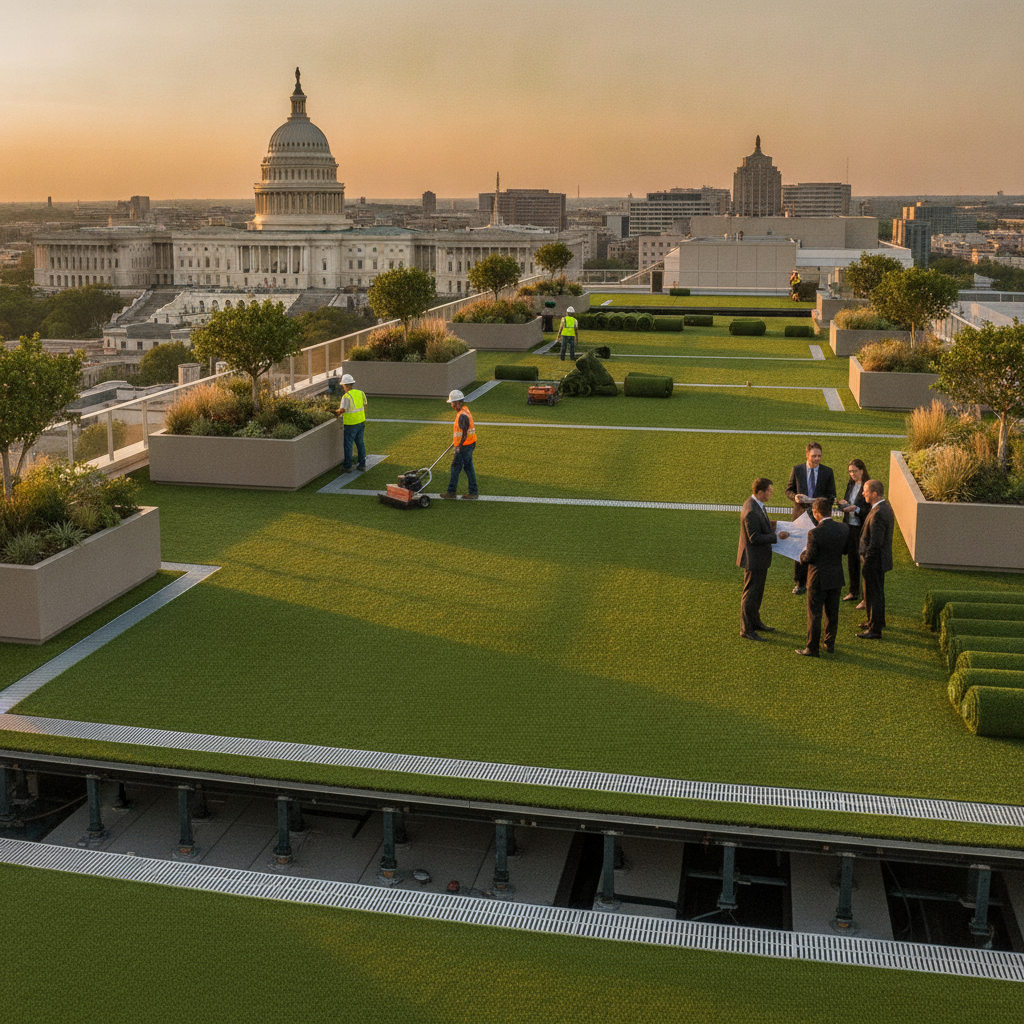
How Do You Install Artificial Turf on a Commercial Rooftop or Terrace in Washington, D.C.? What Property Managers and Business Owners Need to Know
Yes — you can absolutely install artificial turf on a commercial rooftop or building terrace in Washington, D.C., and it can completely transform an underutilized space into a usable amenity. But it’s not as simple as unrolling grass and calling it a day. Commercial rooftop and elevated terrace installations require a fundamentally different approach than ground-level residential work, and most general landscapers — or out-of-state franchise turf companies dropping crews into the DMV — are not equipped to handle them correctly. If you’re a property manager, building owner, or commercial tenant evaluating this for a D.C. office building, restaurant, hotel, or mixed-use space, here’s what you genuinely need to understand before anyone touches your roof deck.
Why Commercial Rooftop Turf Is a Different Animal Entirely
The single biggest mistake property managers make is treating a rooftop installation like a patio installation with a better view. They’re not the same. On a rooftop or elevated terrace, you’re working within hard structural constraints that govern everything — what products you can use, how much base material you can add, and how the system needs to drain.
Before any turf conversation begins, you need a structural engineer (or your building’s original structural documentation) to confirm the dead load capacity of the deck surface. Standard artificial turf with a gravel drainage base can easily run 8 to 15 pounds per square foot once you factor in the turf system, infill, and any drainage layer. On a rooftop rated for 50 psf live load, that’s manageable. On an older terrace structure rated for less, it can be a code violation or a liability issue. Any turf contractor who doesn’t ask about your load rating before quoting you is not the right contractor for this job.
The Right Drainage System for an Elevated Installation in D.C.
Washington, D.C. gets serious rain — the region sees 40+ inches annually, and spring storm events can deliver 2 to 3 inches in a matter of hours. On a rooftop, that water has nowhere to go except through your turf system and into your existing roof drains. If the drainage isn’t engineered correctly, you end up with pooling, membrane damage, and eventually expensive structural repairs that dwarf the cost of the turf project itself.
For commercial rooftop applications, we use a low-profile drainage mat system rather than a traditional crushed aggregate base. These drainage mats — typically high-density polyethylene panels — are designed specifically for elevated surfaces. They protect the waterproof membrane beneath them, allow water to flow laterally toward existing roof drains, and add virtually zero dead load compared to a gravel base. Combined with a quality artificial turf backing rated to drain 30 to 60 inches of water per hour, the system handles even the heaviest D.C. downpours without backing up.
This is an area where most competitor installations in the region fall short. A ground-level turf company that occasionally does rooftops will typically just lay turf directly over foam padding or skip a drainage layer altogether. That works fine on a patio with slope. On a flat or minimally pitched roof deck, it’s a moisture trap.
Product Selection: What Actually Holds Up on a Commercial Rooftop
Not every turf product belongs on a rooftop. For commercial elevated installations, you need a product that is UV-stabilized for continuous sun exposure, backed with a chlorine-tolerant and weather-resistant material (especially important if you’re near a rooftop pool or water feature), and light enough in total system weight to stay within your structural parameters.
For most commercial terrace and rooftop projects, a medium-pile turf in the 35mm–40mm range works well — dense enough to look polished and handle foot traffic from tenants or guests, but not so heavy that infill requirements push your system weight into problematic territory. Silica sand infill is the preferred choice for rooftop commercial applications because it’s inert, heavy enough to stabilize the pile, and doesn’t retain heat the way crumb rubber does.
Heat is a real consideration here in the DMV. During July and August, a D.C. rooftop in direct sun can see ambient temperatures well above 100°F, and a dark-backed turf product without heat-mitigation infill can hit surface temperatures that are uncomfortable for barefoot guests or event attendees. Heat-resistant turf fibers and lighter-colored infill materials can meaningfully reduce surface temperatures — something worth discussing explicitly with your installer if the space will be used for events, dining, or client entertainment.
For commercial clients exploring product options for elevated outdoor spaces, our Plush Pad turf product is specifically designed for poolside, patio, and deck environments, with a backing system built to handle the moisture and UV demands of exposed outdoor installations.
Permitting, Building Management, and Lease Considerations in D.C.
Commercial rooftop projects in Washington, D.C. add a layer of complexity that you simply don’t deal with on a residential backyard job in Burke, VA or Arlington. Depending on your building type and the scope of the installation, you may need to coordinate with:
- Your building’s property management or ownership group for membrane access and warranty preservation
- D.C. DCRA (Department of Consumer and Regulatory Affairs) if your installation is considered a structural modification or part of a larger build-out
- Your roofing contractor or membrane manufacturer to confirm the installation method won’t void your existing roof warranty
- Your commercial lease terms if you’re a tenant, not the building owner
A licensed, insured turf contractor with commercial rooftop experience will flag these issues upfront and help you work through the coordination — not discover them after the job is half-done. Always ask your installer whether they carry general liability insurance and whether they have experience working directly with building managers and roofing contractors. At Grassify, our crews are licensed, insured, and background-checked, and we handle commercial installs with the documentation and coordination that building managers actually require.
What Does a Commercial Rooftop Turf Project Actually Cost?
Commercial rooftop and terrace turf installations run higher than ground-level residential work, and for legitimate reasons. Material hoisting, specialized drainage mat systems, membrane protection requirements, and the coordination overhead of working in a commercial building all add real cost. Rough ranges for elevated commercial turf in the D.C. metro area typically fall between $18 and $28 per square foot installed, depending on the complexity of the drainage system, product selection, and site access logistics.
That said, the ROI on a well-executed commercial rooftop turf installation is significant for the right property. Hotels and restaurants in D.C. that have converted underused roof decks into green amenity spaces routinely see meaningful increases in bookings, event revenue, and tenant retention. The turf itself — once installed correctly — requires almost no maintenance compared to planters, sod, or hardscape, and carries a lifetime seam and edge warranty when installed by a qualified contractor.
If you’re managing commercial properties across the Beltway corridor — including properties in Bethesda, Silver Spring, or Fairfax County — the same principles apply. Elevated surfaces and commercial applications always demand more upfront engineering than a standard residential lawn, and the difference in outcome between a properly engineered system and a shortcut installation is dramatic over a 10- to 15-year lifespan.
For commercial clients across our service area, explore our full range of outdoor commercial turf solutions to understand how we approach large-scale and elevated installations.
Frequently Asked Questions: Commercial Rooftop Turf in Washington, D.C.
Do I need a structural engineer before installing turf on my roof deck?
You should. A structural load assessment — either from your building’s original documentation or a licensed engineer — is essential before specifying a turf system. The weight of turf, infill, and any drainage base needs to fall within your deck’s rated load capacity. Skipping this step is a liability risk and can cause long-term structural damage.
Will installing turf on my rooftop void my existing roof membrane warranty?
It can, if done incorrectly. Turf installed directly on a membrane without a protective drainage mat layer can trap moisture and damage the membrane over time. A knowledgeable commercial installer will use membrane-compatible installation methods and may recommend coordinating with your roofing contractor before the project starts.
How do you handle drainage on a flat or low-slope roof?
We use high-density polyethylene drainage mat panels designed specifically for elevated surfaces. These protect the membrane, allow water to flow laterally toward existing roof drains, and add minimal dead load. The turf backing itself also drains at a rate of 30 to 60 inches per hour, so the system handles heavy rainfall without pooling.
Can rooftop turf handle foot traffic from events or customers?
Yes, when the right product is selected. A medium-density turf in the 35mm–40mm range with silica sand infill holds up well under regular foot traffic from guests, tenants, or event attendees. For high-traffic commercial hospitality applications, product selection and infill weight should be calibrated to the expected use level.
Is rooftop turf too hot for guests in D.C. summers?
It can be if the wrong product is chosen. D.C. rooftops in direct July sun can get extremely hot. Heat-resistant turf fiber technology combined with lighter-colored silica infill can significantly reduce surface temperatures compared to standard turf. If your space will be used during summer afternoons, this is a product specification conversation worth having explicitly with your installer before the project is quoted.
Ready to Turn Your Rooftop or Terrace into a Real Amenity?
Commercial rooftop and elevated terrace turf is one of the most rewarding installations we do — and one of the most technically demanding. If you’re evaluating this for a D.C. office building, hotel, restaurant, mixed-use property, or any commercial space in the DMV area, the starting point is a real conversation with an installer who has done this before and can walk you through the structural, drainage, and product decisions with actual expertise.
Contact Grassify today for a free commercial consultation. We serve Washington, D.C., Northern Virginia, and the Maryland suburbs, and we’ll come to your property, assess your deck, and give you an honest recommendation — not just a quote designed to close a sale.


