
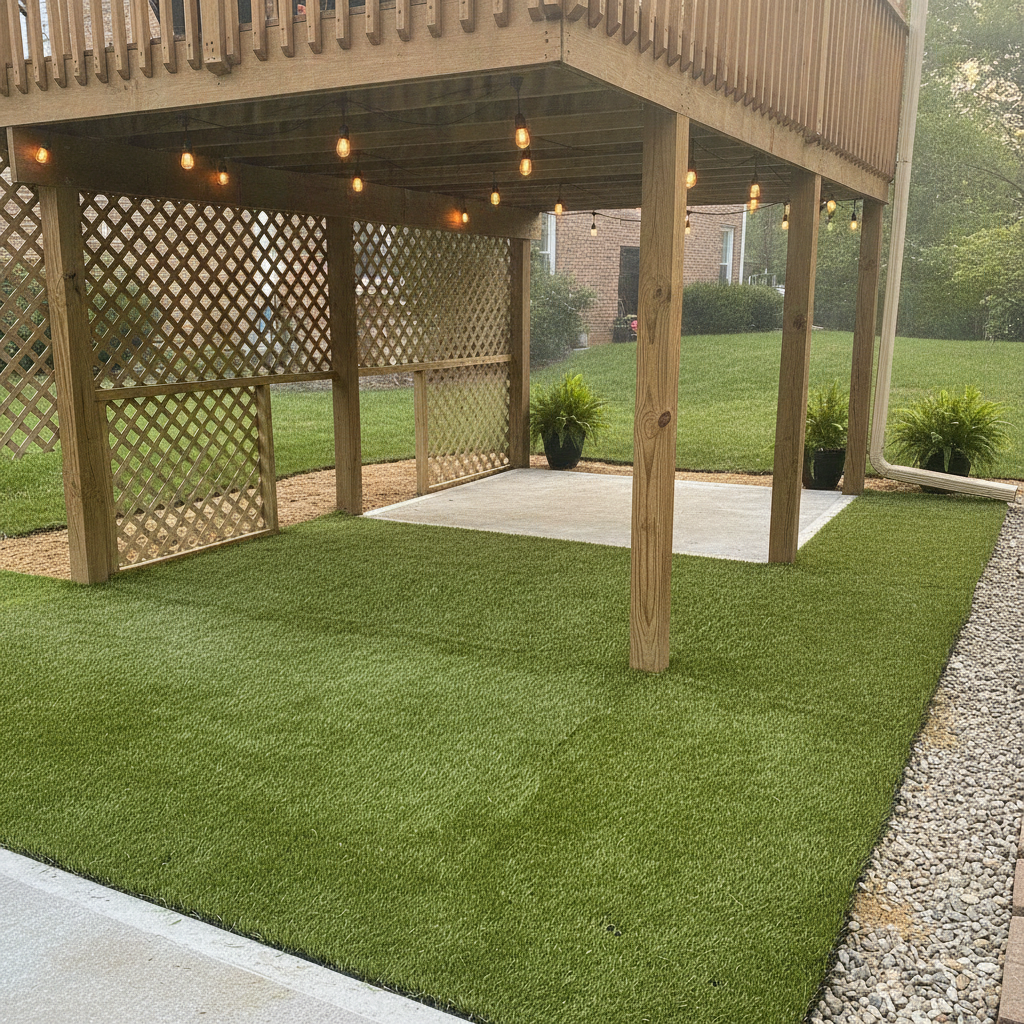
How Do You Install Artificial Turf Under a Deck or Raised Structure in Falls Church, VA? What Homeowners Need to Know
Yes — you can absolutely install artificial turf under a deck or raised structure, and in Falls Church, VA, it’s one of the more practical uses of synthetic grass we see on residential projects. That dead zone beneath a raised deck — muddy after every rain, impossible to grow anything in, usually just wasted square footage — becomes genuinely usable space with the right turf system. But this is not a standard backyard installation. The low clearance, limited airflow, rain channeling off deck boards, and reduced UV exposure all change how the base needs to be built, what product you choose, and how drainage gets handled. Get any of those wrong, and you’re looking at standing water, odor, or turf that shifts and bunches within a season.
Why Under-Deck Turf Installations Are Different From a Standard Lawn Job
Most artificial turf installations across Northern Virginia follow a predictable pattern: excavate 3–4 inches of native soil, lay a compacted base of crushed aggregate, install a permeable weed barrier, roll out the turf, secure the edges, and infill. Under a deck, that process gets complicated in a few specific ways that most homeowners — and honestly, a lot of general landscapers — don’t think through in advance.
Rain channeling is the biggest drainage risk. Deck boards don’t absorb water — they redirect it. Depending on how your deck is oriented and how wide the overhanging boards are, you can get concentrated water flow dropping in sheets off the outer deck edge right onto a narrow strip of turf below. That’s not the same as distributed rainfall across an open lawn. If the base isn’t engineered to handle concentrated flow in specific zones, you get pooling, and pooling under a deck leads to mold, odor, and base erosion over time.
In Falls Church and across Fairfax County, spring rainfall averages are significant — we regularly see two to four inches of rain in a single week during April and May. When that water funnels off a 400-square-foot deck surface and concentrates along the perimeter edge, your turf system needs real drainage capacity underneath, not just a permeable backing and a prayer.
Low clearance changes your installation options. If you’ve got 12 inches of clearance under a deck, your installer is working flat on their back or belly. That’s not an exaggeration. It limits compaction equipment access, changes how edges can be secured, and means every inch of base grading has to be done by hand. Any installer who quotes an under-deck job without walking the space and measuring clearance hasn’t done many of them.
What the Base Preparation Actually Looks Like for a Low-Clearance Space
Here’s what a proper under-deck base installation involves, step by step, so you know what to expect when you’re vetting installers:
- Excavation to 3 inches minimum. Even in tight-clearance spaces, the native soil needs to come out. If your installer is skipping excavation to save time in a hard-to-access area, walk away. Skipping it leads to settling, uneven surface, and drainage failure within 12–18 months.
- Crushed aggregate base (Class II or decomposed granite equivalent), compacted in lifts. The base is what carries water away. A 3-inch compacted aggregate layer with 1–2% grade toward a drainage outlet is the standard. Under a deck, you need to be intentional about where that water exits — ideally away from your home’s foundation.
- Permeable weed barrier above the aggregate. Weed pressure under a deck is lower because of reduced sunlight, but it’s not zero. A quality woven geotextile barrier goes in before the turf.
- Edge securing adapted for low clearance. Bender board and nailing strips are standard for open yards. Under a deck, edges often need to be tucked and secured against deck posts, concrete footings, or existing hardscape — which requires more custom work and adds to labor cost.
One thing that’s genuinely underexplored in most competitor content we’ve seen locally is what happens at the transition point where the under-deck turf meets the open yard turf. If you’re extending the synthetic grass from under the deck out into an open patio or lawn area, the seam between the two zones needs to be handled precisely. A visible or raised seam in a high-visibility area is one of the most common complaints homeowners have after a rushed installation. Proper seaming means aligning fiber direction, using quality seaming tape rated for outdoor thermal cycling (relevant in Northern Virginia where freeze-thaw winters stress everything), and making sure both sides of the seam sit on solid, level base.
Which Turf Products Work Best Under a Deck?
Not all turf performs the same in covered, lower-light environments. Here’s what matters in product selection for this specific application:
- Pile height: Keep it shorter — 30mm to 37mm is generally better in low-clearance spaces because it minimizes the risk of fibers touching deck framing overhead and because shorter piles maintain a cleaner look without heavy foot traffic grooming.
- UV stabilization: Even under a deck, UV exposure happens from reflected and indirect light. UV-stabilized fibers are still worth specifying because they prevent fiber degradation and color fade over the 15–20 year product lifespan.
- Backing permeability: For under-deck applications, backing with a higher drainage rate matters more than in open lawn installations. Look for products rated at 30 inches per hour minimum through the backing alone — separate from base drainage.
- Infill selection: Standard silica sand infill works well in covered areas. If you have pets using the space, a zeolite infill layer adds ammonia-neutralizing capacity and reduces odor buildup in a zone that has less natural airflow to dissipate smells.
For Falls Church homeowners whose under-deck area doubles as a dog hangout zone, Grassify’s pet-friendly turf systems are worth considering — particularly the 5-layer drainage design with zeolite deodorizer and antimicrobial infill, which performs well in lower-airflow environments where odor can accumulate faster than in open yards.
HOA Approval: Don’t Skip This Step in Fairfax County
Falls Church sits at the intersection of two jurisdictions — Falls Church City and portions of Fairfax County — and HOA rules in both areas vary significantly by community. If your home is governed by an HOA, you need architectural review approval before any turf goes down, even in an under-deck area that isn’t immediately visible from the street. Some HOAs in this part of Northern Virginia have specific language about synthetic surfaces on residential lots, and submitting for approval after the fact creates real headaches. Grassify’s installation process includes helping homeowners pull together the product specs and documentation needed for HOA review — that’s not something every installer around here does proactively.
If you’re in Arlington or Springfield and dealing with a similar situation, the same process applies. HOA approval timelines in this region typically run two to six weeks, so factoring that into your project schedule before scheduling an installation date is important.
What Does Under-Deck Turf Installation Cost?
Expect to pay at the higher end of the residential turf range for under-deck work — generally $18–$25 per square foot installed — because of the labor intensity involved in low-clearance spaces and the custom edge and drainage work required. Smaller footprints (under 200 square feet) don’t benefit from the same economies of scale as larger open lawn installations. If an installer quotes you the same price per square foot for under-deck work as an open backyard, ask them specifically how they’re handling drainage and edge securing in the tight-clearance zones. The answer will tell you whether they’ve actually done this before. For a broader look at what the full installation process involves, the Grassify installation guide walks through base prep and product specs in more detail.
Frequently Asked Questions: Under-Deck Turf in Falls Church and Northern Virginia
Can you install turf under a deck with only 8–10 inches of clearance?
It’s possible but significantly more labor-intensive. At that clearance, all base work and edge securing is done by hand, and standard compaction equipment can’t be used. Installation costs go up, and not every installer is willing to take the job. Be upfront about clearance when you’re getting quotes — it’s not a detail to hide until the crew shows up.
Will turf under a deck get moldy or smell over time?
Only if drainage isn’t engineered correctly. A properly graded aggregate base with appropriate drainage exits prevents standing water, which is the root cause of both mold and odor. If you have pets using the space, adding a zeolite infill layer and periodic enzyme rinse maintenance eliminates odor even in low-airflow zones.
Does turf under a deck need infill?
Yes. Infill provides fiber support, ballast to prevent shifting, and in pet applications, odor control. Skipping infill — even in a low-traffic under-deck zone — leads to fibers matting and backing that can shift or bubble over time.
How do you handle the edge where under-deck turf meets the open yard?
This is one of the most technically demanding parts of the job. The seam needs to align fiber direction, sit on continuous compacted base, and be secured with outdoor-rated seaming tape. A well-done seam is invisible from standing height. A poorly done seam is an obvious ridge that collects debris and eventually separates.
Does Grassify work in Falls Church City, or only Fairfax County?
Grassify serves Falls Church, Burke, Springfield, Arlington, and across the broader Northern Virginia area. We’re based in Burke and operate throughout Fairfax County and surrounding jurisdictions — Falls Church City included.
Ready to Put That Dead Space to Work?
That patch under your deck doesn’t have to stay a mud pit. With the right base engineering, the right product, and an installer who’s actually done low-clearance work before, it becomes clean, usable outdoor space — whether that’s a dog hangout zone, a covered play area for kids, or just a good-looking surface visible from your living room windows. Grassify has been handling exactly these kinds of installations across Falls Church, Burke, Springfield, and the rest of Northern Virginia for over a decade. We’ll come out, measure the space, assess your clearance and drainage situation, and give you a straight answer on what’s realistic and what it’ll cost. Contact Grassify today to schedule your free on-site consultation. Reach us at grassify.us/contact-us or call (609) 727-8635.


