
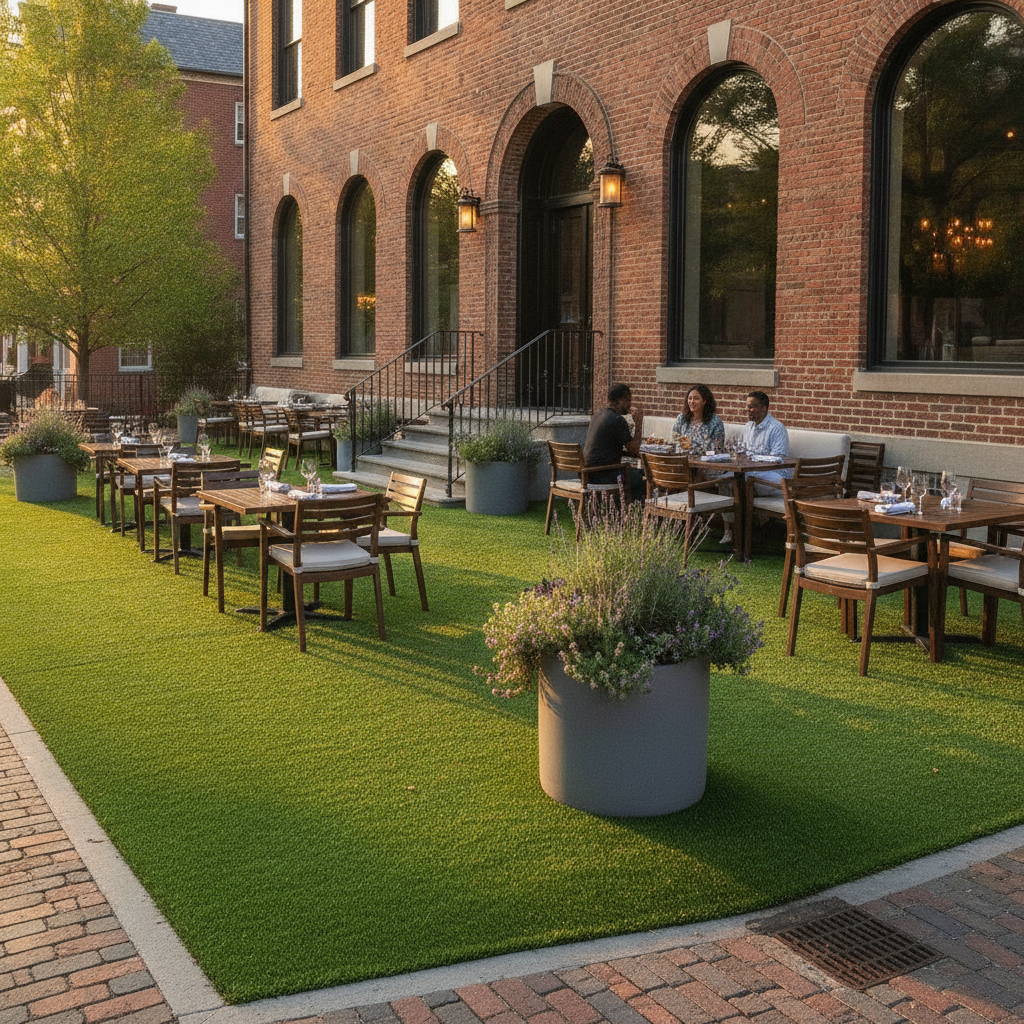
How Do You Install Artificial Turf on a Commercial or Retail Storefront Property in Alexandria, VA? What Business Owners Need to Know
If you’re a business owner in Alexandria, VA thinking about replacing scraggly mulch beds, cracked concrete edging, or a tired strip of natural grass outside your storefront, artificial turf is probably already on your radar. And it should be. Done right, commercial turf installation can dramatically improve curb appeal, eliminate ongoing lawn maintenance contracts, and give your outdoor space a polished, year-round look that attracts foot traffic. But commercial installation is a fundamentally different animal than a residential backyard job — and most of the turf content online (including from a few local competitors) focuses almost exclusively on homeowners. This article closes that gap.
Why Commercial Turf Is Different from Residential Turf
The core installation process — excavate, compact base, lay turf, secure edges — is similar whether you’re doing a suburban backyard in Burke, VA or a storefront on King Street. But commercial jobs carry a different set of pressures that require more planning and more technical precision.
For one, commercial properties in Alexandria see significantly higher foot traffic. A turf area outside a restaurant, boutique retail shop, or professional office suite might have dozens or hundreds of people walking across it daily. That means you need a denser, more durable turf product — typically something in the 50-ounce face weight range or higher — with a reinforced backing designed to resist compression over time. Standard residential turf rated for light use will flatten and mat down within a year under commercial conditions.
Second, commercial drainage requirements are more demanding. Northern Virginia’s spring rain season is no joke — we routinely see multiple inches in a single storm event. A storefront turf area adjacent to a building foundation needs a properly engineered drainage slope and a crushed aggregate base (typically 4 to 6 inches of Class II road base) that channels water away from the structure, not toward it. Getting this wrong doesn’t just create a soggy lawn — it creates liability. Waterlogged turf that drains slowly becomes a slip hazard and can accelerate mold growth at the base layer.
What the Permit and Code Situation Looks Like in Alexandria
This is an area where most competitor content goes completely silent. Business owners searching for commercial turf installation guidance in Alexandria, VA almost never get a clear answer on permits — and that’s a problem, because the answer matters.
In the City of Alexandria, commercial property modifications that alter impervious surface coverage, stormwater flow, or site grading may require a land disturbance permit or a site plan amendment depending on the scale of the work. Turf installation that simply replaces an existing landscaped strip or mulch bed with minimal grading is typically low-risk from a permitting standpoint. But if you’re converting a significant paved or hardscape area to turf — or installing turf on a rooftop — you’ll want to loop in your commercial property manager and possibly check with the City’s Department of Planning and Zoning before work begins.
If your commercial space is located inside a retail center or shared property governed by a commercial HOA or landlord association, you’ll almost certainly need architectural approval before any exterior modification. This mirrors what residential HOA owners in Fairfax County deal with — but on a commercial lease, the approval process may also require sign-off from your property manager or leasing office. Grassify works directly with property managers and building owners to handle this documentation, so you’re not navigating it alone.
Choosing the Right Turf Product for a Storefront Application
Not every turf product is appropriate for commercial exterior use. Here’s what to look for when evaluating products for a storefront, restaurant patio, or retail entrance:
- Face weight and blade density: For high-traffic commercial areas, look for products with a face weight of 50 oz/yd² or higher. Lower face weight products designed for residential lawns will show wear patterns quickly under foot traffic.
- UV stabilization: Commercial turf faces full sun exposure year-round. UV-stabilized polyethylene fibers resist fading and fiber breakdown for 10 to 15 years, which matters when your turf is part of your brand’s visual impression.
- Antimicrobial backing: Especially important for restaurant patios and food service areas where spills and organic debris are common. Antimicrobial backing inhibits bacteria and mold growth at the base of the fibers.
- Drainage rate: Commercial installations should use products rated for 30 inches per hour or higher. In a heavy rain event, a parking lot or street-adjacent storefront needs turf that drains fast enough to prevent standing water from flowing toward your entrance.
- Slip resistance: For any area where customers walk — especially after rain — the turf texture and infill selection must provide adequate traction. A silica sand or crumb rubber infill layer improves stability and grip underfoot.
Grassify’s outdoor commercial turf installations are engineered specifically for durability under real-world use conditions — not just aesthetics. We’ll recommend the right product based on your traffic patterns, sun exposure, and the functional demands of your space.
The Real Cost of Commercial Turf Installation in Alexandria, VA
Commercial turf installation typically runs between $15 and $25 per square foot depending on scope, site conditions, and product selection. That range accounts for base preparation, drainage engineering, turf material, infill, and edge finishing. Larger projects or those with complex grading needs will sit toward the higher end. Simple strip installations replacing an existing mulch bed with minimal excavation may come in closer to the lower end.
Compare that against a typical commercial landscaping contract — mowing, edging, fertilizing, irrigation maintenance — and the math often favors artificial turf within three to five years. You eliminate irrigation costs entirely, cut out weekly maintenance visits, and stop dealing with seasonal brown patches and mud tracked into your building after every hard rain.
For businesses in the Beltway corridor — Alexandria, Arlington, or closer in toward Washington, D.C. — where commercial real estate is expensive and every square foot of exterior space contributes to your property’s image, a well-installed turf area pays for itself in curb appeal alone. A dead strip of grass outside your front door costs you customers who walk by and make snap judgments. Clean, lush-looking turf communicates that you take your business seriously.
What Good Installation Actually Looks Like for a Commercial Property
A professional commercial turf installation at a storefront or retail property should follow this sequence:
First, the existing material is excavated to a depth of 4 to 6 inches, depending on drainage needs and existing soil conditions. Native soil in parts of Alexandria and across Fairfax County tends to run clay-heavy, which means natural drainage is already poor — this makes proper base engineering non-negotiable, not optional.
Next, a crushed aggregate base (Class II road base or decomposed granite) is installed and mechanically compacted in lifts to prevent settling. A 3 to 4 inch compacted base layer is standard. For areas with particularly poor drainage or where the grade slopes toward the building, a perforated drain pipe system may be embedded in the base before compaction.
Weed barrier fabric is then laid over the compacted base, and the turf is cut and positioned. On commercial jobs, seam placement is critical — seams should never fall in high-traffic walking paths or corners where stress concentrations are highest. Seams are secured with industrial-grade adhesive and joined with seam tape rated for exterior commercial use. Edges are bender-boarded and staked to lock the perimeter against shifting under traffic and through freeze-thaw cycles.
Finally, infill is installed using a power broom. Silica sand is the standard for most commercial applications, though antimicrobial or heat-resistant infill may be specified depending on the environment. A full brushing and grooming pass finishes the installation.
Grassify crews are licensed, insured, and background-checked. Our commercial installations carry a lifetime warranty on seams, edges, and base integrity — because we know commercial clients can’t afford to revisit a problem installation six months after the job is done. You can learn more about our installation process and what’s covered in our installation guide.
Frequently Asked Questions: Commercial Turf for Storefronts in Alexandria, VA
Does artificial turf hold up under outdoor restaurant furniture and heavy foot traffic?
Yes — when the right product is specified. Restaurant patio turf should use a high face weight product (50 oz or higher) with a reinforced primary backing. Furniture legs should be fitted with rubber caps to prevent concentrated pressure points that compress fiber over time. With proper product selection and base prep, commercial turf handles restaurant patio use without visible wear for 10 to 15 years.
Do I need a permit to install commercial turf in Alexandria, VA?
It depends on the scope of the work. Simple landscape bed replacements with minimal grading typically don’t require a permit. More significant site modifications that alter stormwater flow or involve structural changes may. We recommend checking with the City of Alexandria’s Department of Planning and Zoning for your specific parcel, and Grassify can help you document the project scope for that review.
Can my landlord or commercial HOA reject my turf installation?
Potentially, yes. If your commercial space is part of a managed property or retail center, exterior modifications typically require approval from the property owner or HOA board. We have experience working through this process and can provide documentation, product specs, and drainage plans that support your approval request.
What happens to commercial turf in winter? Does freeze-thaw damage it?
Properly installed turf with a well-compacted base handles freeze-thaw cycles without issue. The risk is in poor base prep — if the aggregate base wasn’t compacted correctly or isn’t thick enough, heaving can occur during hard freezes, causing edges to lift and seams to separate. That’s why base engineering isn’t something to cut corners on, especially in Northern Virginia where hard freezes are annual.
How long does a commercial turf installation take?
Most storefront and retail turf installations are completed in one to two days depending on the square footage and site complexity. We can often schedule commercial work early morning or on weekends to minimize disruption to your business hours.
Ready to Upgrade Your Storefront? Let’s Talk.
If you’re a business owner in Alexandria, Arlington, or anywhere in Northern Virginia looking to replace dead grass, muddy mulch beds, or cracked hardscape with professional commercial turf, Grassify is ready to walk the site with you. We’ll assess your drainage, recommend the right product for your traffic and sun conditions, help you navigate any approval requirements, and give you a straight answer on cost and timeline.
No sales pitch. No bait-and-switch pricing. Just honest commercial turf expertise from a locally rooted team that’s been doing this work in the DMV for over a decade. Request your free consultation here and we’ll get back to you within one business day.


