
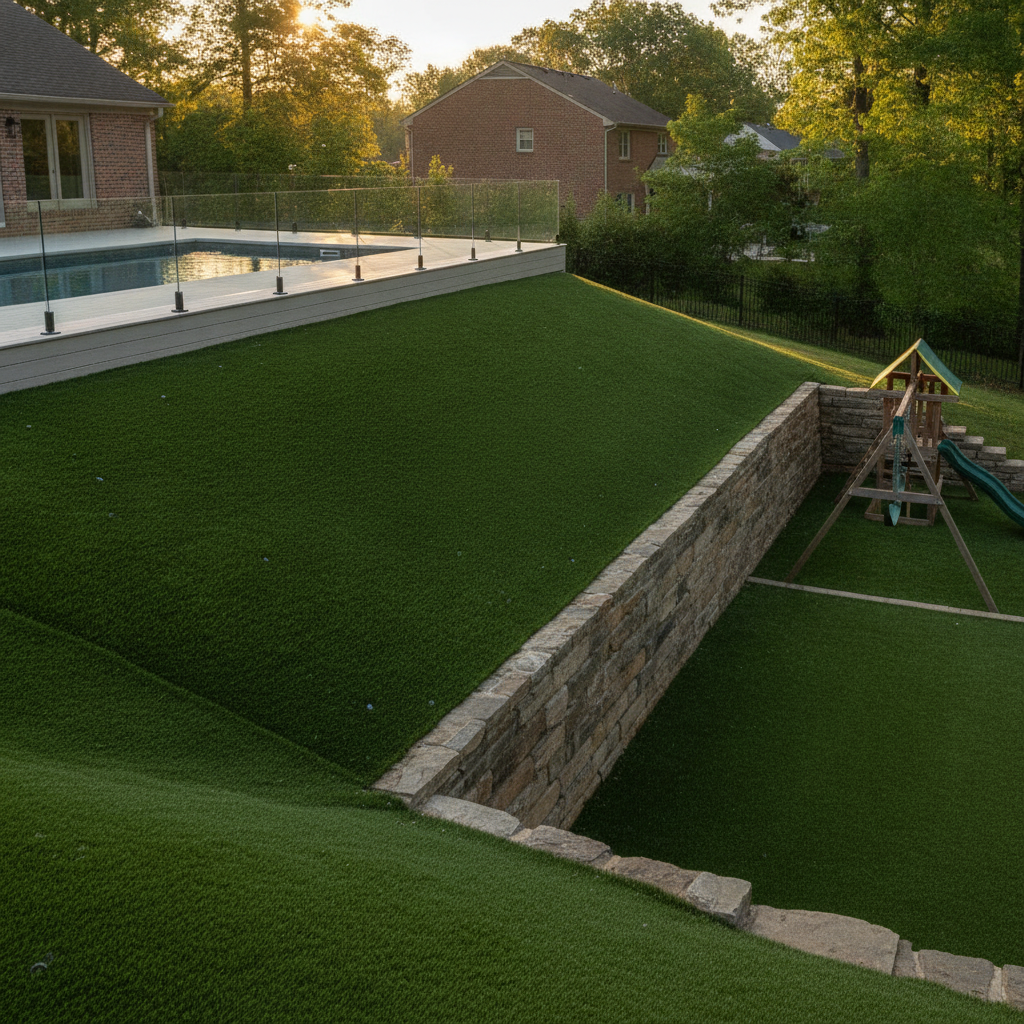
How Do You Install Artificial Turf on a Steep Embankment or Retaining Wall Area in Loudoun County, VA? What Homeowners Need to Know
If you’ve got a steep embankment or a slope running along a retaining wall on your Loudoun County property, you already know the routine: natural grass doesn’t grow evenly on the face, it burns out in dry spells, washes out in hard rains, and mowing it is either a genuine physical hazard or something you’re paying a landscaper to skip entirely. Artificial turf is one of the most practical long-term fixes for these areas — but embankment and retaining wall installs are technically different from a flat backyard job, and getting the base prep and anchoring wrong means the turf slides, separates at the seams, or buckles after the first hard freeze. Here’s what actually goes into doing it right.
Why Embankments Are a Different Kind of Turf Project
Most artificial turf installations start with a relatively flat or gently graded area. The crew excavates several inches of native soil, compacts a crushed aggregate base layer, grades for drainage, and then rolls and anchors the turf on top. On a slope steeper than roughly 15 to 20 degrees, that standard sequence stops being enough. Gravity is working against you the entire time — during installation, and for every year the turf is down afterward.
In Loudoun County specifically, the problem is compounded by the clay-heavy soils common throughout the county’s suburban corridors in Ashburn, Sterling, and Leesburg. Clay holds water rather than releasing it. When heavy spring rains — the DMV gets significant rainfall events from March through May — saturate a clay-heavy embankment, the sub-base can become unstable even if the surface looks fine. Add in the freeze-thaw cycles that hit Northern Virginia from November through February, and you’ve got a situation where an under-engineered base can heave, shift, and eventually cause your turf to ripple, pull away from anchor points, or open up seams along the face of the slope.
Any installer who quotes an embankment job the same way they’d quote a flat backyard is either inexperienced or not paying close attention. Ask them directly: how do you handle sub-base stabilization on a grade above 20 degrees? What anchoring method do you use along the face? How do you manage water running off the top of the slope into and through the turf system? If they can’t answer those questions in specific terms, that’s a red flag.
What a Proper Embankment Turf Install Actually Involves
On a steep embankment or the face of a retaining wall area, a well-executed artificial turf installation typically involves several layers of work that most homeowners don’t see quoted when they compare prices:
- Soil stabilization fabric or geotextile layer: Installed beneath the aggregate base, this prevents the crushed stone from migrating into the native clay below — which is what causes base settlement on slopes over time.
- Compacted aggregate base with proper thickness: On a slope, the base layer needs to be slightly thicker than on flat ground — often 4 to 5 inches of compacted Class II road base — to compensate for the drainage forces moving water down the face rather than straight through.
- Mechanical anchoring at the top of the slope: The turf is secured at the crown of the embankment using either a buried anchor board (typically a treated 2×4 or composite bender board sunk below grade) or heavy-duty landscape staples at close intervals — sometimes as tight as 4 to 6 inches along the top edge.
- Intermediate anchoring on longer slopes: On embankments longer than 8 to 10 feet, experienced crews add intermediate staple or nail rows across the face at regular intervals to prevent the turf from slowly migrating downward under gravity and infill weight over time.
- Seam placement strategy: Seams should never run horizontally across the face of a slope — that’s a path for the turf to separate under load. Seams should run vertically, perpendicular to the direction of gravity, and be secured with both adhesive and mechanical fasteners.
For residential lawn turf installations on embankments, Grassify typically recommends pile heights in the 35mm to 40mm range — dense enough to look natural and hold infill weight without the longer fibers flopping under their own mass on a grade. UV-stabilized polyethylene fibers are standard for any exterior slope exposure.
The Drainage Engineering That Most Installers Skip
This is the section that separates a professional install from a weekend project, and it’s a topic that most competitor websites in the DMV area don’t address in any meaningful depth when they talk about slope or embankment installations.
On a flat yard, drainage runs straight down through the turf backing and aggregate base into the native soil below. On a slope, water moves laterally across the face before it can penetrate vertically. If your aggregate base isn’t properly graded and your backing doesn’t have adequate perforations, water can pool between the turf and the base along the lower edge of the embankment — which saturates the base, softens it, and eventually causes edge lifting or base settlement.
The correct approach is to ensure the aggregate base is graded to direct water toward a drainage outlet — either an existing storm drain, a French drain running parallel to the base of the embankment, or a gravel trench at the toe of the slope. The turf backing itself should have a perforated or hole-punched drainage pattern rated for high flow volumes. In the heavy rain conditions that Loudoun County sees in spring and early fall, a drainage rate of at least 30 to 40 inches per hour through the backing is a reasonable minimum for slope applications.
Freeze-Thaw Durability: A Northern Virginia-Specific Concern
Embankment turf takes more stress from freeze-thaw cycles than flat installations do, because the base is more exposed on a grade and frost penetrates from multiple angles. When water in the sub-base freezes and expands, it exerts upward pressure on the aggregate — a process called frost heave — and on a slope, that pressure can shift the base laterally as well as vertically.
Properly installed geotextile fabric and a well-drained base significantly reduce this risk by limiting the water content in the base layer that’s available to freeze. This is why base preparation quality isn’t just about aesthetics — it directly determines whether your turf still looks flat and seam-tight after five winters in Leesburg or Ashburn.
Grassify backs all installations — including slope and embankment work — with a lifetime warranty on seams, edges, and base performance. If something shifts or separates, we come back out and fix it. That’s the kind of guarantee that should be in writing before any shovel goes in the ground. You can learn more about what professional installation entails on our installation guide page.
What Does Embankment Turf Cost in Loudoun County?
Embankment and slope installations typically run at the higher end of the residential turf pricing range — generally $18 to $25 per square foot installed, depending on slope severity, drainage complexity, soil conditions, and access. That’s more than a flat lawn job for a reason: the anchoring, stabilization fabric, additional base material, and increased labor time on a slope are real costs, not padding. Be cautious of quotes that come in well below this range for a genuine embankment project — the savings are almost always coming out of base quality or anchoring density, and you’ll see it within a few years.
Frequently Asked Questions: Embankment Turf in Loudoun County, VA
Can artificial turf actually prevent erosion on a steep slope?
Yes — when installed with proper anchoring and a stabilized base, synthetic turf eliminates the bare soil exposure that causes erosion and eliminates foot traffic on vulnerable slopes. The geotextile fabric beneath the base also holds the soil layer in place. It’s not a substitute for a structural retaining wall if the slope is actively failing, but for stable embankments that are losing grass and eroding slowly, turf is an excellent long-term solution.
Will the turf slide down the embankment over time?
Not if it’s anchored correctly. The key is mechanical fastening at the crown of the slope and intermediate anchor rows across the face for longer embankments. Infill weight, if the slope exceeds roughly 30 degrees, can migrate toward the base over years — a qualified installer will account for this in the infill type and density they select.
Does Loudoun County or my HOA have rules about turf on front-facing embankments?
Loudoun County itself doesn’t have a blanket prohibition on artificial turf, but many HOA communities in Ashburn, Sterling, and the Broadlands area have architectural review requirements. Some HOAs restrict synthetic grass on street-facing slopes specifically. We recommend pulling your HOA’s architectural guidelines before signing any turf contract — Grassify can help you navigate the approval process and, where required, submit materials on your behalf.
How long does an embankment turf installation take?
Most residential embankment jobs in the 500 to 1,500 square foot range take two to three days from excavation to final infill. Larger projects or areas with difficult access or significant drainage work may run three to five days. Weather holds can extend timelines, particularly during wet spring months.
Is pet turf an option for a sloped yard in Loudoun County?
Absolutely. If your dogs use the embankment area regularly, we can install a pet-specific turf system with a 5-layer drainage design, zeolite deodorizer, and antimicrobial infill — engineered to handle both the slope drainage challenges and the odor control demands of heavy pet use. Drainage rate on pet systems runs above 400 inches per hour, which is more than sufficient for slope applications even during heavy rain events.
Ready to Stop Fighting That Embankment?
If you’ve got a steep slope or retaining wall area in Loudoun County that’s given up on natural grass — or that you’ve been mowing at your own risk for years — Grassify can give you a straight assessment of what a properly engineered turf installation would involve, what it would cost, and whether it’s the right fit for your specific site conditions. We serve Ashburn, Leesburg, Sterling, and the surrounding Loudoun County communities, along with clients across Fairfax County and the broader Northern Virginia area.
Contact us at grassify.us/contact-us to schedule a free on-site consultation. We’ll look at your slope, your soil, your drainage, and your goals — and give you a real plan, not a generic quote.


