
How Do You Install Artificial Turf on a Steep Slope or Hill in a Backyard in Fairfax, VA? What Homeowners Need to Know
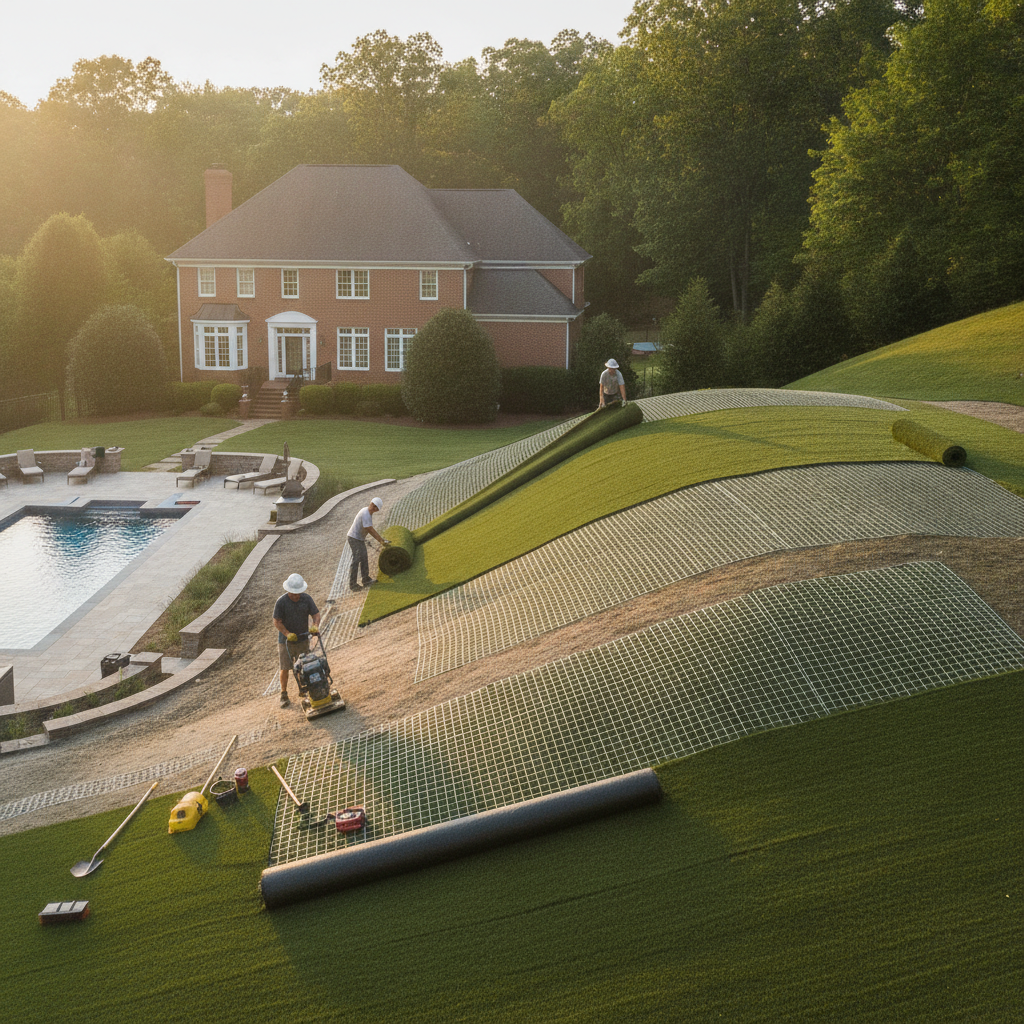
Yes, you can install artificial turf on a steep slope — but it is not the same project as a flat backyard, and treating it like one is exactly how installs fail. If you have a hillside yard in Fairfax, VA or anywhere else in Fairfax County, you already know the frustration: natural grass won’t hold, erosion channels form after every spring storm, and the slope is either too steep to mow safely or too shaded to grow reliably. Artificial turf solves all of that — when it’s installed correctly. The key phrase is installed correctly. Slope installations require a fundamentally different approach to base engineering, anchoring, drainage routing, and seaming than flat-grade work. This guide explains exactly what that looks like.
Why Hillside Yards in Fairfax County Create Unique Installation Challenges
Fairfax County sits on a mix of clay-heavy Piedmont soils and weathered granite sub-base. That combination behaves very differently from the sandy soils you’d find further south. On a flat yard, clay-heavy soil is a drainage challenge. On a slope, it becomes a structural one. Clay retains moisture, becomes slick and unstable when saturated, and expands slightly during freeze-thaw cycles in winter. If your base prep doesn’t account for this, the entire sub-base can shift — and your turf moves with it.
Add Northern Virginia’s spring rainfall patterns to the equation. The DMV area routinely sees 4 to 6 inches of rain in April and May, often falling in concentrated multi-day events. On a slope, that volume of water doesn’t just drain — it accelerates. Without proper drainage engineering beneath the turf, water will find the path of least resistance, which is typically under the edges of the turf or along seam lines. That leads to edge lifting, seam separation, and in severe cases, base displacement.
This is the content gap that most competitor sites in this region never address. You’ll find plenty of general information about base compaction and infill types, but almost no guidance specific to slope installation — even though hilly backyards are common throughout Fairfax, Burke, and Springfield.
What Slope Grade Actually Changes About the Installation Process
Installers measure slope as a percentage — rise over run. A 5% grade is gentle and barely affects installation logistics. Once you’re above 15%, the installation approach changes meaningfully in several ways:
- Base material selection: Standard crushed aggregate base (Class II road base or decomposed granite) can migrate on slopes steeper than 15–20% unless it’s stabilized. A properly engineered slope install uses a compacted angular aggregate that locks together and resists downhill creep. Some slopes also benefit from a geotextile stabilization layer beneath the base to prevent sub-base migration over time.
- Drainage routing: On a flat yard, drainage disperses evenly across the base. On a slope, water moves in a predictable direction, and the drainage system needs to be designed around that. Perforated drain lines at the base of the slope, combined with directional grading within the base material, prevent water from pooling or undermining the downhill edge.
- Anchoring density: Flat installs use galvanized nails or staples along the perimeter every 3 to 4 inches, with field anchors placed at seams. On a slope, anchoring needs to be significantly denser — especially along the uphill edge, where gravity creates constant downward tension on the turf. Bender board edging alone won’t hold turf on a meaningful grade; steel anchor bars or power-driven nails at closer intervals are standard practice.
- Seam placement and orientation: Seams should never run horizontally across a slope. A horizontal seam is a point of structural weakness, and gravity pulls the lower panel away from the upper one over time. On slopes, seams should run vertically — parallel to the fall line — to minimize stress concentration.
- Infill application: Standard silica sand or crumb rubber infill will migrate downhill on grades above 20% without proper fiber support. Products with a higher pile density and stiffer fiber structure hold infill more effectively on slopes. For steeper installations, a partial zeolite or coated sand infill is often preferable because it compacts more reliably than round-grain silica.
Erosion Control: What Turf Does and Doesn’t Do on a Slope
One of the most common reasons homeowners in Fairfax call about slope turf is erosion. Natural grass fails to establish on steep or shaded slopes, bare soil washes out, and mulch migrates downhill every time it rains. Artificial turf does solve the erosion problem — but only if the base is properly built first.
Turf itself is not a structural erosion control material. The fabric backing covers the surface but doesn’t anchor soil underneath. If you install turf over an unstable or poorly compacted slope, you’ve just covered the problem temporarily. The base needs to be excavated, re-graded with proper slope geometry, compacted in lifts, and stabilized before any turf goes down. On very steep slopes — above 35% or so — retaining walls or terracing may be necessary to create flat or gently graded sections before turf installation becomes practical.
When the base is engineered properly, though, residential lawn turf on a slope is exceptionally durable. It eliminates mowing hazards, ends the erosion cycle permanently, and converts an unusable section of yard into clean, usable outdoor space. For families with kids or dogs who currently avoid the slope entirely, that’s a meaningful quality-of-life improvement.
Freeze-Thaw Cycles and What They Mean for Your Slope Base
Burke and Fairfax County get enough freeze-thaw cycles each winter — typically 20 to 40 per season — to stress any outdoor surface installation. On a flat yard, freeze-thaw primarily affects seam integrity and edge anchoring. On a slope, the stakes are higher because the freeze-thaw cycle can also affect sub-base stability.
When moisture in clay soil freezes, it expands slightly. On a slope, that expansion can have a directional component — pushing material downhill. Over several winters, a poorly built slope base can gradually deform, creating waviness or low spots in the turf surface. The fix is proper base depth (typically 3 to 4 inches of compacted aggregate minimum on slopes, sometimes more), adequate drainage to keep moisture levels low in the sub-base, and the geotextile barrier mentioned earlier.
This is why choosing an installer with specific DMV-area experience matters. A franchise installer trained in Florida or Arizona climates may build a perfectly functional flat-grade turf install but have little experience with the freeze-thaw engineering requirements specific to Fairfax County and the broader Northern Virginia region.
What a Slope Turf Install Costs and How Long It Takes
Slope installations cost more than flat installs — typically in the $16 to $25 per square foot range depending on grade, access, and soil conditions. The additional cost reflects extra excavation work, denser anchoring, drainage engineering, and longer installation time. Tight-access hillside yards — common in older neighborhoods in Fairfax and Springfield — can add cost if equipment access is limited and more work has to be done by hand.
Timeline for a standard residential slope project in Fairfax County is typically 2 to 4 days, depending on size and complexity. A detailed site visit is essential before any estimate is provided — slope angle, soil type, drainage direction, and access all affect scope significantly.
Grassify provides a lifetime installation warranty covering seams, edges, and base integrity. On slope installations, that warranty is backed by the engineering standards described above — not just a materials guarantee on the turf itself. That distinction matters on a slope more than anywhere else.
Frequently Asked Questions
Can artificial turf be installed on any slope, or is there a maximum grade?
Most slopes up to about 40–45% (roughly a 2:1 ratio) can be successfully turfed with proper engineering. Above that, terracing or retaining walls are typically needed first. A site visit will confirm what your specific slope requires.
Will the turf slide or creep downhill over time?
Not when anchored correctly. Dense perimeter anchoring, field anchors at appropriate intervals, and a stabilized sub-base prevent downhill movement. The key is anchor density — slope installations require significantly more anchoring than flat installs.
Does Fairfax County require a permit to install turf on a slope?
Most residential turf installations in Fairfax County do not require a building permit, but significant grading or drainage work may require a grading permit depending on scope and proximity to property lines or waterways. Your installer should flag this during the site visit.
What happens to the turf surface during heavy rain on a slope?
With proper drainage engineering, surface water moves through the turf backing and into the aggregate base, then routes to a perforated drain or disperses at the base of the slope. You should not see ponding or surface runoff across a properly built slope install, even during heavy spring rains.
I have an HOA — do I need approval before installing turf on a visible slope?
Yes, almost certainly. Most HOA communities in Fairfax County require architectural review committee approval before any significant landscaping change on a visible area of your property. Grassify helps homeowners prepare accurate product specifications and visual references to support the approval process before installation begins.
Ready to Reclaim That Hillside?
If you’ve been looking at an eroded, unmowable, or overgrown slope in your backyard in Fairfax, Burke, or anywhere else in Fairfax County and wondering whether turf is actually a realistic solution — the answer is yes, when it’s done right. Grassify has been engineering slope installations across Northern Virginia for over a decade, and we know exactly what these yards require to hold up long-term.
Contact us to schedule a free on-site consultation. We’ll walk the slope with you, assess soil and drainage conditions, and give you a clear picture of what the project involves — no obligation, no pressure. Request your free consultation here.


