
How Do You Install Artificial Turf in a Backyard with Chronic Drainage Problems in Ellicott City, MD? What Homeowners Need to Know
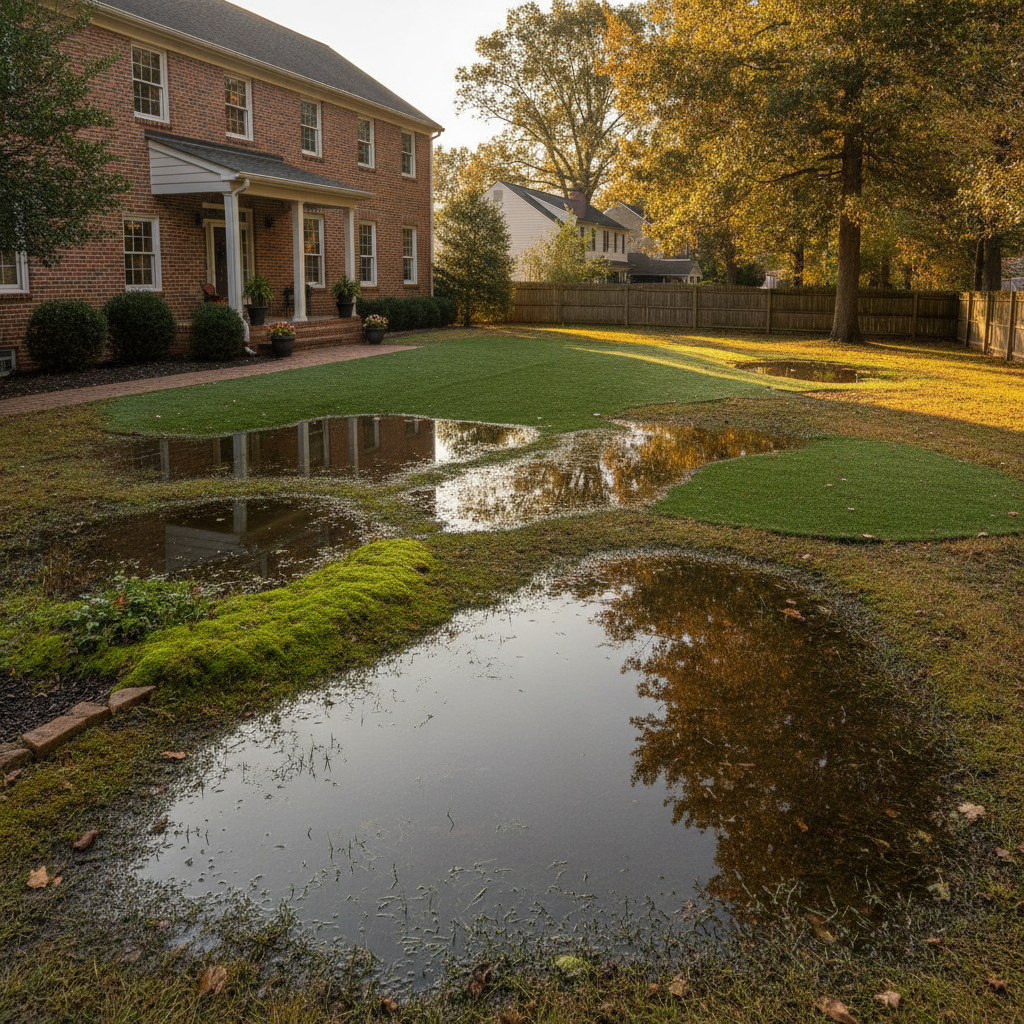
Yes, you can install artificial turf over a chronically wet or poorly draining backyard — but only if the underlying drainage problem is engineered out of the ground first. If you skip that step, you’re not fixing a soggy yard; you’re hiding it under a $15,000 carpet that will buckle, smell, and fail within a few years. Homeowners in Ellicott City know this reality better than most. Howard County sits in a topographic bowl that funnels stormwater from the surrounding hillsides, and that heavy spring rainfall doesn’t just pass through — it saturates the clay-heavy soils common across this part of Maryland. Done correctly, a professionally installed synthetic lawn with engineered sub-drainage can turn a waterlogged backyard into a clean, functional outdoor space that drains faster after a storm than any natural grass ever did. Done wrong — or done cheap — it becomes a health hazard and a financial loss.
Why Wet Yards and Artificial Turf Are a Dangerous Combination Without Proper Engineering
Here’s what most competitor websites in this market won’t tell you: artificial turf itself drains extremely fast. The backing material on quality turf products is perforated with drainage holes rated at 30 to 60 inches per hour. That’s not the problem. The problem is what happens to that water once it exits the turf and hits the ground below.
If your native soil is dense Maryland clay — which is extremely common in Howard County and across Montgomery County — water moving through the turf backing has nowhere to go. It pools at the base layer, saturates the compacted aggregate underneath, and eventually backs up through the turf itself. You end up with standing water visible on the surface, seams lifting as the base shifts, and anaerobic bacterial growth underneath the turf causing odors that no amount of deodorizer infill will mask. This is exactly the failure mode that happens when general landscapers or budget installers skip the drainage engineering phase and go straight to laying stone and rolling out turf.
The fix isn’t optional. It’s the foundation of the entire project.
What Proper Drainage Engineering Actually Looks Like
Before any synthetic grass gets unrolled in a problem drainage yard, the subsurface system has to be designed and built from scratch. Here’s what that process looks like when it’s done right:
- Excavation to the right depth: Typically 3 to 4 inches of native soil is removed, sometimes more if the ground is severely compacted or if the grade needs to be corrected to direct water away from the home’s foundation. In yards where flooding is severe, we may excavate 5 to 6 inches and install a full French drain network before any aggregate goes down.
- Perforated drain pipe installation: In chronically wet yards, 4-inch perforated corrugated pipe is laid in a herringbone or parallel pattern across the excavated surface, sloped at a minimum 1% grade toward a designated outlet — a pop-up emitter, a dry well, or a connection to an existing storm drain. This intercepts water at the sub-base level and moves it laterally off the property before it can saturate the aggregate above it.
- Drain pipe wrapped in geotextile fabric: The perforated pipe is wrapped in filter fabric to prevent fine soil particles from migrating into the pipe and clogging it over time. This is a detail that separates a 5-year drainage system from a 15-year one.
- Crushed aggregate base layer: 3 to 4 inches of crushed angular stone (typically 3/8-inch clean crushed granite or trap rock) is installed over the drain network. This stone has no fines, so water moves through it freely at rates exceeding 400 inches per hour. Round pea gravel is not an adequate substitute — it compacts unevenly and allows base migration over freeze-thaw cycles.
- Compaction and grading of the base: The aggregate is mechanically compacted in lifts and graded to a 1 to 2 percent cross-slope, directing surface water toward the drainage outlets while maintaining a visually level surface for the turf above.
A decomposed granite (DG) layer is sometimes added on top of the aggregate base to create a firm, stable surface for turf adhesion along seams and edges. The total system is designed not just to let water through, but to move it somewhere specific.
The Gap Competitors Aren’t Filling: Site-Specific Drainage Assessment
When you look at how most synthetic grass contractors in this region approach drainage, you’ll find a common pattern: they describe what their turf’s backing drains at (impressive-sounding numbers), reference a crushed stone base in passing, and move on. What they don’t discuss is how drainage is assessed and engineered for a specific yard’s conditions — particularly for properties with documented flooding history, significant slope, high water tables, or soils that passed a perc test poorly.
At Grassify, a drainage assessment is part of every residential consultation for yards with known wet areas. We evaluate the existing grade, identify where water enters and pools, check proximity to the home’s foundation, and determine what outlet options are available for intercepted water. Only then do we design the sub-base. That’s the piece that separates a permanently green, dry backyard from a soggy mess with turf on top of it. If you’re talking to a contractor who gives you a turf quote after a 10-minute walkthrough and never mentions drainage engineering, that’s a red flag worth taking seriously.
You can learn more about how Grassify approaches residential turf installation — including base prep and drainage considerations for lawns across the DMV.
What Homes in Ellicott City (and Across the DMV) Are Actually Dealing With
Howard County’s terrain creates drainage challenges that are distinct from what you see in flatter parts of the Beltway corridor. Ellicott City in particular has steep terrain feeding into lower residential lots — a combination that can mean significant stormwater volume moving through a backyard even during moderate rain events. Homeowners who’ve dealt with flooding aren’t imagining it; the topography is genuinely challenging.
Similar dynamics play out across the broader DMV. Properties in Montgomery County, Fairfax County, and Burke, VA with heavy clay subsoils and negative grades all share the same fundamental problem: water doesn’t move fast enough through native soil. Artificial turf doesn’t worsen the hydrology — but poorly installed turf absolutely can concentrate water in ways that accelerate foundation and fence-post erosion. Done right, the turf system actually manages stormwater more predictably than natural grass because the base is engineered rather than left to the variable performance of living soil.
What It Costs to Do This Right
Installing turf in a problem drainage yard costs more than a standard installation — and it should. Depending on the severity of the drainage issue, French drain pipe network, outlet construction, and additional excavation can add $2 to $5 per square foot to the project cost on top of the base turf installation range of $12 to $25 per square foot. For a 500-square-foot backyard with serious drainage engineering, budget $8,000 to $15,000 for the complete project. That’s a meaningful investment, but it’s a fraction of the cost of foundation repairs or repeated turf replacement after a failed installation. Ask any contractor quoting your project to itemize the drainage scope separately so you understand exactly what’s being done below the surface.
For families with dogs, wet yards and odor issues often go hand in hand. If your drainage problem yard also serves as a pet run, a five-layer drainage system with zeolite deodorizer and antimicrobial infill is worth building in from the start. See how Grassify designs pet-friendly turf systems for yards with both drainage and odor challenges.
Frequently Asked Questions: Artificial Turf and Drainage Problems in Ellicott City and the DMV
Will artificial turf make my flooding problem worse?
Not if the drainage system underneath it is properly engineered. The turf backing itself drains rapidly — the problem is always in the sub-base and native soil. Properly installed turf with a crushed aggregate base and perforated drain pipe will actually move stormwater off your property more efficiently than compacted natural grass in most cases.
Do I need a permit in Howard County, MD to install a drain pipe system in my backyard?
In most cases, routine sub-base drainage for artificial turf — perforated pipe to a pop-up emitter or dry well — does not require a permit in Howard County. However, if you’re connecting to a public storm drain or making significant changes to your lot’s grading or impervious surface coverage, it’s worth a call to the Howard County Department of Public Works before work begins. A licensed installer should handle this assessment for you.
How long does a properly engineered drainage system under artificial turf last?
When installed with wrapped perforated pipe, crushed angular aggregate, and a quality geotextile weed barrier, a sub-base drainage system is designed to outlast the turf itself — typically 15 to 20 years or longer without maintenance. The turf above it carries a manufacturer warranty of 8 to 15 years depending on the product. Grassify backs our installations with a lifetime warranty on seams, edges, and base construction.
Can artificial turf be installed over an existing French drain?
Yes, in many cases an existing French drain can be incorporated into the new sub-base design. Before installing, we assess whether the existing pipe is still functional, properly sloped, and adequate for the drainage load. Older clay tile drains or collapsed corrugated plastic pipe often need to be replaced or supplemented, not just buried under new aggregate.
What if my yard has a high water table rather than just runoff problems?
High water table situations require a different engineering approach — often a raised base build-up combined with a robust lateral drain network rather than simply trying to push water down. In extreme cases, a raised grade using imported fill material may be necessary before any aggregate base is placed. This is a scenario where a site assessment is absolutely essential before pricing the project, and it’s not something a one-size-fits-all quote can address responsibly.
Ready to Stop Fighting Your Wet Backyard?
If you’re in Ellicott City, Howard County, or anywhere across the DMV dealing with a yard that never quite dries out, artificial turf with proper drainage engineering might be the most practical long-term fix available to you. The key is making sure the drainage system is designed for your specific yard — not templated from a job across town on different soil. Grassify offers free on-site consultations where we assess your drainage conditions before we talk about turf products, pile heights, or pricing. That sequence matters. Contact Grassify today to schedule your consultation and find out what it actually takes to fix your yard for good.


