
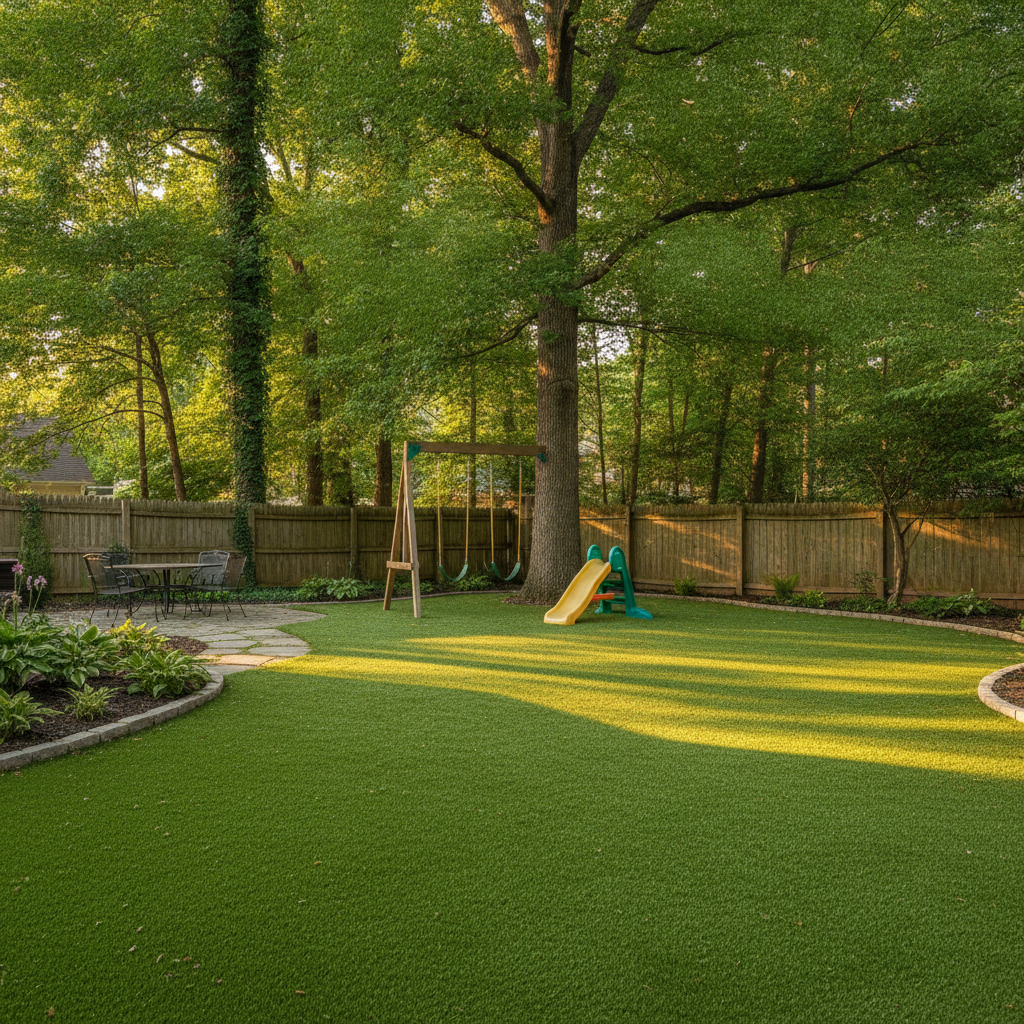
How Do You Install Artificial Turf in a Shaded Backyard or Under a Tree Canopy in Waldorf, MD? What Homeowners Need to Know
If you have a big, beautiful tree canopy in your Waldorf, MD backyard, you already know the problem: natural grass simply refuses to grow under it. You end up with bare dirt, exposed roots, and muddy patches that stay wet long after a rainstorm. Artificial turf is one of the most practical solutions for this situation — but installing it under a tree or in a heavily shaded yard is not a simple roll-and-staple job. Done wrong, it buckles, drains poorly, and gets destroyed by root movement within a year or two. Done right, it looks clean, drains fast, and holds up for 15 years or more. Here is what you actually need to know before you move forward.
Why Shaded Yards Are Such a Problem for Natural Grass — and Why Turf Fixes It
Grass needs direct sunlight to photosynthesize. Most turf varieties need at least four to six hours of full sun per day to maintain a healthy root system. Under a mature oak, maple, or sweetgum — all common in Charles County — you might get 30 minutes of dappled light on a clear summer day. The grass thins, then dies, leaving soil that compacts easily and becomes a muddy mess every time it rains.
Waldorf gets real rain. Southern Maryland typically sees 40 to 44 inches of precipitation annually, and spring storms can be intense. A shaded yard with dead grass becomes a drainage problem fast — water pools on compacted soil and has nowhere to go. This is exactly the scenario where a properly engineered artificial turf system outperforms anything organic.
Artificial turf does not need sunlight to look green and lush. It does not thin, yellow, or die in low-light conditions. And when it is installed over a properly graded aggregate base, it drains faster than any natural lawn ever could — typically at rates exceeding 30 inches per hour across the field, and significantly higher in premium drainage-optimized systems.
The Biggest Installation Challenge: Tree Roots
This is where most generic installers — and almost every DIY attempt — fail. Tree roots are dynamic. They grow laterally, they shift, and they push upward over time. If your base prep does not account for the root system beneath the surface, you will end up with bumps, lifted seams, and uneven turf within a few seasons.
Here is how a professional installation handles this correctly:
- Root mapping before excavation: Before any digging begins, a crew should probe and map the visible root structure. Large surface roots may need to be carefully cut and treated to prevent regrowth pushing through the base. Smaller feeder roots are typically managed through excavation depth.
- Appropriate excavation depth: Standard residential turf installation requires 3 to 4 inches of excavation. In root-heavy zones, this may need to increase to 5 or 6 inches to get below the densest root concentration and allow adequate base material depth.
- Root barrier installation: In many shaded installations, a physical root barrier — a heavy-duty polyethylene sheeting material — is laid along the perimeter and under the base to prevent lateral root re-entry into the turf zone over the coming years.
- Proper base compaction: A minimum of 3 to 4 inches of crushed aggregate (typically Class II road base or decomposed granite) is mechanically compacted in layers. This creates the firm, stable foundation that resists future root movement from below.
If you are getting quotes from contractors who do not mention any of this, that is a red flag. This is one of the most commonly skipped steps in the Waldorf and Charles County market, particularly from general landscapers who dabble in turf as an upsell.
Choosing the Right Turf Product for a Shaded Environment
Not all artificial turf looks the same in low-light conditions. In a bright, open backyard, almost any mid-range product with UV-stabilized fibers looks convincing. Under a tree canopy, the lighting is different — softer, more diffuse — and the color and texture of the turf becomes more visible up close.
For shaded residential applications, look for products with these characteristics:
- Realistic multi-tone fiber color: Turf with a blend of green shades and tan or brown thatch fibers mimics real grass under natural light far more convincingly than bright monocolor turf.
- Appropriate pile height: For shaded yards that are primarily aesthetic (not sports or pet-use), a pile height between 35mm and 45mm typically looks most natural.
- UV-stabilized polyethylene fibers: Even in shade, UV stabilization matters. Reflected UV from surrounding surfaces still degrades fiber quality over time in unprotected products.
- Perforated backing with high drainage rate: Shade means moisture lingers longer. A backing with a drainage rate of at least 30 to 40 inches per hour keeps the surface from staying damp and prevents mold or mildew buildup on the backing material.
Grassify’s Lush Life product line is a strong fit for shaded residential yards — it’s engineered with a realistic multi-tone fiber blend and UV-stabilized construction that holds its appearance year after year, even in low-light conditions.
What Happens to the Tree? Does Turf Harm It?
This is a question we hear often, and it deserves a direct answer. Installing artificial turf around a mature tree does carry some risk to the tree’s health if done carelessly, but a properly designed installation mitigates most of it.
Trees primarily absorb water through their feeder roots, which extend well beyond the drip line. The turf and base system must allow water to pass through and reach the soil below — which is exactly what a permeable aggregate base does. A perforated turf backing over a gravel base is actually quite tree-friendly in terms of water delivery. What trees do not tolerate well is physical root damage during excavation or a solid, non-permeable membrane that completely blocks water infiltration.
The key rules: do not excavate aggressively within the root zone (generally within the drip line radius), use a permeable base rather than a solid concrete or hardscape sub-base, and avoid cutting large lateral roots unnecessarily. A crew that has done tree-zone turf installations before will know how to work around the root structure without causing dieback.
Drainage Engineering in Southern Maryland’s Climate
Charles County and the Waldorf area get significant rainfall, particularly during spring and fall. Shaded areas under tree canopies are also typically lower-lying microclimates — they stay cooler, they dry out slower, and they collect runoff from adjacent hardscape. This means drainage engineering is not optional — it is the most important part of the installation.
A professionally installed system in this region should include a properly graded sub-base sloped at minimum 1 to 2 percent toward a natural drainage outlet, whether that is a lawn edge, a French drain, or a municipal drainage swale. If the yard has a history of standing water, a perforated pipe drainage channel underneath the base may be necessary before turf goes down.
Skipping proper drainage in a Waldorf installation means you will have pooling on top of your turf within the first heavy rain season, and the backing material will degrade faster than it should. This is another area where local experience matters — an installer who has worked in the DMV corridor understands the rainfall patterns and designs accordingly. Our residential lawn turf installations are engineered with drainage as a primary design consideration, not an afterthought.
What a Shaded Backyard Turf Project Typically Costs and How Long It Takes
In the Waldorf and Charles County market, residential artificial turf installation typically runs between $12 and $20 per square foot, depending on the complexity of the site. A shaded, root-heavy yard with drainage considerations tends to fall toward the middle to upper end of that range due to the additional base prep work involved.
A typical backyard project of 500 to 800 square feet takes two to three days from excavation to final grooming. Root-zone work and drainage channel installation may add a day. Most projects in this range carry a multi-year product warranty from the turf manufacturer (commonly 8 to 15 years depending on the product tier) and a lifetime installation warranty on seams, edges, and base integrity from a qualified installer.
Frequently Asked Questions
Will artificial turf grow mold or mildew in a shaded backyard?
Not if it is installed correctly. A perforated backing over a compacted aggregate base allows water to drain away quickly, which prevents the moisture retention that causes mold. Turf products with antimicrobial infill treatments add an additional layer of protection in persistently damp environments.
Can I install turf right up to the base of the tree trunk?
You can get close, but it is generally better to leave a small ring of natural mulch around the trunk — typically 12 to 18 inches — to protect the root flare and allow natural gas exchange in the soil immediately around the trunk. The turf can be cut and finished cleanly against this border for a professional look.
What if my shaded yard has a slope?
Sloped, shaded yards require careful drainage grading and secure perimeter anchoring. The base needs to be graded to direct water toward a drainage outlet, and the turf edges need to be anchored into a bender board or concrete perimeter to prevent shifting. This is manageable but requires more detailed planning than a flat installation.
How long does artificial turf last in a shaded environment compared to a sunny yard?
Interestingly, shaded turf often experiences less UV degradation than turf in full sun, which can extend fiber life. The main longevity factors in shaded installations are base stability (root management) and drainage quality — both of which a properly engineered system handles well. Expect 15 or more years from a quality product with correct installation.
Does Grassify serve Waldorf and Charles County, MD?
Yes. Grassify installs residential and commercial artificial turf throughout the DMV region, including Waldorf, La Plata, and the broader Charles County area. We regularly work in Southern Maryland alongside our Northern Virginia and DC service territory.
Ready to Stop Fighting a Shaded, Muddy Backyard?
A properly installed artificial turf system will permanently solve the bare-patch, muddy-rut problem under your tree canopy — and it will do it without harming the tree, without flooding your yard, and without looking plastic or fake. The key is working with an installer who takes base prep and drainage seriously, not one who shows up with rolls of turf and a staple gun.
If you are in Waldorf, MD or anywhere in Charles County and you want a straight answer about whether turf is the right call for your specific yard, reach out to Grassify for a free on-site consultation. We will walk the space with you, assess the root situation, look at your drainage, and give you an honest recommendation — no pressure, no upselling on things you do not need.


