
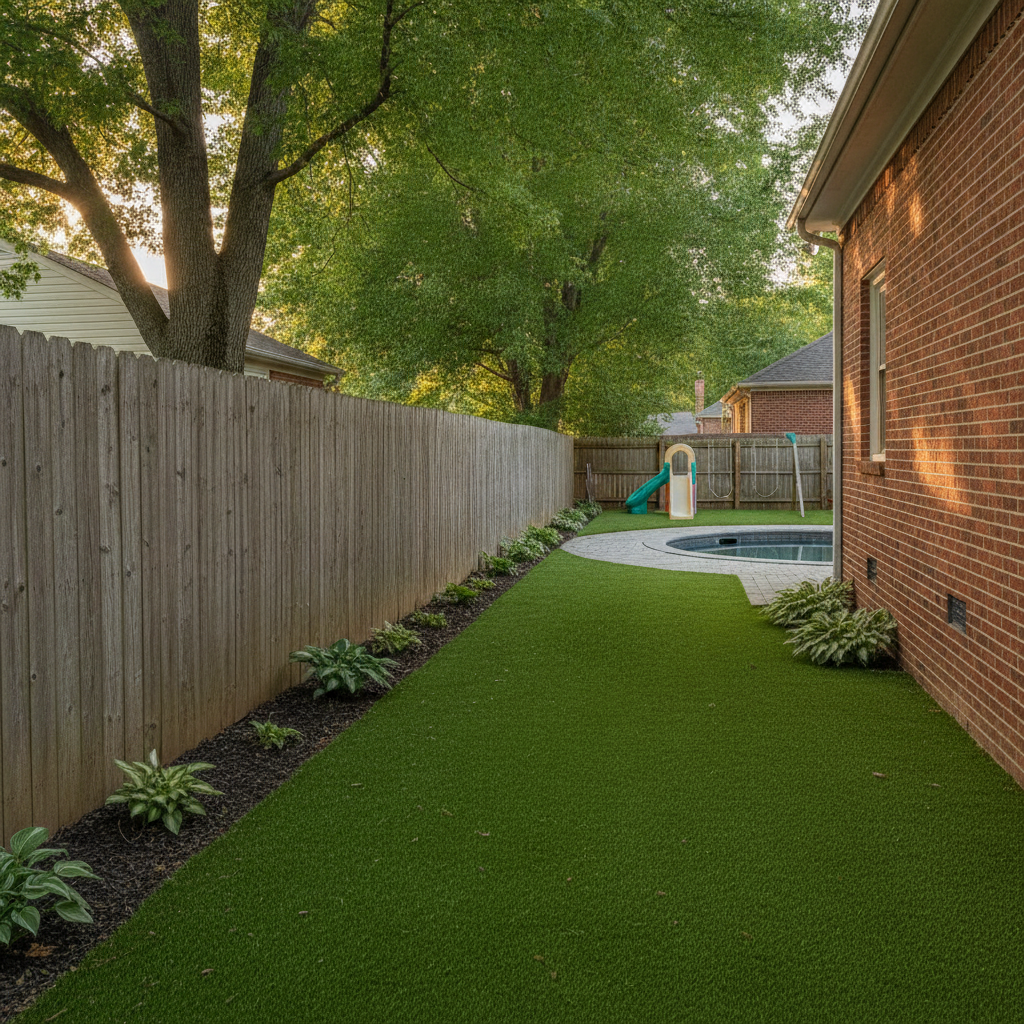
How Do You Install Artificial Turf on a Steep Driveway Strip or Narrow Side Yard in Silver Spring, MD?
That thin strip of ground between your driveway and your neighbor’s fence is one of the most universally hated spots in residential landscaping across Silver Spring, Montgomery County, and the broader DMV area. It’s too narrow for a push mower to turn around, too shaded to support healthy grass, and just wide enough to collect every leaf, cigarette wrapper, and random piece of mulch that blows through the neighborhood. If you’ve been ignoring it for two summers, you’re not alone — most general landscapers ignore it too, because it doesn’t pencil out for them. But it’s a perfect candidate for artificial turf, and when it’s done right, it requires zero maintenance from the moment it goes in.
Here’s what the installation actually involves, why most contractors get it wrong in tight spaces, and what you should expect from a qualified installer in the Silver Spring and Montgomery County area.
Why Narrow Strips and Side Yards Are Harder Than They Look
The challenge with driveway strips and narrow side yards isn’t the turf itself — it’s everything underneath it and around it. A strip that’s three feet wide and thirty feet long sounds simple. In practice, it involves precise excavation without damaging adjacent hardscape, careful compaction in a space where heavy equipment can’t operate, edge restraints that hold against freeze-thaw cycles without buckling into the driveway, and drainage routing that doesn’t push stormwater toward a foundation or a neighbor’s property line.
In Silver Spring specifically, many older neighborhoods have clay-heavy soil that drains poorly to begin with. Add the region’s heavy spring rains and you’ve got a scenario where a poorly installed turf strip turns into a standing water problem within a season. That’s not a turf failure — that’s a base prep and drainage engineering failure, and it’s the most common mistake made by general landscapers who decide to take on a turf job to pad their schedule.
A proper installation in a narrow space starts with removing four to six inches of existing soil and debris, then grading the sub-base with a slight cross-slope (typically 1.5 to 2 percent) to direct water away from your foundation. From there, a compacted aggregate base — usually decomposed granite or crushed miscellaneous base — is tamped in lifts until it’s firm and level. Only then does the turf go down. Cut that process short and you’ll be dealing with rippling, pooling, and edge separation within a year or two.
Tight-Access Installation: What Happens When Equipment Can’t Reach
One thing most competitor sites in the DMV area don’t talk about is what actually happens on install day when there’s no room for a plate compactor or a wheelbarrow to maneuver. This is a real constraint in Silver Spring neighborhoods where side yards are gated, fenced, or sandwiched between a concrete driveway and a masonry wall. Grassify’s installation process is designed specifically to handle these access limitations without cutting corners on base quality.
For truly tight spaces — we’re talking anything under four feet wide — experienced crews hand-tamp in sections, use narrower compaction tools designed for confined areas, and stage materials in manageable loads rather than dumping everything at once. It takes longer. It costs a bit more per square foot than an open backyard job. But it produces the same structural result: a base that won’t shift, settle, or drain poorly over time.
If a contractor quotes a narrow strip job without mentioning access or hand-compaction methods, that’s a red flag. It usually means they plan to use whatever equipment they showed up with, regardless of whether it fits.
Choosing the Right Turf Product for a Side Yard or Driveway Strip
Not every turf product is right for this kind of space. Driveway strips typically get foot traffic, occasional bike wheels, and heavy shade — a combination that calls for a denser, shorter pile fiber that holds its shape under compression and doesn’t look matted in low-light conditions. A 30mm to 35mm pile height with a dense blade count is usually the right call. Taller, softer blades designed for open backyard aesthetics tend to flatten and stay flat in high-contact strips.
For side yards that also handle pet traffic — which is common across Silver Spring and Chevy Chase neighborhoods where dogs need a direct path to the backyard — you’ll want to build in proper drainage infrastructure from day one. That means a permeable base layer and, depending on how much pet use the strip sees, a zeolite deodorizer layer in the infill. If your dog uses that side yard as a bathroom corridor, a standard silica sand infill won’t stay odor-neutral through a hot Maryland summer. Plan accordingly before the turf goes down, not after. You can read more about what that system looks like on the pet turf installation page.
Edge Finishing: The Detail That Separates Good Installations from Cheap Ones
Edge work is where narrow strip installations are won or lost, and it’s the section of the job that out-of-state franchise installers consistently rush. In a standard open backyard, a bender board or aluminum edging along a turf perimeter is relatively simple. In a three-foot driveway strip, the edge butts up against concrete on one or both sides, which means the infill needs to be contained precisely and the turf face needs to terminate cleanly without fraying into the driveway joint.
In Fairfax County and across Maryland, freeze-thaw cycles from November through March put significant stress on edge connections. Concrete expands and contracts. If the turf is nailed too rigidly into a concrete edge without any flex allowance, you’ll get separation by spring. Proper edge fastening for hardscape-adjacent strips involves a combination of nailing into the sub-base, adhesive where appropriate, and maintaining the right amount of overlap at the transition so movement doesn’t produce a visible gap.
This is worth asking about explicitly when you’re getting quotes. Ask the contractor how they finish the edge where the turf meets your driveway or concrete walk. If they say “we nail it and glue it” without further explanation, push for specifics. A qualified installer will be able to walk you through exactly what they’re doing at every transition point.
What This Kind of Job Typically Costs in the Silver Spring Area
Small space jobs carry higher per-square-foot costs than large open backyard installations. That’s not a markup for inconvenience — it reflects the real labor intensity of working in confined spaces, managing tight-access logistics, and doing precise edge work in areas where there’s no room for error. For driveway strip and side yard installations in Silver Spring, Bethesda, and the surrounding Montgomery County area, expect a range of roughly $18 to $25 per square foot depending on the complexity of the access, the depth of base prep required, and the product selected.
On a 90-square-foot side yard, that works out to approximately $1,600 to $2,250 — a permanent, zero-maintenance solution for a space that’s been draining your time and frustration for years. The math tends to look very good when you account for what you’re no longer spending on mulch, edging, spraying, and re-seeding year after year.
Frequently Asked Questions
Can you install artificial turf in a space that’s only 2–3 feet wide?
Yes, but it requires hand-compaction techniques and narrower tools than a standard residential job. Make sure your installer has experience with confined-space installations specifically — not every turf crew is equipped for it.
Will artificial turf in a shaded side yard still look natural?
A quality UV-stabilized turf product maintains its color in shade. The bigger factor is pile selection — shorter, denser blades hold up better under limited light and foot traffic than tall, soft landscape blades designed for open, sun-exposed areas.
How does drainage work in a narrow strip between a driveway and a fence?
The base is graded with a slight cross-slope so water drains laterally — either toward a low point in the yard or toward a permeable edge. This is engineered during base prep, not something you improvise at the time of turf installation. In Silver Spring’s clay-heavy soil, the sub-base drainage layer is especially important.
Do I need an HOA approval for a side yard turf installation in Maryland?
Many communities in Montgomery County — including planned neighborhoods near Silver Spring and Chevy Chase — do require architectural committee approval before any visible landscaping change. Check your HOA CC&Rs before you schedule installation. A good installer will help you put together the documentation you need for submission.
How long does a driveway strip or side yard turf installation take?
Most installations in this size range — 50 to 150 square feet — are completed in one day. The base prep and compaction typically take longer than the turf installation itself, so a contractor who quotes a two-hour turnaround on a clay-soil site is likely skipping critical steps.
Ready to Stop Fighting That Side Yard?
If you’ve got a narrow strip that nothing grows in, a side yard that stays muddy four months out of the year, or a driveway edge that looks like it gave up — reach out to Grassify for a free consultation. We serve Silver Spring, Bethesda, Chevy Chase, and communities across Montgomery County, as well as Northern Virginia from our home base in Burke, VA. We’ll come out, measure the space, walk you through the right product and base system for your specific site conditions, and give you a straight quote with no pressure. Small spaces are our specialty — and they deserve the same quality of installation as any other part of your property.


