
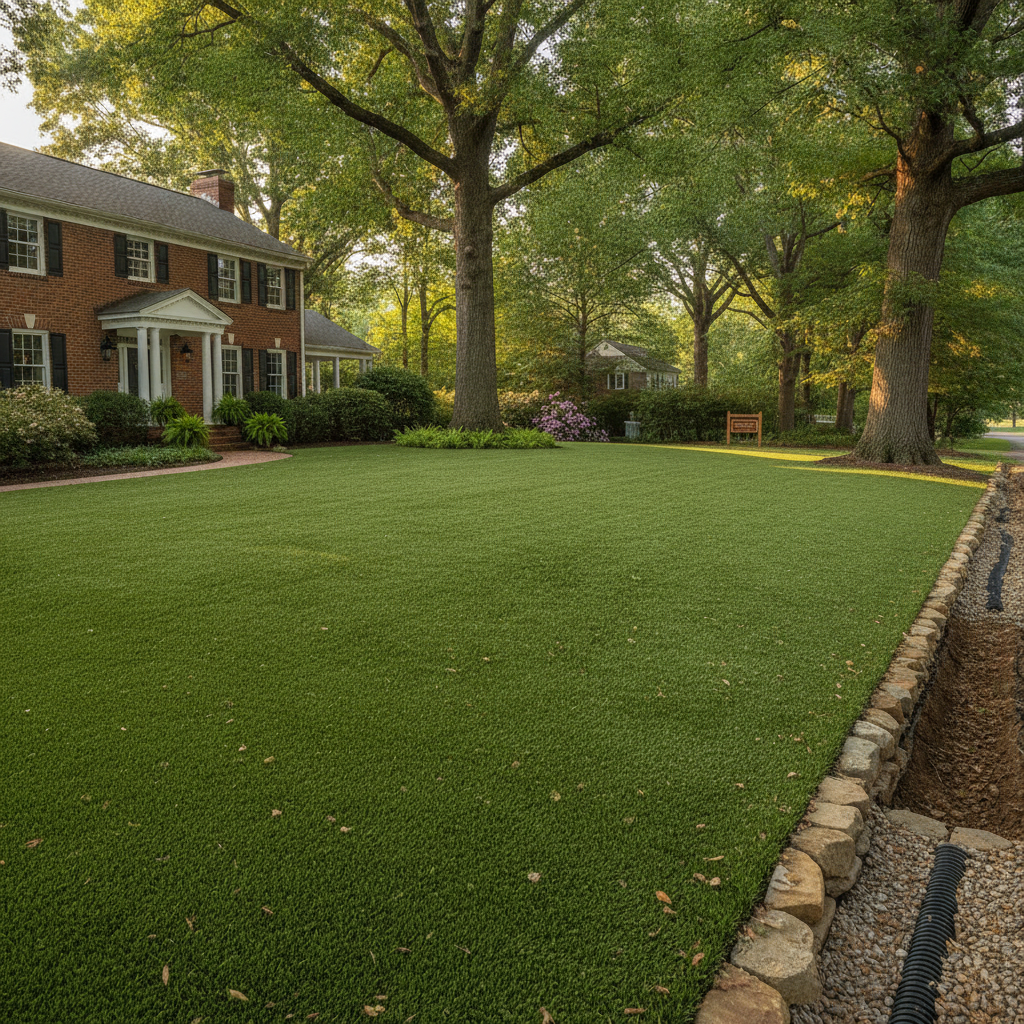
How Do You Install Artificial Turf in a Heavily Shaded Front Yard in Arlington, VA? What Homeowners Need to Know About Low-Light Installations
If your front yard in Arlington, VA gets swallowed by tree shade for most of the day, you already know the problem: natural grass barely survives, bare patches spread every summer, and by fall you’re looking at a muddy patchwork that no amount of overseeding will fix. The short answer is yes — artificial turf works exceptionally well in heavily shaded front yards, and it actually outperforms natural grass in low-light conditions. But a shaded installation isn’t just a standard turf job with the same steps. It introduces specific challenges around moisture retention, base composition, drainage slope engineering, and even HOA approval that a lot of turf installers — especially out-of-state franchise outfits — tend to gloss over. Here’s what you actually need to know before pulling the trigger.
Why Shaded Front Yards in Arlington Require More Engineering Than a Standard Install
Arlington County sits under a dense tree canopy — mature oaks, maples, and elms line neighborhood streets across Waverly Hills, Bluemont, Penrose, and Dominion Hills. That canopy is beautiful. It’s also what kills natural grass by blocking the sunlight it needs to photosynthesize and dry out between rainfalls.
The same moisture problem that kills grass creates a real technical challenge for turf installation. In shaded areas, the ground stays wet longer after rain. Organic matter — leaf debris, mulch runoff, decomposed roots — builds up in the soil and retains water. If your installer doesn’t account for this in the base prep, you end up with a turf surface that drains slowly, develops soft spots, and can push moisture back up through the backing over time. In the DMV’s humid summers and heavy spring rain cycles, that’s a recipe for a failed installation in two or three years.
The fix isn’t complicated, but it requires attention to detail. A properly engineered shaded install starts with deeper excavation — typically 4 to 5 inches of native soil removal — followed by a compacted crushed stone base (Class II road base or equivalent) that promotes rapid vertical drainage. Any organic material, tree root debris, or soft subsoil must be removed entirely before compaction. We also recommend a light application of a pre-emergent weed barrier membrane on the base layer, since decomposed leaf matter near tree drip lines tends to introduce weed seed even through dense backing.
Choosing the Right Turf Product for a Low-Light, High-Moisture Environment
Not all synthetic turf products are the same, and shade installations have specific requirements that narrow your options.
First, pile height. For front lawns — shaded or not — you generally want turf in the 35mm to 42mm range. Shorter pile (under 30mm) looks thin and artificial when viewed from the street. Taller pile (above 45mm) can trap moisture and leaf debris in shaded environments, which accelerates matting and requires more frequent brushing to maintain blade erectness.
Second, fiber material. Look for polyethylene monofilament fibers with UV stabilization. Shaded areas don’t receive intense sun, but UV-stabilized fibers still matter for longevity — reflected light, seasonal sun angle changes, and partial shade windows all introduce cumulative UV exposure. Polypropylene fibers are cheaper and should be avoided; they become brittle and fade within a few years even in moderate light conditions.
Third, backing permeability. In a shaded yard with moisture-retentive soil, you want a backing with a drainage rate well above 30 inches per hour. Some products marketed as drainage-efficient only perform at that rate under ideal conditions. In Arlington’s heavy spring rains, you need backing that performs consistently. Our residential lawn turf products are engineered for exactly this kind of real-world drainage demand — not just lab-condition specs.
The Moss and Algae Problem Nobody Talks About
This is the section that most competitor installers skip entirely — and it’s one of the most common complaints we hear from homeowners who had turf installed by a general landscaper or a low-bid national brand with no local expertise.
In heavily shaded, north-facing, or tree-canopied front yards across Arlington County and the broader Northern Virginia area, algae and moss growth on synthetic turf is a real issue. The surface stays cool and damp. Without direct sunlight to dry the backing and infill between rain events, green algae can begin to colonize turf fibers and infill material — especially in installations that used organic infill or that didn’t incorporate an antimicrobial infill layer.
The solution has two components. First, specify a silica sand infill with an antimicrobial coating — this significantly reduces organic growth on the surface and in the infill bed. Second, make sure your installer grades the base with a positive slope away from the structure (minimum 1% grade) so water doesn’t pool. A flat or reverse-graded base is one of the most common installation shortcuts we see when we’re called in to diagnose problems with work done by other companies in Arlington, Falls Church, and Alexandria.
If you’re dealing with a particularly low-lying or north-facing front yard, ask your installer specifically about algae mitigation. If they haven’t heard the question before or wave it off, that’s a flag.
HOA Approval for Front Yard Turf in Arlington County
Arlington County itself doesn’t have a blanket prohibition on artificial turf, but if your home falls within an HOA-governed community — which covers a significant portion of residential properties across Arlington — you’ll need architectural review committee (ARC) approval before installation begins. This is non-negotiable. Installing without approval can result in a formal removal order and fines, and some HOA governing documents in Northern Virginia include specific language about synthetic landscaping materials.
The good news is that HOA approvals for turf have become much more routine over the past several years. Most committees want to see product samples, a color rendering or before/after photo reference, a drainage plan, and confirmation that the installation won’t affect shared stormwater systems. We help Grassify clients assemble this documentation before the first shovel goes in. The process typically takes two to four weeks depending on when your HOA’s ARC meeting schedule falls.
If you live in an HOA-free neighborhood, the process is simpler — check Arlington County’s landscaping ordinances, confirm your planned install doesn’t fall within a regulated floodplain area (more relevant near Four Mile Run or the Arlington-Alexandria border), and you’re generally clear to move forward.
What a Professional Shaded Front Yard Install Actually Looks Like
Here’s a realistic picture of what to expect from a properly executed project:
- Site assessment: A qualified installer should walk the site and assess canopy coverage, drainage patterns, slope direction, soil composition, and access constraints before giving you a number. Any quote generated from square footage alone — without a site visit — is incomplete.
- Excavation and base prep: 4 to 5 inches of soil removal, root clearing within the turf footprint, and a compacted Class II crushed aggregate base. Expect this to take a full day or more for an average front yard.
- Infill and finishing: Antimicrobial silica sand infill, proper seam placement (seams should never run perpendicular to the primary viewing angle from the street), and perimeter securing with bender board or concrete nailing.
- Cost range: For a shaded front yard install in Arlington, expect to budget in the $14 to $22 per square foot range depending on yard size, access complexity, tree root conditions, and product selection. Smaller installs tend to run higher per square foot due to fixed mobilization costs.
Frequently Asked Questions: Shaded Front Yard Turf in Arlington, VA
Will artificial turf fade or degrade faster in a shaded yard?
No — in fact, shaded turf generally holds its color longer than turf in full sun because it’s exposed to less cumulative UV radiation. The risk in shade is moisture-related deterioration, not UV fading, which is why base prep and drainage matter more than the sun exposure level.
How do I keep leaves and debris from building up on turf under trees?
Leaf blowers work fine on synthetic turf and are the fastest method. A stiff bristle push broom also works for light accumulation. You’ll want to clear leaves promptly in the fall to prevent decomposing organic matter from sitting on the infill layer for extended periods — especially in a shaded, low-evaporation environment.
Can tree roots damage artificial turf from underneath?
Active surface roots in the installation footprint need to be addressed during excavation — they can lift turf and disrupt the base over time. Deep root systems that run below your base depth typically don’t cause problems, but your installer should evaluate any significant root presence before installation begins. A weed barrier alone is not a substitute for removing active root material in the turf zone.
Does Arlington County require a permit for artificial turf installation?
In most cases, a standard residential turf installation in Arlington County does not require a building permit. However, if your project involves changes to grading, stormwater runoff pathways, or impervious surface calculations in a regulated area, additional review may be required. Your installer should confirm this during the site assessment phase.
How long does a properly installed shaded front yard turf last?
A quality synthetic grass product installed on a properly engineered base should last 15 to 20 years in normal residential use. Shaded environments don’t accelerate wear — the primary life-limiting factors are base settlement, infill compaction, and fiber fatigue from foot traffic, none of which are worsened by low light. Grassify backs our installations with a lifetime warranty on seams, edges, and base work.
Ready to Fix Your Front Yard for Good?
If you’re done reseeding the same bare patches under your tree canopy every spring, artificial turf is a permanent solution that works better in shade than natural grass ever will. The key is working with an installer who understands the moisture dynamics, base engineering requirements, and HOA process specific to Arlington County — not a generalist landscaper who does turf on the side or a franchise operation that’s never worked a shaded Northern Virginia yard.
Grassify has been installing turf across Fairfax County, Arlington County, Alexandria, Falls Church, and the broader DMV area for over a decade. We know what shaded front yards in this region need, and we build every install to hold up through the freeze-thaw cycles, heavy spring rains, and humid summers that are the reality of living in the Beltway corridor.
Request your free on-site consultation today and we’ll walk your yard, assess your specific conditions, and give you a straight answer on what it takes to do this right.


