
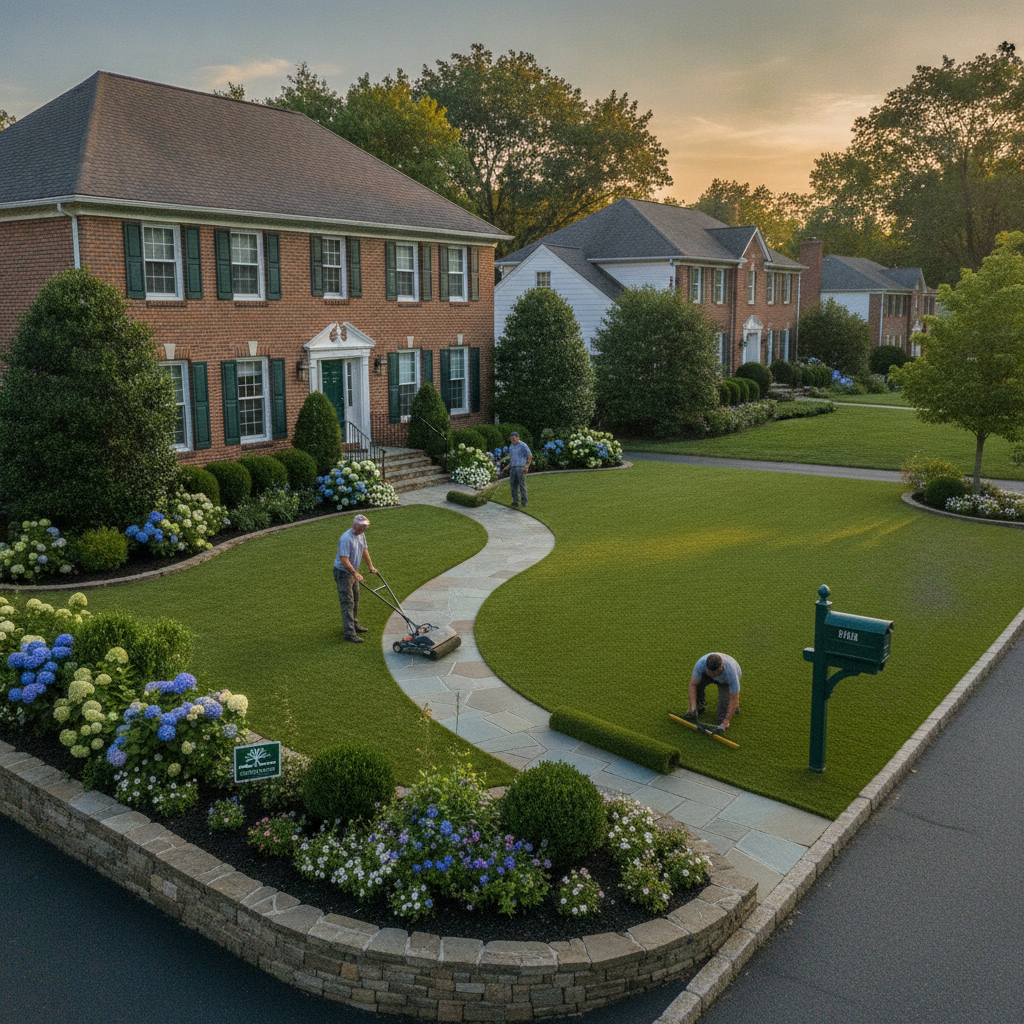
How Do You Install Artificial Turf in a Front Yard in Bethesda, MD? What Homeowners Need to Know About Curb Appeal, HOA Rules, and Permits
Installing artificial turf in a front yard in Bethesda, MD is one of the most impactful landscaping decisions you can make — and also one of the most scrutinized. Unlike a backyard project that stays private, your front yard faces the street, your neighbors, your HOA’s architectural committee (if you have one), and in some cases, Montgomery County’s own landscaping guidelines. Done right, a front yard turf installation looks sharp, saves hundreds of dollars annually in water and lawn care, and holds up through the DMV’s punishing freeze-thaw winters. Done wrong, it can cost you a formal complaint from your HOA or leave you with a front lawn that looks like a putting green carpet — and not in a good way.
Here’s what you actually need to know before you pull the trigger on a front yard turf project in Bethesda or anywhere in the surrounding Montgomery County area.
Why Front Yard Turf Is More Complicated Than a Backyard Install
Most of the artificial turf content online — and frankly most of what the local turf companies around the DMV publish on their websites — focuses on backyard transformations. There’s a reason for that: backyard projects are simpler. You’re working in an enclosed space, drainage runs away from public view, and nobody’s HOA president is walking by twice a day to inspect your seams.
Front yards are different. You’ve got foot traffic from the sidewalk, potential runoff toward the street or a neighbor’s property, and in many Bethesda neighborhoods, an HOA or civic association with real authority over what your home looks like from the curb. Even if you don’t have an HOA, Bethesda sits within Montgomery County, which has its own stormwater management rules that may apply depending on how much impervious surface your project adds.
The good news: none of this makes front yard turf impossible. It just means the planning phase matters as much as the installation itself.
HOA Approval for Front Yard Turf in Bethesda and Montgomery County
If your Bethesda home is governed by an HOA — and a significant number of Montgomery County properties are — you’ll need architectural approval before any turf goes in the ground. This is true whether you’re in a single-family neighborhood near Chevy Chase, a townhome community closer to Rockville, or a newer development in Potomac.
What HOA committees typically evaluate for front yard turf applications:
- Color and pile height: Committees almost always prefer natural-looking turf in the 35mm–45mm range with a blend of green shades and thatch. Anything that reads as “too bright” or “too uniform” tends to get flagged.
- Edge finishing: HOAs want clean bender board or concrete border transitions — not raw turf edges that fray over time. This is a place where cheap installs fail visibly and fast.
- Coverage percentage: Some HOAs cap how much of your front yard can be synthetic, requiring that you retain a percentage of natural plantings, mulched beds, or native ground cover.
- Drainage plan: A few Montgomery County HOAs now ask for documentation that the installation won’t redirect runoff toward neighboring properties or the street.
If your HOA hasn’t dealt with a turf application before, they may not have a formal policy. That’s actually an opportunity — you can get in early and set the standard. Grassify has helped homeowners throughout the Beltway corridor navigate HOA submissions, including preparing sample boards and written drainage plans that committees can actually approve.
What Proper Base Preparation Looks Like for a Front Yard
This is where the gap between a quality installer and a budget crew becomes obvious — and it’s a gap that most competitor websites in the DMV area don’t bother to explain clearly.
A front yard installation in Bethesda typically starts with removing 3–4 inches of existing soil and organic material. That excavation depth matters because organic matter compresses and shifts, which causes your turf surface to develop low spots, waves, and edge separations over time — especially after Maryland’s heavy spring rains and freeze-thaw winter cycles work on the ground beneath.
After excavation, a quality install requires:
- A compacted Class II aggregate base (crushed granite or decomposed granite) at a minimum of 3 inches — more in areas with clay-heavy soil, which is common in Montgomery County
- A weed barrier membrane that’s permeable enough to drain but durable enough to resist root penetration for 10+ years
- Proper grading to direct drainage away from your foundation and away from the sidewalk or street curb — not just flat and level
- Seam placement that avoids high-traffic walking paths, since seams are the first thing that degrades under repeated foot pressure
Drainage rates matter here too. A well-engineered front yard installation should drain at 30+ inches per hour minimum. The DMV’s spring rain events can be intense, and a front yard that puddles or channels water toward the street will get your installation noticed — by the county, not just the HOA.
Choosing the Right Turf Product for Street-Facing Visibility
Not every synthetic grass product is appropriate for a front yard. Products designed for heavy pet use or athletic fields prioritize durability and drainage over aesthetics. For a front yard in Bethesda where curb appeal is the primary goal, you want a landscape-grade turf with a natural multi-tone fiber blend, a realistic thatch layer, and UV-stabilized fibers that won’t bleach out or fade in Maryland’s humid summers.
Pile heights in the 35mm–45mm range tend to look the most natural from the street. Anything shorter reads as a sport field. Anything over 50mm can look overgrown if it doesn’t maintain an upright blade structure. Grassify’s Lush Life product is specifically designed for this use case — it’s built for residential lawns where appearance is non-negotiable and low maintenance is the whole point.
Street-Facing Heat Considerations in the DMV Summer
Bethesda summers are legitimately hot and humid. South- and west-facing front yards absorb significant solar heat, and standard synthetic grass can reach surface temperatures 30–50°F above air temperature on a clear summer afternoon. For a front yard, this matters less than a play area, but it does affect how the turf feels underfoot and whether your neighbors notice any off-gassing smell on the hottest days.
UV-stabilized, heat-resistant fiber technology addresses most of this. Grassify uses turf products with cool-touch fiber coatings where appropriate, and we’ll always give you an honest assessment of what surface temperatures to expect based on your yard’s sun exposure and orientation.
What a Front Yard Turf Project Actually Costs
Front yard installations in Bethesda typically fall in the $14–$22 per square foot range installed, depending on yard size, existing grade complexity, HOA edge-finishing requirements, and the specific product selected. Smaller yards often cost more per square foot because mobilization, excavation, and base prep costs don’t scale down as quickly as square footage does.
A typical Bethesda front yard in the 400–800 square foot range runs between $6,000 and $16,000 fully installed with proper base prep, borders, and infill. That’s not a number you’ll find on most competitor websites — they tend to avoid publishing cost context because they’re quoting jobs without seeing the site. We’d rather give you a realistic range upfront and then refine it with a free on-site consultation.
For homeowners looking at the long-term math: natural grass in a Montgomery County front yard typically costs $800–$1,500 per year in water, fertilizer, mowing, and seasonal seeding. A synthetic installation pays for itself in 6–10 years and keeps performing for 15–20 years with basic maintenance. The environmental savings add up too — no irrigation runoff, no chemical inputs, and no gas-powered mowing emissions.
Frequently Asked Questions: Front Yard Turf in Bethesda, MD
Does Montgomery County require a permit to install artificial turf in a front yard?
Montgomery County does not typically require a building permit for a synthetic grass installation on its own, but if your project involves significant grading, drainage rerouting, or impervious surface changes, you may need to consult with the county’s Department of Permitting Services. Grassify handles this pre-project research as part of every Bethesda-area job.
Will my HOA automatically deny a front yard turf application?
Not necessarily. Many HOAs in Montgomery County have approved turf installations when the application includes a quality product sample, a realistic rendering, and a documented drainage plan. Approvals are more common than denials when the applicant comes prepared. We help with this process.
How long does a front yard turf installation take in Bethesda?
Most residential front yard projects in the 400–1,000 square foot range take one to two days for installation. HOA approval timelines vary — some committees meet monthly, so factor that into your planning window if your community requires it.
Can you install turf in a front yard that has a slope or grade change?
Yes, but it requires careful base preparation and seam planning. Sloped front yards in Bethesda and Potomac are common, and they’re very manageable with the right crew and the right drainage grading. What you want to avoid is a flat-slab installation on a slope — water has to go somewhere, and it shouldn’t pool at your foundation or run onto the sidewalk.
What happens to front yard turf in a hard freeze?
Synthetic grass handles freeze-thaw cycles well as long as the base is properly compacted and drained. A poorly prepared base — one that retains moisture — will shift and heave during a Maryland winter, causing edge separations and surface waves. Proper crushed aggregate base prep eliminates this risk. Grassify backs every installation with a lifetime warranty on seams, edges, and base performance.
Ready to Talk About Your Front Yard?
If you’re thinking about artificial turf for your front yard in Bethesda, Chevy Chase, Potomac, or anywhere in Montgomery County, Grassify is the DMV-based team that knows how to get it done right — from HOA submission through final edge finishing. We’re based in Burke, VA and serve the entire Beltway corridor with licensed, insured, background-checked crews and a transparent process from the first site visit to the last infill pass.
Request your free on-site consultation today and we’ll come out, measure your yard, walk through product options, and give you a detailed written quote — no pressure, no vague estimates. Front yard turf done right should make your neighbors stop and ask who you used. Let’s make that happen.


