
How Do You Renovate a Worn-Out HOA Common Area with Artificial Turf in Fairfax County, VA? What Property Managers and Board Members Need to Know
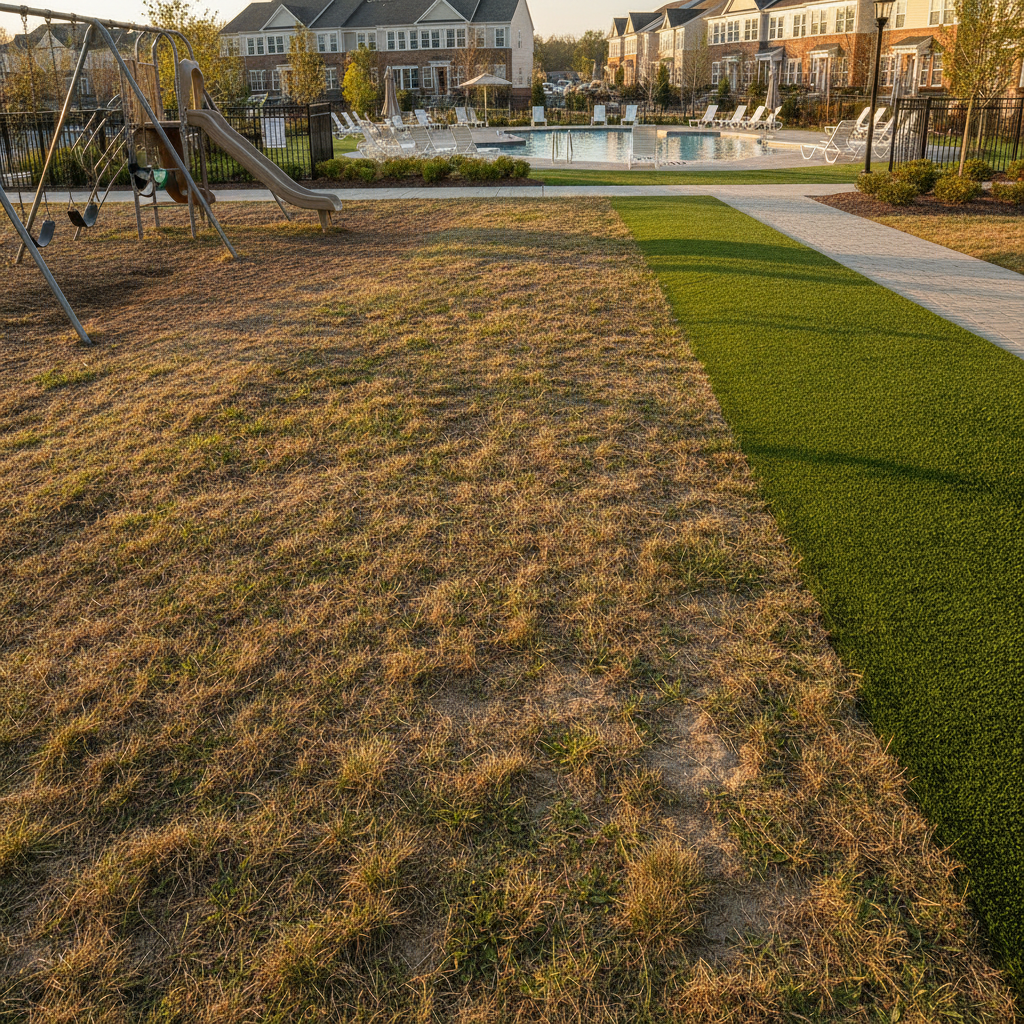
If you manage an HOA community in Fairfax County — whether that’s a townhome cluster in Burke Centre, a garden-style condo complex near Springfield, or a single-family neighborhood along the Route 123 corridor — you already know what happens to shared grass over time. It gets beaten down by foot traffic, killed out in high-shade zones, turned to mud after spring rains, and churned into bare patches by lawn crews showing up every week with mowers. You’re paying to maintain something that looks worse every season. Replacing it with properly installed artificial turf is one of the most cost-effective infrastructure upgrades an HOA board can make — but the process is more involved than ordering sod. Here’s exactly what you need to know before putting a proposal in front of your board.
Why HOA Common Areas Are a Different Animal Than Residential Lawns
Residential turf installations are relatively straightforward: one homeowner, one yard, one decision. HOA common areas involve multiple stakeholders, shared liability, a governing board, a landscape maintenance contract, and sometimes a community vote. The stakes are higher, and so is the square footage. Common areas in Fairfax County HOA communities can range from a few hundred square feet of pathway edging to several thousand square feet of central green space, dog walk corridors, tot lot surrounds, and entrance medians.
The good news is that artificial turf actually simplifies the long-term management picture significantly. Once installed correctly, you eliminate irrigation scheduling, weekly mowing, seasonal overseeding, and the muddy mess that follows every heavy DMV rainstorm. In a region where spring can dump two or three inches of rain in a single afternoon, proper drainage engineering underneath the turf is what separates a 15-year asset from a soggy, smelly liability.
The Approval and Governance Process: What Boards Need to Line Up First
Before a single square foot of grass gets removed, you need to sort out the internal governance side. Most HOA boards in Fairfax County require a capital expenditure vote for projects above a certain dollar threshold — commonly $5,000 to $10,000 depending on the CC&Rs. If your common area renovation qualifies, you’ll need to present the project to homeowners at a scheduled board meeting with cost estimates, a product specification sheet, and a maintenance plan comparison showing projected savings over five and ten years.
That last piece is where a lot of boards get stuck. They receive a quote from a contractor, bring it to the meeting, and get pushback because no one has framed the return on investment. Here’s a useful framing: the average Fairfax County HOA spends between $800 and $2,500 per year per zone on irrigation, mowing, aeration, and overseeding for natural grass common areas. A quality artificial turf installation at $14–$22 per square foot typically breaks even within four to six years — and then the savings compound. When you present it that way, skeptical board members start doing the math themselves.
You’ll also want to check whether your HOA’s own governing documents have any restrictions on synthetic surfaces in common areas. This is rare but not unheard of in older Fairfax County communities. A quick review of your CC&Rs by the association’s attorney before you go to the board will save you from an embarrassing reversal later.
What the Right Installation Actually Looks Like for Common Areas
This is the section most competitor installers in Northern Virginia skip entirely, and it’s the most important part of a commercial-scale turf project.
Common areas get far more foot traffic than a private backyard. Entrance medians, dog walk paths, playground surrounds, and gathering lawns see dozens to hundreds of people walking, playing, and congregating on them daily. That means the base preparation needs to be engineered for load-bearing performance, not just cosmetic drainage. Here’s what a proper common area base system involves:
- Full organic removal: All existing sod, roots, and soft topsoil are stripped to a depth of three to four inches. Leaving organic material under the base causes uneven settling and odor problems within two to three years.
- Compacted Class II road base aggregate: A minimum four-inch compacted layer of crushed aggregate (3/8″ or 3/4″ clean crush) creates a stable, load-bearing surface that doesn’t shift under foot traffic or during freeze-thaw cycles. Northern Virginia winters are mild but not frost-free — that cycle matters for base integrity over time.
- Perimeter drainage routing: In common areas with adjacent hardscape — walkways, parking lots, curbs — water needs a designed path to exit. This often means installing a French drain or perforated pipe network beneath the turf, tied into the existing stormwater system or a gravel absorption bed.
- Commercial-grade turf backing: For high-traffic zones, you want a turf product with a reinforced dual-backing system and a drainage rate of at least 30 inches per hour per square yard. This keeps the surface dry and safe after rain events — which matters for liability as much as aesthetics.
For common areas that also include a pet walk zone or dog run corridor, a 5-layer drainage system with an antimicrobial zeolite infill layer is the right call. Our pet-friendly turf installation process specifically addresses odor control for multi-unit settings where dozens of dogs are using the same strip of grass every day — which is a completely different maintenance challenge than a single backyard dog run.
Choosing the Right Product Specification for Your Community
Not all synthetic grass is the same, and the spec matters more in a shared-use environment than in a private yard. Here’s how to think about it:
- Pile height: For common area lawns and gathering spaces, a 35mm to 40mm pile height gives you a realistic appearance without the matting that comes with shorter-pile products under heavy traffic. For pet walk zones, 35mm is the sweet spot — drainable and easy to clean.
- Fiber shape: C-shaped or W-shaped monofilament fibers stand up better under foot traffic than flat-blade alternatives. This isn’t a cosmetic detail — it affects how long the surface looks good before it needs grooming.
- UV stabilization: DMV summers are hot and humid, and south-facing common areas take a beating from direct sun. UV-stabilized fibers resist color fade and fiber degradation for 15+ years. This should be non-negotiable in your product spec.
- Infill type: For general common areas, a sand-silica infill provides ballast and blade support without the heat retention problems associated with crumb rubber. If the area is adjacent to a playground, check whether the spec needs to meet CPSC or IPEMA shock-absorption standards — different products apply for those zones.
If your common area renovation includes a tot lot or kids’ play zone adjacent to the turf, that portion needs to be treated as a separate installation with certified shock-absorbing backing rated to the appropriate critical fall height. See our playground turf page for the compliance details that apply to community play surfaces in Virginia and Maryland.
What General Landscapers Get Wrong on HOA Turf Projects
Across Fairfax County, Alexandria, and Springfield, we regularly get called in to assess common area turf that was installed by the HOA’s existing landscaping contractor — usually as an add-on to a general maintenance contract. The patterns of failure are consistent: inadequate base depth, no perimeter drainage routing, residential-grade turf in a commercial traffic setting, and seams that have opened up within 18 months because they weren’t heat-welded properly under load-bearing conditions.
A general landscaper’s core skill is horticulture and maintenance. Artificial turf installation is a separate trade that requires civil base prep knowledge, drainage engineering, and familiarity with product specifications that vary significantly by application. When boards hand the job to the existing landscape crew to save procurement headaches, they often end up paying twice — once to the landscaper, and once to a specialist to fix it.
Make sure whoever you hire carries general liability insurance at commercial coverage levels (not just a residential policy), has documented experience with HOA or multi-unit projects, and provides a written warranty that covers both materials and installation workmanship. At Grassify, our installations carry a lifetime warranty on seams, edges, and base — and that applies to commercial common area work just as it does to private yards.
If your board wants to see what a well-executed common area renovation looks like before committing, we’re happy to walk you through comparable completed projects in the Burke, Reston, and Fairfax areas. Our Fairfax County service page covers the range of property types we work with across the county.
Frequently Asked Questions: HOA Common Area Turf in Fairfax County
Does the entire HOA board need to vote to approve a common area turf project?
It depends on your community’s governing documents and the total project cost. Most Fairfax County HOAs require a board majority vote for capital expenditures above a set threshold. If the project exceeds a higher dollar amount defined in your CC&Rs, you may need a community-wide vote. Your association attorney or property management company can tell you exactly where the threshold sits for your community.
How long does a common area turf installation take?
For a typical HOA common area between 2,000 and 5,000 square feet, plan on two to four installation days after site prep is complete. Larger or more complex projects with drainage routing, multiple zones, or adjacent hardscape work may take longer. We’ll give you a project schedule before work begins so you can notify residents appropriately.
Will the turf get too hot for kids and pets in Virginia summers?
Synthetic turf does absorb more heat than natural grass in direct sun — this is a real consideration for open common areas in the DMV. In areas with afternoon shade cover, it’s generally not an issue. For sun-exposed zones, we specify heat-resistant fiber technology and recommend adequate tree canopy or shade structure planning. The right product spec and infill type make a meaningful difference in surface temperature.
What happens to water runoff after the turf is installed?
Properly installed artificial turf is permeable — it drains water through the backing and into the base system below. In common areas, we engineer the drainage path based on the existing grading and stormwater infrastructure. In most cases, well-installed turf actually improves drainage over compacted, worn natural grass, which tends to sheet-flow water rather than absorb it.
Is there ongoing maintenance the HOA needs to handle?
Yes, but it’s minimal compared to natural grass. Occasional rinsing to remove dust and pet waste, periodic grooming with a stiff-bristle broom or mechanical power broom to keep fibers upright, and annual inspection of seams and edges. No mowing, no irrigation, no fertilizing, no seasonal overseeding. Most HOA boards find that maintenance responsibility shifts from the landscape crew to an occasional rinse-down by facilities staff.
Ready to Bring This to Your Board?
If you’re managing an HOA community in Fairfax County — or anywhere in the Northern Virginia and DMV area — and you’re tired of fighting a losing battle with deteriorating common area grass, Grassify can help you build a proposal your board can actually approve. We’ll walk you through product options, drainage design, cost-per-year savings modeling, and project timeline — everything you need to present a complete capital improvement plan. Reach out for a free site assessment and consultation. We’ll come out, measure the space, assess the drainage conditions, and put together a written proposal your board can vote on with confidence.


