
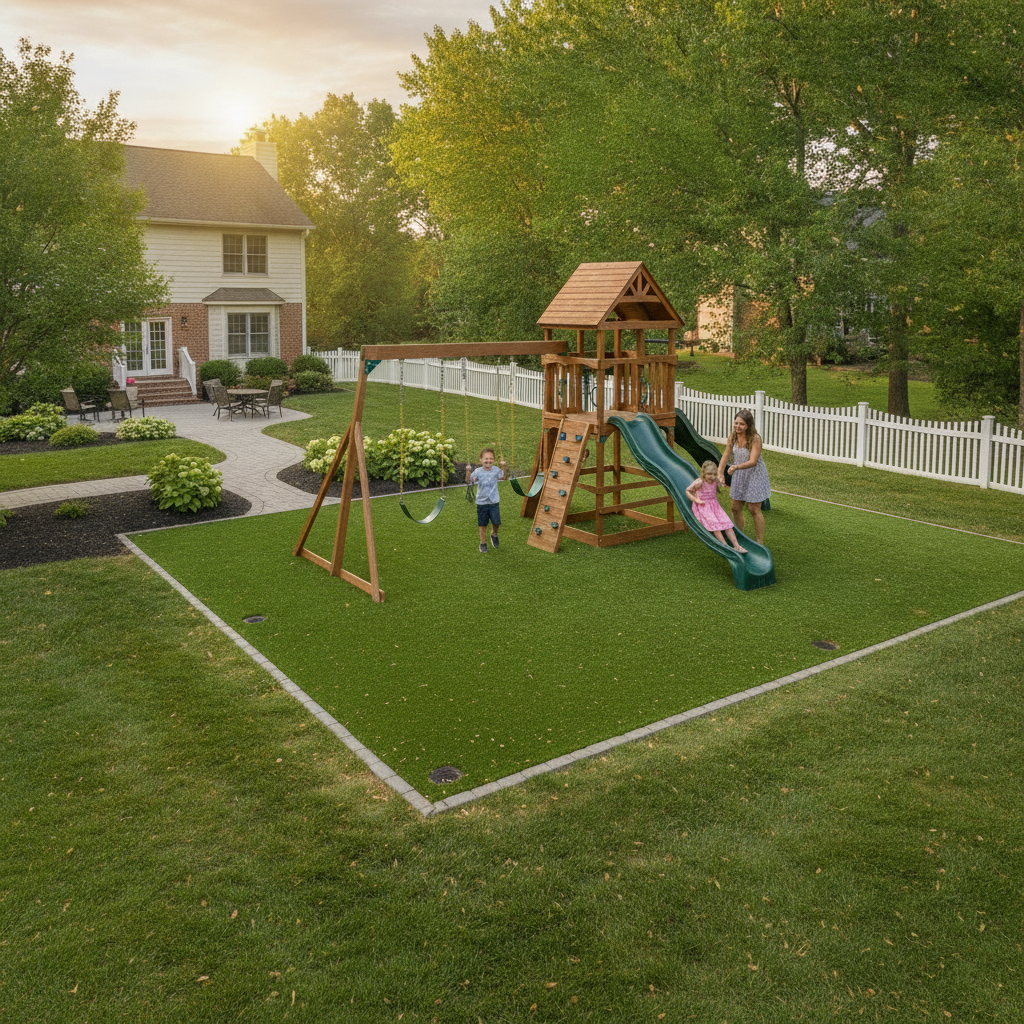
How Do You Install Artificial Turf Around a Swing Set or Backyard Play Structure in Burke, VA? What Parents Need to Know About Safety, Drainage, and Compliance
If you’ve got a swing set, climbing structure, or combo play unit in your backyard in Burke, VA, you already know what the ground underneath looks like after a few seasons — muddy craters where feet drag, bare dirt patches, and whatever weed situation is trying to reclaim the edges. Installing artificial turf under and around a play structure solves all of that, but it’s not as simple as rolling out a grass-colored mat and calling it a day. The surface under a swing set is a safety system, not just a landscaping choice. Get it wrong and you’ve got a liability issue. Get it right and you’ve got a clean, low-maintenance play zone your kids can use year-round — even after the DMV’s soggy spring rains roll through.
Here’s what parents and homeowners in Fairfax County actually need to know before they start this project.
Why Standard Artificial Turf Isn’t Enough Under a Play Structure
Most artificial turf articles — including a lot of what you’ll find from regional competitors — focus on residential lawn replacement or pet drainage. Very few address what’s actually different about installing turf directly beneath a swing set or play structure, which is a fundamentally different application from a lawn or patio surface.
The critical factor is critical fall height (CFH). The U.S. Consumer Product Safety Commission (CPSC) publishes guidelines specifying how much impact attenuation a playground surface must provide based on the maximum fall height of the equipment. If your swing set’s highest point is six feet off the ground, the surfacing system beneath it needs to absorb that fall to a standard that reduces the probability of a life-threatening head injury. Standard turf installed over a basic crushed stone base does not meet this threshold on its own.
For residential play structures — the kind sold at Home Depot, Costco, or through specialty retailers — the CPSC guidelines aren’t always legally mandated, but they are the recognized safety benchmark. Any installer who doesn’t bring this up during your consultation isn’t approaching the project correctly.
What a Properly Engineered Backyard Play Zone Actually Looks Like
A compliant, well-built turf system under a residential play structure involves several layers working together:
- Excavation: The existing soil is removed to the depth required by the turf system and shock pad — typically 4 to 6 inches total, depending on the surface design. In Fairfax County, the clay-heavy soil common in neighborhoods like Burke Centre and West Springfield drains poorly on its own, so this step can’t be skipped or rushed.
- Compacted aggregate base: A layer of crushed angular aggregate (typically Class II base rock) is compacted and graded for drainage. This provides structural stability and channels water away from the surface quickly — important given the heavy spring rain events common to Northern Virginia.
- Shock-absorbing foam pad: This is the layer that makes the installation CPSC-relevant. A foam or rubber shock pad, engineered to a specific CFH rating, is installed over the base before the turf goes down. These pads are rated in inches of fall height they can absorb — a 6-foot CFH pad is different from a 9-foot CFH pad. The product must match the equipment.
- Turf layer: A durable, UV-stabilized synthetic turf product with a permeable backing is installed over the pad. For play areas with kids and likely dogs, you want antimicrobial infill options. Pile height in the 35mm–40mm range strikes the right balance between cushioning feel and a surface that stays upright under foot traffic.
- Infill: For play areas, silica sand infill is standard and IPEMA-compatible. If you have pets sharing the space, a zeolite blend can be added to manage odor without compromising the surface’s CPSC-relevant performance characteristics.
This is a fundamentally different build than a standard backyard lawn replacement, and the cost reflects that. Play zone installations in the Burke and Springfield area generally run toward the higher end of the $15–$25 per square foot range, depending on the shock pad specification and project complexity. That’s a realistic number — any quote that comes in dramatically lower deserves a hard question about what’s being left out of the build.
The Drainage Problem Under Swing Sets Is Real and Often Ignored
In the DMV, spring rainfall is heavy and sustained. A poorly drained play area doesn’t just look bad — it creates standing water under and around the structure, accelerates rust on metal components, and turns the surface into a slip-and-fall hazard. The clay content in Fairfax County soil makes this worse than it would be in a sandier region.
A properly built artificial turf system for a play zone should drain at a minimum of 30 inches per hour through the turf face itself — and your base aggregate must be graded so water has somewhere to go. If the installer isn’t discussing positive drainage slope (typically 1–2% away from the structure) and how the water will exit the play zone footprint, that’s a significant red flag.
The playground turf installations we engineer at Grassify are built with drainage as a primary design constraint, not an afterthought. That matters year-round in Northern Virginia, but especially in March through May when storm events are frequent and the ground is already saturated.
HOA and Permit Considerations in Fairfax County
If you’re in an HOA-governed neighborhood — and a lot of Burke, Burke Centre, Rolling Valley, and Fairfax Station fall into that category — you’ll likely need architectural review committee (ARC) approval before modifying your backyard surface, even for a play area underneath an existing structure. The good news is that synthetic turf installed under a play structure is generally approved without much friction in most Fairfax County HOAs, especially when it’s replacing a muddy, bare-dirt eyesore. That said, you should get the approval in writing before any work starts.
At Grassify, we’ve navigated the HOA approval process dozens of times across Fairfax County and can help you pull together the product specs, drainage documentation, and visual references that review committees typically want to see. It’s one of those details that out-of-state franchise installers often underestimate — because they haven’t been doing this specific work in these specific neighborhoods for over a decade.
What to Ask Any Installer Before You Hire Them
Not every turf contractor who shows up for a residential play zone quote actually understands the safety engineering involved. Here’s a short list of questions that will separate knowledgeable local specialists from general landscapers trying to upsell turf:
- What critical fall height will this installation be rated to, and what shock pad product are you using to achieve it?
- Is the turf you’re proposing IPEMA-listed for playground use?
- How are you handling drainage slope and water exit from the play zone?
- What infill system are you using, and is it appropriate for a surface where children play?
- Do you carry general liability and workers’ comp insurance, and are your crews background-checked?
- What does your warranty cover — specifically the seams, edges, base stability, and infill?
At Grassify, every crew is licensed, insured, and background-checked. We back our installations with a lifetime warranty on seams, edges, and base prep — because in a climate with freeze-thaw winter cycles and wet-spring ground movement, those are the failure points that show up three years later if the original work was sloppy.
Can You Use the Same Turf for Pets and Kids?
Yes — and for a lot of families in Burke and Springfield, the play zone is also where the dog spends most of its outdoor time. The good news is that the right infill and drainage system can support both uses without compromise. A zeolite deodorizer layer combined with antimicrobial infill keeps odors controlled, and the high-drainage-rate permeable backing ensures waste flushes through the system quickly.
If you’re planning a combined kid-and-pet zone, check out our pet-friendly turf installation options — we can spec a system that meets both the playground safety requirements and the pet drainage performance you need, without building two separate surfaces.
Frequently Asked Questions
Does artificial turf under a swing set get too hot for kids in the summer?
Synthetic turf can get warmer than natural grass in direct sun — that’s a real consideration for a play zone in the Northern Virginia summer heat. We address this with heat-resistant UV-stabilized fibers and by recommending a light water mist before heavy use on hot days. Shaded play structures, common in many Burke and West Springfield backyards, significantly reduce this concern.
How much space around the play structure does the turf need to cover?
CPSC guidelines recommend a minimum 6-foot use zone extending outward from the perimeter of any play equipment. For swings specifically, the use zone should extend twice the height of the swing pivot point in front and behind. Your turf installation should cover this entire zone — not just the footprint of the structure itself.
Can I install artificial turf around a play structure myself?
You can install basic decorative turf yourself, but a play zone installation with a shock pad and proper drainage engineering is not a weekend DIY project. Getting the base compaction wrong, cutting corners on shock pad specification, or installing improper drainage slope creates real safety and performance problems that show up fast in Fairfax County’s climate.
Will my HOA in Burke or Fairfax County approve turf under a swing set?
Most HOAs in Fairfax County view backyard play zone turf favorably, especially as a replacement for eroded grass or bare dirt. You’ll typically need to submit a materials spec sheet and site plan to your architectural review committee. We can help you prepare that documentation.
How long does a backyard play zone turf installation take?
Most residential play zone installations in the Burke area take one to two days, depending on the size of the zone, site access, and whether excavation is required. We’ll give you a firm timeline during the free site assessment.
Ready to Build a Play Zone That’s Actually Safe, Clean, and Low Maintenance?
If you’re ready to stop fighting the mud pit under your swing set and put in a surface that’ll hold up through the DMV’s wet springs, hot summers, and freeze-thaw winters — and do it the right way with proper fall protection and drainage engineering — Grassify is ready to take a look at your yard.
We’re based right here in Burke, VA, and we’ve built play zone installations across Fairfax County, Springfield, Fairfax, and the surrounding Northern Virginia area. We know the local HOA landscape, the soil conditions, and the drainage challenges specific to this region — and we build every system to last.
Request your free consultation today and we’ll come out, assess your play structure and yard, and put together a system spec that actually meets the safety standards your kids deserve.


